Global Wit & Worldly Wisdom
GLOBAL PROVINCE - Home - About This Site - Agile Companies - Annual Reports - Best of Class - Best of theTriangle - Big Ideas - Brain Stem - Business Diary - Dunk's Dictums - Global Wit & Worldly Wisdom - Gods, Heroes, & Legends - Infinite Bookstore - Investor Digest - Letters from the Global Province - Other Global Sites - Poetry & Business - Scenes from the Global Province - A Stitch in Time - Two Rivers
Entries 1-50
- Entries
51-100 - Entries
101-150 -
Current Entries
Our friends send us 300 jokes a week. We want to share a few of the best ones with you, to tease your mind and soul, as well as your funnybone. We will be frequently adding to this page, so come back and visit often. More importantly, send us some global jokes: advisors at beecom.net.
554. -new- Truly Advanced Technology: Old Gadgets
Joe Queenan reminds us that old ways often work a helluva lot better than new technical widgets.
"I stand there behind him, clutching my bottled water and my $5 bill. And a thought occurs to me. What if debit cards had been invented first and cash was invented later? Wouldn't the person who brought the long green to market be treated with the same reverence as Marconi or Edison or Gutenberg?"
"There are many, many devices or traditions or foods superseded by exciting new inventions that in some ways are inferior to the thing they rendered obsolete. What if Caesar salads had been invented after kale? What if sound systems with powerful speakers and booming bass had been invented after tinny MP3 players?" Wall Street Journal, July 18-19 2015, p.C11
553. Nary a Tampon
At the beginning of the 20th century Argentina was one of the leading countries of the world. It has been in mournful decline ever since, largely the result of humongous political mismanagement. Somehow we find it ironic that it now has a tampon shortage, even though it has been headed up by a lady hack at the moment--Christina Kirchner.
"The shortages stem from another scarcity issue-—the lack of U.S. dollars. Argentina doesn't have enough dollars on hand to pay down its debt while also paying for critical imports like fuel and supplying dollars to importers. Economists say with dollars in short supply, the bureaucracy has to decide who gets the dollars that are available and some importers inevitably lose out."
"In the past four days, Argentines referred to the problem more than 25,000 times on Twitter and Facebook, according to www.t-bee.tv, which monitors social networks."
"Howard Hawks had to fix Lauren Bacall a bit before she was fittin' for the screen. He made her lower her voice until it became sultry. "Tyler was confounded by Ms. Bacall's husk and doesn't seem to have known that, per Hawks's instructions, she had stripped away any trace of what he deemed a potential feminine flaw. After signing her, Hawks had begun shaping Ms. Bacall, telling her, in an anecdote related in Todd McCarthy's invaluable biography Howard Hawks: The Grey Fox of Hollywood: "When a woman gets excited or emotional, she tends to raise her voice. Now, there is nothing more unattractive than screeching."(8-27-14)
“That’s not a bad wine, if you don’t mind bad wine.” (7-23-14)
550. Free Hugs in Sondria


548. Books Are Alive and Well Somewhere

547. Tee Shirt Spotting in Santa Barbara Store
I saw the best t shirt today....
"there are three kinds of people in this world....those who are good at math and those who aren`t” (3-26-14)
“Then, sir,” nipped in the witty Logan Pearsall Smith, “your dentist must be an American.” Shaw has just said his dentist pronounced ‘canine” as “cane-ine.”
“Of course!” roared Shaw, “how d’you suppose I came to have all my teeth at my age?” (3-26-14)
545. Winter Weather in North Carolina

(3-26-14)
544. Groucho and T.S. Eliot
T. S. Eliot wrote to Groucho Marx to confirm that a car would be at waiting at the Savoy to pick "you and Mrs. Groucho" up for dinner. Eliot also noted that Groucho's announcement of having "come to London to see me has greatly enhanced my credit in the neighbourhood, and particularly with the green grocer across the street." Eliot began corresponding with Marx several years earlier, having first sent a fan letter saying how much he enjoyed his movies. They exchanged photographs -- Eliot had to ask for a second of Groucho as his first one had no cigar -- and over several years tried to arrange an occasion for dinner or, as envisioned by Groucho, an evening wherein "you and I will get drunk together." Their letters show an increasing familiarity, though perhaps more on Groucho's part: Eliot's salutations evolve from "Dear Groucho Marx" to "Dear Groucho," while Groucho, having been encouraged to use "Dear T. S. E." goes one better to "Dear T. S.," or "Dear Tom" to start, and "My best to you and Mrs. Tom" or "My best to you and your lovely wife, whoever she may be" at the close. In one letter Groucho says that he has just finished his latest opus, "Memoirs of a Mangy Lover": "... I doubt whether it will live through the ages, but if you are in a sexy mood the night you read it, it may stimulate you beyond recognition. . . . I would be interested in reading your views on sex, so don't hesitate. Confide in me."
Their much-postponed dinner took place just seven months before Eliot's death at the age of seventy-six. In a letter to Gummo, Groucho describes finding his "celebrated pen pal" to be "tall, lean and rather stooped over. . . from age, illness, or both," but "a dear man and a charming host." Though "a memorable evening," all did not go as expected:
... At any rate, your correspondent arrived at the Eliots' fully prepared for a literary evening. During the week I had read "Murder in the Cathedral" twice, "The Waste Land" three times, and just in case of a conversational bottleneck, I brushed up on "King Lear." Well, sir, as the cocktails were served, there was a momentary lull - the kind that is more or less inevitable when strangers meet for the first time. So, apropos of practically nothing (and not with a bang but a whimper) I tossed in a quotation from "The Waste Land." That, I thought, will show him I've read a thing or two besides my press notices from Vaudeville. Eliot smiled faintly -- as though to say he was thoroughly familiar with his poems and didn't need me to recite them. So I took a whack at "King Lear". . . . That too failed to bowl over the poet. He seemed more interested in discussing "Animal Crackers" and "A Night at the Opera." He quoted a joke -- one of mine -- that I had long since forgotten. Now it was my turn to smile faintly. . . . We didn't stay late, for we both felt that he wasn't up to a long evening of conversation -- especially mine. Did I tell you we called him Tom? -- possibly because that's his name. I, of course, asked him to call me Tom too, but only because I loathe the name Julius.
Yours, Tom Marx
--------from Steve King’s Today in Literature (1-15-14)
543. Modern Art Trips Us All Up
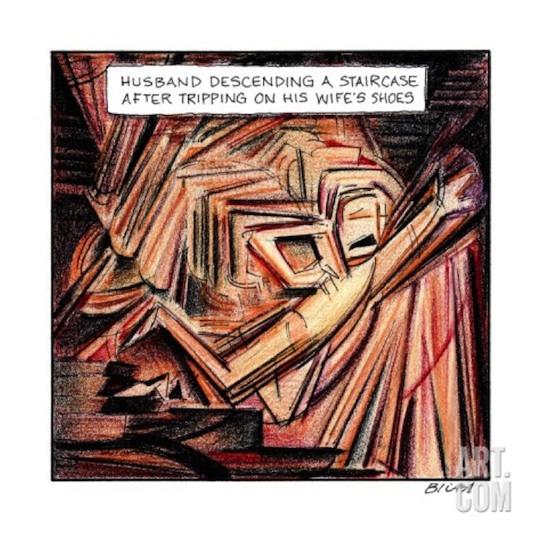
(01-01-14)
542. Winning the War by Powerpoint
The McChrystal Afghanistan PowerPoint slide: can you do any better?
Is the "Afghanistan Stability/COIN Dynamics – Security" slide a set of meaningless squiggles or a comprehensive guide to Afghanistan? And how would you improve on it?

Gen Stanley McChrystal, leader of American and NATO forces in Afghanistan, was shown a PowerPoint slide in Kabul last summer meant to portray the complexity of American military strategy Illustration: PA
Well you can see why Nato hasn't cracked Afghanistan yet. The Microsoft PowerPoint slide which drove US military General Stanley McChrystal to declare that "When we understand that slide, we'll have won the war" at a briefing in Kabul last summer has led to big questions about the world's reliance on the presentation software.
As Julian Borger wrote yesterday:
The diagram has an undeniable beauty. Done the right way (embroidered perhaps) it would make a lovely wallhanging and an ideal gift for the foreign policy-maker in your life. But it is a bit of a red herring … It was designed to convey the complexity of the Afghan conflict. But the big problem with PowerPoint is that it makes everything seem simple.It does not link ideas or facts in any kind of human narrative. It just lists them as bullet-points, a shopping list of things to do or jobs already done. (12-11-13)
The creator of this website has made it terribly hard to read, using very small type and dropping it out of black background. Probably a humorless wretch. But read his insults anyway. There’s a lot of dross here. But there are gems we have not encountered before. Joey Adams: Stay with me, I want to be alone. E.S. Turner: Sociology is the study of people who do not need to be studied by people who do. (12-11-13)
540. Puns to Ponder Everywhere
These from our friend Jim Lynagh who adds, by way of nostalgia: “My high school debate partner married an OB-GYN. He described himself to me as a "Spreader of Old Wives Tails":”

(11-27-13)
An old gentleman lived alone in New Jersey. He wanted to plant his annual tomato garden, but it was very difficult work, as the ground was hard. His only son, Vincent, who used to help him, was in prison. The old man wrote a letter to his son and described his predicament:
Dear Vincent,
I am feeling pretty sad because it looks like I won't be able to plant my tomato garden this year. I'm just getting too old to be digging up a garden plot. I know if you were here my troubles would be over. I know you would be happy to dig the plot for me, like in the old days.
Love, Papa
A few days later he received a letter from his son:
Dear Papa,
Don't dig up that garden. That's where the bodies are buried.
Love, Vinnie
(11-27-13)
538. A Witty Irishman on France
"France, now, not just France the country but France the idea, suddenly loomed large for him, as if he had been running a magnifying glass idly over a map of the world and had come to a wobbly stop on that big ghost-shaped mass at the western edge of Europe. He had only to take a sip of claret and he was there, in a Midi of the mind, under dappled vine leaves, smelling the dust and the garlic, or in some sultry impasse by the Seine, with swaggering pigeons and water sluicing cleanly along the cobbled gutters, half the street in purple shadows and the other half blinded by sunlight."— Benjamin Black, A Death in Summer (9-25-13)
A guest at a dinner party attended by Eliot and Valerie describes how he was shocked to see an apparently enfeebled Eliot spilling his soup; then he realized that Eliot was using his spoon with his left hand so that he could hold hands under the table with his wife, seated to his right.—about T.S. Eliott in Steve King’s Today in Literature (8/28/13)
“The most merciful thing in the world, I think, is the inability of the human mind to correlate all its contents”----H.P. Lovecraft (8/28/13)
Laughing is the shortest distance between two people—Victor Borge (8/28/13)
534. Some Definitions of Localism
Our definition: plumb loco or narrow minded.
Some others:
1. a local linguistic feature
2. a local custom or peculiarity
3. devotion to local interests and customs
4. the limitation of ideas and interests resulting from 1-3 (8/14/13)
Italian is best at it. But other nations have gotten into it, too. Free Hugs (7/24/13)
"Stay close to those who are interested in opening only one important door: the door to your heart. They will never invade your soul without consent or shoot a deadly arrow through that open door." - Paulo Coelho, Manuscript Found in Accra (7/24/13)
531. Pole Jokes (Tom Gauld in the Paris Review)

(7-10-13)
530. Tourist vs. Traveler
The tourist, Bowles wrote in The Sheltering Sky, accepts his own civilization without question; not so the traveler, who compares it with the others, and rejects those elements he finds not to his liking. Bowles, the perpetual expatriate, wrote movingly about the empathy required for this project. He took on his ventures as a search for alternate modes of living and beingnot mere anthropological study, but more like continuing education in existential possibility. Deep in the Sahara, he distilled the sense of danger, of the risk versus reward in commitment to ones travels, and the transcendence available thereinwhat he called the baptism of solitude: You have the choice of fighting against it, and insisting on remaining the person you have always been, or letting it take its course. For no one who has stayed in the Sahara for a while is quite the same as when he came. (June 26, 2012)
Philippe Starck, the prolific cutting edge designer, told Pico Iyer how he stays ahead of the curve. “I never read any magazines or watch TV,” he said. “Nor do I go to cocktail parties, dinners or anything like that” “He lived outside conventional ideas,” Iyer wrote, “Because I live alone mostly, in the middle of nowhere.” (See “The Joy of Quiet,” The New York Times, January 1, 2012) (June 26, 2012)
528. I Love New York--Many Times Over
“Last week, after JetBlue Airways became the first company authorized to incorporate Milton Glaser’s “I-heart-NY” logo into its own, The New York Times invited readers to design other interpretations of the iconic symbol. About 200 poured into the City Room blog—from as far away as Seoul, South Korea, Ireland, and Williamsburg, Brooklyn.” (New York Times, September 26, 2010).” Included were gems like I loaf New York and I’m Leaving New York. (April 24, 2013)
While Malcolm Muggeridge was the editor of Punch, it was announced that Khrushchev and Bulganin were coming to England. Muggeridge hit upon the idea of a mock itinerary, a lineup of the most ludicrous places the two paunchy pear-shaped little Soviet leaders could possibly be paraded through during the solemn process of a state visit. Shortly before press time, half the feature had to be scrapped. It coincided exactly with the official itinerary, just released, prompting Muggeridge to observe: We live in an age in which it is no longer possible to be funny. There is nothing you can imagine, no matter how ludicrous, that will not promptly be enacted before your very eyes, probably by someone well known.------------From Tom Wolfe’s Stalking the Billion-Footed Beast: A literary manifesto for the new social novel, Harpers, November, 1989
(March 27, 2013)
“Gravina’s definition of a bore, a person who deprives you of solitude without providing you with company”-- Emily Hahn’s whispered remark at a cocktail party where another writer had numbed the assembled with an endless train of words. (03-13-13)
"But only one anecdote survives in a letter I wrote at the time. It was about a young Chinese whom Lord Russell had known. The man's teacher in China was known for his wisdom and also for never having taken a bath. When he died, somebody suggested that his body be bathed, but the young man said, "No, bury him whole!"—from Donald Keene's Chronicles of My Life.
(01-23-13)
"Any idiot can face a crisis - it's the day-to-day living that wears you out."—Anton Chekhov
(01-23-13)
Thornton Wilder died on this day in 1975, aged seventy-eight. Gilbert Harrison's biography of Wilder is titled The Enthusiast for good reason, as even in the week of his death Wilder was describing himself as "temperamentally undiscourageable." Gilbert's biography concludes by quoting Wilder's account of a pleasant dream he had had about his dead parents, from which he woke with the thought, "How wonderful it is that people die—from Today in Literature.
The once we encountered Wilder proved his description true. He gave a few of us a talk on the complexities of James Joyce. He was like a detective, decoding a foreign intercept. With joy and laughter, he told us about the arcane web of cross illusion that Joyce wove into his scripts. In other words, he too sheer delight and radiated no pain at his obsessive task.
(12-12-12)
Common sense is the least common of the senses
(11-28-12)
Told that he was to die of cancer, a chap named Moraitis moved back to the Greek isle where he was born. But the cancer went into remission Ikaria where people commonly live to very ripe old ages. His doctors back in America could not explain why he lived.
"I called Moraitis a few weeks ago from my home in Minneapolis. Elpiniki died in the spring at age 85, and now he lives alone. He picked up the phone in the same whitewashed house that he'd moved into 35 years ago. It was late afternoon in Ikaria. He had worked in his vineyard that morning and just awakened from a nap. We chatted for a few minutes, but then he warned me that some of his neighbors were coming over for a drink in a few minutes and he'd have to go. I had one last question for him. How does he think he recovered from lung cancer?
"It just went away," he said. "I actually went back to America about 25 years after moving here to see if the doctors could explain it to me."
I had heard this part of the story before. It had become a piece of the folklore of Ikaria, proof of its exceptional way of life. Still, I asked him, "What happened?"
"My doctors were all dead."
(11-28-12)
520. Life is a Cabaret, My Friend
Life does not cease to be funny when people die any more than it ceases to be serious when people laugh. ---GBS
(11-28-12)
519. Some of Wilson Mizner's Zingers
Back in the 1930's Warner Brothers had a whole slew of quick-witted contract writers on payroll. "The most colorful storyteller was Wilson Mizner, who's done a little bit of everything—very little of it reputable—on his way to a gig at Warner's…." His rapier lines included: "Be nice to people on your way up, because you'll meet 'em on your way down." "His best, however, was his assessment of his job: 'Working for Warner Brothers is like fucking a porcupine: it's a hundred pricks against one.' " New Yorker, 1 October 2012, pp.35-36.
(11-14-12)
Years ago we told of a battle royal between a snail and a sloth, which the victim could not describe because "it was all too fast for me." Now we have found a cartoon that pretty much tells the same story:
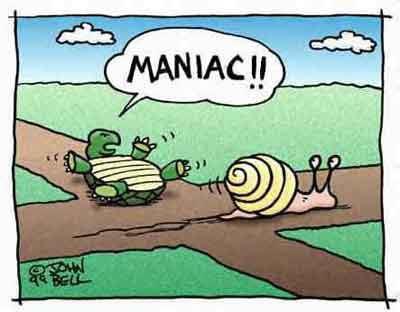
(10-31-12)
517. David Brooks on Mitt Romney
David Brooks, at his best, caught Mitt Romney in his gun sights. Everybody should read the whole article but here is a sample:
Mitt Romney was born on March 12, 1947, in Ohio, Florida, Michigan, Virginia and several other swing states. He emerged, hair first, believing in America, and especially its national parks. He was given the name Mitt, after the Roman god of mutual funds, and launched into the world with the lofty expectation that he would someday become the Arrow shirt man.
Romney was a precocious and gifted child. He uttered his first words ("I like to fire people") at age 14 months, made his first gaffe at 15 months and purchased his first nursery school at 24 months. The school, highly leveraged, went under, but Romney made 24 million Jujubes on the deal.
(10-17-12)
'Nature is where the birds fly around uncooked' – Anon according to Nigel Rees in the Quote ….UnQuote newletter.
(10-03-12)
Gen. MacArthur once said, "the Philippines is a country that has lived in a convent for 200 years and in Hollywood for the last 60."
(09-19-12)
514. Mr. Kipling Regrets or Mulvaney Regrets
In the Fall of 1895, according to the Yale Alumni Magazine (September-October 2012), a group of sophomores founded the Kipling Club at Yale. In the spring of 1896, they invited Kipling, then living in Vermont, to the Club's first annual banquet. He nicely declined. 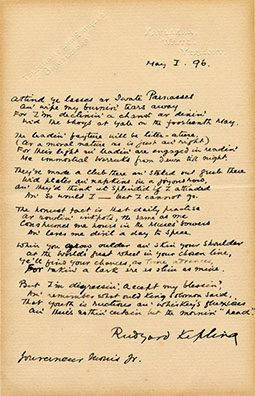
MULVANEY REGRETS.
Attind ye lasses av swate Pamasses,
And woipe me bumin' tears away ;
For I'm declinin' a chanst av dinin'
W'id the boys at Vale on the fourteenth May.
The leadin' fayture will be liter-ature
(Av a moral nature, as is just an' right),
For their light an' leadin' are engaged in readin'
Me immortal womiks from dawn till night.
They've made a club there an' staked out grub there,
Wid plates and dishes in a joyous row ;
An' they'd think ut splindid if I attindid ;
An' so would I but I cannot go.
The honest fact is that daily practise
Av rowlin' ink-pots the same as me
Conshumes me hours in the Muses' bowers,
An' laves me divil a day to spree.
Whin you grow oulder an' skin your shoulder
At the world's great wheel in your chosen line.
(09-19-12)
Singer Judy Collins' song "From Both Sides Now" (aka "Clouds") has lyrics including "I look at clouds from both sides now" and "It's love's illusion that I recall, I really don't know love at all." The first stanza illustrates the difference between illusions and the wake-up of reality-"Bows and flows of angel hair and ice cream castles in the air; And feather canyons everywhere, I've looked at the clouds that way; But now they only block the sun they rain and snow on everyone; So many things I would have done, but clouds got in the way." ---Ray DeVoe in The DeVoe Report, August 5, 2011.
(08-01-12)
Questions from The New York Times to Carol Hiaasen:
What's the one book you wish someone else would write?I'm waiting for the day when Rush Limbaugh's pharmacist writes a book
If you could meet any writer, dead or alive, who would it be? What would you want to know? Have you ever written to an author?
I would have loved to have gone deep-sea fishing with Hemingway, as long as he didn't bring the Thompson submachine. He liked to shoot his initials into the heads of sharks. Seriously.
(07-18-12)
Lucy Kellaway of the Financial Times has caught up with the marble-mouthed meaninglessness of corporate chieftains in her "Burberry chief's top mix of brand and bunkum," Financial Times, July 9, 2012, p. 12.
"So today I am creating a July award to be given to a chief executive for Outstanding Services to Bunkum. The winner must be a big business name who is equally adept at using guff for exaggeration, euphemism and obfuscation, and for conveying fake emotion. Above all, they must never use a simple word when a longer one would do."
"She is Angela Ahrendts, CEO of Burberry and a living legend in a trenchcoat. Her words speak for themselves. Here are some of them, from the latest Burberry annual report: "In the wholesale channel, Burberry exited doors not aligned with brand status and invested in presentation through both enhanced assortments and dedicated, customised real estate in key doors."
This meets the most important criterion for jargon – it is utterly impenetrable. What are all these doors? Has Burberry acquired Travis Perkins building supplies? And what is an enhanced assortment? As for all those other words – channel, aligned, enhanced, dedicated, key – they are all clichés, but to put so many of them together in such a short space takes great skill."
(07-18-12)
Delia Ephron, whom we assume to be Nora's sister, writes amusingly of Microsoft and Adobe and Facebook and Java and all the other software houses and social networks, all of whom are constantly 'improving their systems' which roughly means they are consuming more of our computer's memory while putting forward updates that are ever more confusing. Only computer nerds think these 'improvements" are really improvements.
"The Timeline, for anyone who isn't on it, is the redesign of the Facebook page. It has been this word I am now terrified of--upgraded. The Facebook page used to be quite basic. Even a moron (me) could understand it. At the top of the page you posted a message. Below that, "friends" could respond, and below that were your earlier posts. Now thanks to this newer better thing called a Timeline, I'm sure many people, younger people, understand why it's called this, but I don't, there are multiple columns. The Facebook page is now completely confusing. What is new? What is old? The messages are where? Where? Your eye is flying around having no idea where to land." Yes, the Timeline is unimaginably horrible.
"This month Apple unveiled a new iPhone with 200 more features. Facebook announced recently that it was going to develop a smartphone. My phone is already too smart for me and I assume this new phone will be smarter. All a smarter phone means is another way for me to feel dumber."
"I'll just say that I believe not empirically, alas, but only theoretically that, for someone who has read a lot of Dickens, to shoot his like in the name of some idea is more problematic than for someone who has read no Dickens. And I am speaking precisely about reading Dickens, Sterne, Stendhal, Dostoevsky, Flaubert, Balzac, Melville, Proust, Musil, and so forth; that is, about literature, not literacy or education. A literate, educated person, to be sure, is fully capable, after reading this or that political treatise or tract, of killing his like, and even of experiencing, in so doing, a rapture of conviction. Lenin was literate, Stalin was literate, so was Hitler; as for Mao Zedong, he even wrote verse. What all these men had in common, though, was that their hit list was longer than their reading list"------Joseph Brodsky
"Man thrives where angels die of ecstasy and pigs die of disgust. The contemporary situation is like a long-standing, fatal disease. It is impossible to recall what life was like without it. We seem always to have had cancer of the heart."---Kenneth Rexroth in his essay, "Kenneth Patchen, Naturalist of the Public Nightmare."
"I lack what the English call character, by which they mean the power to refrain"—Alan Bennett
506. Wit about the Witless from Mr. Firehock
"He has been going around the country deliberately stirring up apathy" --William Whitelaw on Harold Wilson
"Her trouble is that she lacks the power of conversation, but not the power of speech"--- George Bernard Shaw
505. Doing Germany: Arriving in Munich
Dancer, MFA candidate, and essayist, Abigail Rasminsky excels at talking about life outside one's comfort zone. So one should not miss her tale of dropping into the strange planet of Germany and trying to feel at home when she lands in Munich.

504. Mark Twain Runs for President
Now that it's presidential season, one must get a breath of fresh air by reading Mark Twain's "A Presidential Candidate." We have already determined previously that if you don't drink, you are not fit for the presidency. Twain as candidate then suggests that if you are to run for office, you must make yourself bulletproof against the slings and arrows of journalists and politicians:
I have pretty much made up my mind to run for President. What the country wants is a candidate who cannot be injured by investigation of his past history so that the enemies of the party will be unable to rake up anything against him that nobody ever heard of before. If you know the worst about a candidate to begin with, every attempt to spring things on him will be checkmated. Now I am going to enter the field with an open record. I am going to own up in advance to all the wickedness I have done, and if any Congressional committee is disposed to prowl around my biography in the hope of discovering any dark and deadly deed that I have secreted, why–let it prowl.
These are about the worst parts of my record. On them I come before the country. If my country don't want me, I will go back again. But I recommend myself as a safe man –a man who starts from the basis of total depravity and proposes to be fiendish to the last.
503. Presidential Qualifications
Timothy Egan's "The Wrath of Grapes" makes a persuasive case that presidents who don't drink don't govern well. Amongst the sipless presidents he cites are Jimmy Carter, William Howard Taft, and even Herbert Hoover, whose large wine cellar was all given away by his wife.
"The last president to swear off alcohol was George W. Bush, who seems doomed to have his name forever followed by the words, 'and we know how that turned out.' "
"Franklin D. Roosevelt was a martini drinker, much to Eleanor's displeasure, and an extraordinary president. Again, was there a connection? Solving a Great Depression and crushing the Nazi war machine—aided by the oft-besotted Winston Churchill—is a pretty strong brief.
In his younger days, F.D.R. knew how to plan ahead. He had four cases of Old Reserve delivered to his town house on East 65th Street, just before Prohibition went into effect."502. What Did He Mean by That?
"An old joke among psychiatrists is the one where a patient enters, sits down on the couch and says, "Good morning doctor, how are you feeling today?" and the psychiatrist, looking puzzled, thinks, "What did he mean by that?" It doesn't take much to set people off these days, and some groups (ethnic, racial, religious, sexual—or whatever has some spokespeople representing them) can take offense at the slightest politically incorrect comments."---The DeVoe Report
Alabama
Hell, Yes, We Have Electricity.
Alaska
11,623 Eskimos Can't Be Wrong!
Arizona
Yes, But It's A Dry Heat.
Arkansas
Literacy Ain't Everythang.
California
By 30, Our Women Have More
Plastic Than Your Honda.
Colorado
If You Don't Ski, Don't Bother.
Connecticut
Like Massachusetts, only smaller.
Delaware
We Really Do Like The Chemicals In Our Water.
Florida
Ask Us About Our Grand kids
And Our Voting Skills.
Georgia
We Put The Fun In Fundamentalist Extremism.
Hawaii
Haka Tiki Mou Sha'ami Leeki Toru
(Death To Mainland Scum, Leave Your Money)
Idaho
More Than Just Potatoes.
Well, Okay, We're Not, But The Potatoes Sure Are Real Good
Illinois
Please, Don't Pronounce the "S"
Indiana
2 Billion Years Tidal Wave Free
Iowa
We Do Amazing Things With Corn
Kansas
First Of The Rectangle states
Kentucky
Five Million People;
Fifteen Last Names
Louisiana
We're Not ALL Drunk Cajun Wackos, But That's Our Tourism Campaign.
Maine
We're Really Cold, But We Have Cheap Lobster
Maryland
If You Can Dream It, We Can Tax It
Massachusetts
Our Taxes Are Lower Than Sweden 's And Our Senators Are More Corrupt
Michigan
First Line Of Defense From The Canadians
Minnesota
10,000 Lakes... And 10 Zillion Mosquitoes
Mississippi
Come visit And Feel Better About Your Own State
Missouri
Your Federal Flood Relief Tax Dollars At Work
Montana
Land Of The Big Sky, The Unabomber, Right-wing Crazies, and Honest Elections
Nebraska
Ask About Our State Motto Contest
Nevada
Hookers and Poker!
New Hampshire
Go Away And Leave Us Alone
New Jersey
You Want A ##$%##! Motto?
I Got Yer ##$%##! Motto Right here!
New Mexico
Lizards Make Excellent Pets
New York
You Have The Right To Remain Silent,
You Have The Right To An Attorney
And No Right To Self Defense!
North Carolina
Tobacco Is A Vegetable
North Dakota
We Really Are One Of The 50 States!
Ohio
At Least We're Not Michigan
Oklahoma
Like The Play, But No Singing
Oregon
Spotted Owl... It's What's For Dinner
Pennsylvania
Cook With Coal
Rhode Island
We're Not REALLY An Island
South Carolina
Remember The Civil War?
Well, We Didn't Actually Surrender, Yet!
South Dakota
Closer Than North Dakota
Tennessee
Home of the Al Gore Invention Museum
Texas
Se HablaIngles
Utah
Our Jesus Is Better Than Your Jesus
Vermont
Too liberal for the Kennedys
Virginia
Who Says Government Stiffs And Slackjaw Yokels Don't Mix?
Washington
Our Governor can out-fraud your Governor!
West Virginia
One Big Happy Family...Really!
Wisconsin
Come Cut the Cheese!
Wyoming
Where Men are Men and the Sheep are Scared.
Home of Brokeback Mountain
The District of Columbia
The Work-Free Drug Place
500. Oddest Booktitle of the Year
Every year Bookseller celebrates the most eccentric. Among the 2012 candidates are A Century of Sand Dredging and Estonian Sock Patterns All Around the World. Here are some other top contenders.
499. Mencken vs. the Boston Puritans
In the Roaring Twenties in ever-repressed Boston, "H. L. Mencken was arrested by the Boston vice squad, charged with the possession and sale of indecent literature. The literature in question was the April, 1926 issue of Mencken's American Mercury magazine, found offensive for a short story entitled "Hatrack," by Herbert Asbury. "Hatrack" is the nickname of a skinny but welcoming small-town prostitute, one whose attempts to reform have been rebuffed by the upright and churchgoing of her community. This causes Hatrack to fall back to her old and not insensitive ways: servicing her upstanding clients so that those Catholic are accommodated in the Protestant cemetery, and those Protestant in Catholic graveyards. The punch line of Asbury's story compounded hypocrisy with miserliness: when one gentleman tenders Hatrack a dollar, she responds, "You know damned well I haven't got any change."
Reverend Chase, secretary of the New England Watch and Ward Society and a type that Mencken loved to bait, was not amused. He managed to get all available copies of the Mercury pulled from newsstands in the Boston area and he promised trouble to those who attempted to sell any new ones. Editor Mencken conveyed his feelings clearly to publisher Alfred Knopf: "I am against any further parlay with these sons of bitches. Let us tackle them as soon as possible."
The showdown was an orchestrated affair. Chase and his seconds made themselves available at the appointed hour on Brimstone Corner of Boston Common; before police and press, Mencken offered the purchase of his magazine; Chase tendered his half-dollar, and Mencken was hauled off to the station -- though not before biting his coin for the crowd, as Hatrack might have done. The next day the court ruled in Mencken's favor, thus giving him victory, as much publicity as he had the year before with his reports from the Scopes trial, and yet another application of Mencken's Law: "Whenever A annoys or injures B on the pretense of improving or saving X, A is a scoundrel." " ---from Today in Literature
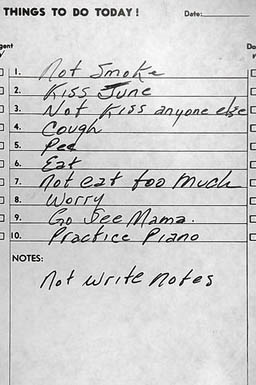
Julien's Auctions
A hand written to-do list by Johnny Cash, who died in 2003, was sold for $6,400 by Julien's Auctions in Beverly Hills, Calif., last year
A man who has the courage of his platitudes is always a successful man. The instructed man is ashamed to pronounce in an orphic manner what everybody knows, and because he is silent people think he is making fun of them. They like a man who expresses their own superficial thoughts in a manner that appears to be profound. This enables them to feel that they are themselves profound---Van Wyck Brooks
496. Ford Motor's Flirtation with Poetry
On December 9, 1955, American poet Marianne Moore submitted the last of the names that she had contracted to provide to the Ford Motor Company for the new car they were about to launch. This labor had begun six weeks earlier, at the behest of David Wallace, the sociology Ph.D. who had been hired by Ford to conduct the search, and who had written to Moore with his despair:
Over the past few weeks this office has confected a list of three hundred-odd candidates which, it pains me to relate, are characterized by an embarrassing pedestrianism. We are miles short of our ambition. And so we are seeking the help of one who knows more about this sort of magic than we....
Moore was almost a cult figure in America during the 50s and 60s, known as much for her love of baseball (sometimes throwing the first pitch) and prize fights (sometimes dining with Cassius Clay), as for her Pulitzer Prize-winning poetry. What Ford wanted was a car name that "flashes a dramatically desirable picture in people's minds," from a woman who seemed to know mainstream America. What they got was "Anticipator," "Thunder Crester," "Pastelogram," "Intelligent Whale," "The Resilient Bullet," "Mongoose Civique," "Andante con Moto," "Varsity Stroke" and then, as her very last try for the name magic, "Utopian Turtletop."
The Mooremobile was not to be, and Ford returned to its old, pedestrian route
Ford wound up with the Edsel, a failing name for a car failure.
A young reporter in New York doing a story on Bing Crosby sent him a telegram:
"How old Bing Crosby?"
The Bing replied:
"Old Bing Crosby fine, How you?"
494. The Sayings of Chairman Hitchens
Mr. Christopher Hitchens has now gone to his maker. Ironic, indeed, since the Hitch was a devout atheist and did not truck with gods and other supreme beings. He had a whole satchel full of skewers, as wonderfully recounted in the Telegraph.We liked particularly his short take on the royal family:
"We have known for a long time that Prince Charles's empty sails are so rigged as to be swelled by any passing waft or breeze of crankiness and cant."
"This is what you get when you found a political system on the family values of Henry VIII. At a point in the not-too-remote future, the stout heart of Queen Elizabeth II will cease to beat. At that precise moment, her firstborn son will become head of state, head of the armed forces, and head of the Church of England. In strict constitutional terms, this ought not to matter much. The English monarchy, as has been said, reigns but does not rule. From the aesthetic point of view it will matter a bit, because the prospect of a morose bat-eared and chinless man, prematurely aged, and with the most abysmal taste in royal consorts, is a distinctly lowering one."
"Together, Margaret and Charles set the tone for the dowdy, feckless, can't-stay-married shower of titled descendants with whose names, let alone doings, it is near-impossible to keep up. There are so many of them! And things always have to be found for them to do."
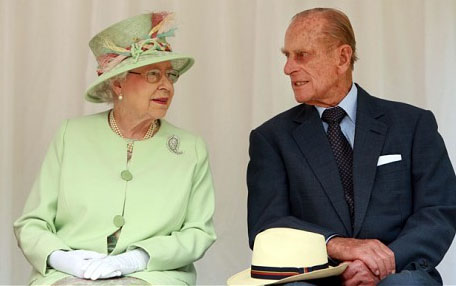
493. Ben Franklin Staves Off a Book Burning
"I might in this place attempt to gain thy Favour, by declaring that I write Almanacks with no other View than that of the publick Good; but in this I should not be sincere; and Men are now a-days too wise to be deceiv'd by Pretences how specious soever. The plain Truth of the Matter is, I am excessive poor, and my Wife, good Woman, is, I tell her, excessive proud; she cannot bear, she says, to sit spinning in her Shift of Tow, while I do nothing but gaze at the Stars; and has threatened more than once to burn all my Books and Rattling-Traps (as she calls my Instruments) if I do not make some profitable Use of them for the good of my Family"
492. Spaghetti Carbonara for Thanksgiving?
Calvin Trillin, who is given to light and effective humor and who loves and writes about all sorts of tasty American food, manages to lighten our mood and skewer the foodistas in his mock campaign to replace Thanksgiving Turkey with spaghetti carbonara. We quote for you here his opening:
I have been campaigning to have the national Thanksgiving dish changed from turkey to spaghetti carbonara.
It does not take much historical research to uncover the fact that nobody knows if the Pilgrims really ate turkey at the first Thanksgiving dinner. The only thing we know for sure about what the Pilgrims ate is that it couldn't have tasted very good. Even today, well brought-up English girls are taught by their mothers to boil all veggies for at least a month and a half, just in case one of the dinner guests turns up without his teeth... (It is certainly unfair to say that the English lack both a cuisine and a sense of humor: their cooking is a joke in itself.).
(12-07-11)
"As you may know, after the song "Alberta, Alberta," Eric Clapton calls out my name, in his English accent, "Chaulk La-Velle!!!' Now, I have this friend that works in the forestry industry, and she tells me, 'my little boy, who is about six years old just loves that part where he calls out your name, because he thinks Eric is saying 'chocolate milk!'"------Chuck Leavell
(11-23-11)
Jann Wenner is the founder of Rolling Stone. But some would claim that Hunter Thompson, who overwhelmed the place, really made it happen:
"And so came the tall and wiry man in wraparound sunglasses and matching black leather gloves and jacket with the misshapen wig on his bald head and the six-pack of Budweiser under his arm to the fourth-floor office of [publisher] Jann Wenner, who looked up at the writer he'd heard so much about, shook the visitor's hand and said, " Well, what have you brought us?"
"Thompson just launched into this rap," said John Lombardi, who witnessed the encounter. "And he must have talked for nearly an hour without stopping, drinking his entire six-pack, chain-smoking and taking his wig off and putting it on for no apparent reason and limping around the room all the while talking about his plans to run for sheriff….
"And Wenner is sitting in this high-backed Huey Newton chair he had, and he's listening to him, and he's sinking lower and lower in his chair till he's practically underneath his desk. Finally Thompson goes down the hall to take a leak. All this time nobody had said anything."
Jann Wenner looked up at Lombardi from his reclined slump. "Look, I know I'm supposed to be the spokesman for the youth generation and everything … but what the fuck was that?"
It was the future of Jann Wenner's magazine. And the future emerged from the bathroom and withdrew a huge syringe from his leather jacket, and lifted his shirt and jammed the syringe into his navel, and looked up at the gaping visages of the Rolling Stone rank and file. And burped."--- from Robert Draper's Rolling Stone Magazine: The Uncensored History
(11-23-11)
"I discovered a term for this subsequently in a movie review for the zombie computer game based film 'House of the Dead.' The review stated, 'To properly convey the jaw-dropping shoddiness of this video game based horror movie one must approach what scientists call Absolute Stupid, a state previously thought to exist only under highly controlled laboratory conditions or at the highest levels of government.' Absolute Zero is where all molecular activity stops, so Absolute Stupid is where all brain activity is non-existent." -------Ray DeVoe in The DeVoe Report, October 10, 2011.
(11-09-11)
"A quintessential Frenchman, Professor Peyre said in an interview in Newsweek, when Yale was still an exclusively male bastion: 'The only sport I enjoy is conversing with women. Most of life is a purely nuance affair, and women help men realize this. Yale is much too masculine a place.' "-----New York Times
(10-26-11)
"One thing he never claimed to be was modest. Under his leadership, he wrote, 'the most sweeping revolution in the history of art museums had taken place.' ….'The Met, once an elitist, stiff, gray and slightly moribund entity, came alive,' he added. 'The mummies did dance. '"—Thomas Hoving's Hurrah for his Reign at the Metropolitan Museum of Art, New York Times, December 11, 2009, pp.A1 & B12
(10-12-11)
486. Hunter Thompson Vs. Everybody
Doing a stint for Rolling Stone, Hunter Thompson not only put the boot to one Patterson whose piece had been routed to him, but he also threw acid in the eyes of the crowd at the magazine. This is a rejection letter of the first writer:
"You worthless, acid-sucking piece of illiterate shit! Don't ever send this kind of brain-damaged swill in here again. If I had the time, I'd come out there and drive a fucking wooden stake into your forehead. Why don't you get a job, germ? Maybe delivering advertising handouts door-to-door, or taking tickets for a wax museum. You drab South Bend cocksuckers are all the same; like those dope-addled dingbats at the Rolling Stone office. I'd like to kill those bastards for sending me your piece... and I'd just as soon kill you, too. Jam this morbid drivel up your ass where your readership will better appreciate it." ----- "Yail Bloor III, Minister of Bell-Lettre"
(08-31-11)
A public school teacher was arrested today at John F. Kennedy International airport as he attempted to board a flight while in possession of a ruler, a protractor, a compass, a slide-rule and a calculator. At a morning press conference, Attorney General Eric Holder said he believes the man is a member of the notorious Al-Gebra movement. He did not identify the man, who has been charged by the FBI with carrying weapons of math instruction.
'Al-Gebra is a problem for us', the Attorney General said. 'They derive solutions by means and extremes, and sometimes go off on tangents in search of absolute values.' They use secret code names like 'X' and 'Y' and refer to themselves as 'unknowns', but we have determined that they belong to a common denominator of the axis of medieval with coordinates in every country. As the Greek philanderer Isosceles used to say, 'There are 3 sides to every triangle'.
(08-31-11)
484. Toto Bidet: Flush With Ambition
“IT IS the Lamborghini of lavatories, the Cadillac of commodes. With its sleekly sculpted basin, high-tech control panel, automatic lid, heated seat and built-in bidet, the “Neorest” is the sort of lavatory that would surely be used by James Bond. Or so Kunio Harimoto, the boss of Toto, believes.Harimoto plans to make a big push in global markets. Commentators wonder if the rest of mankind can become as anal as the Japanese are reported to be. We wonder if Toto needs to comprehensively re-design the whole bathroom, not just the toilet fixtures. (07-7-11)
Toto, based in Japan, is one of the biggest bathroom- and kitchen-ceramics companies in the world. It earns around ¥500 billion ($5 billion) a year, over one-third of that from lavatories and related accessories alone. It is best known for its “Washlet” range including the Neorest, which in addition to all its other functions hides odours and plays sounds like running water or birdsong to drown out embarrassing noises. Introduced in 1980, such sophisticated lavatories have become a national institution, found in 70% of Japanese homes. Until recently more households had one than had a computer. Toto, as the market leader and technological pioneer, sells 1.5m of them a year.”
P.J. O’Rourke has a proposal out to make politics more honest (Wall Street Journal, May 28-29,2011, p.C3). “For years I had an idea that the key was to make speechwriters illegal. Ditch the shining rhetoric that lets politicians with tongues of boughten silver, give Tiffany settings to rhinestone notions, decorate nonsense with bells of ringing phrases and frame their sorry bragging in glittering rodomontade.”
“So let's pass a law: Before any politician makes a speech, gives an interview or answers questions shouted by the press corps, he or she has to have a snootfull. Several highballs should do it. We don't want them three sheets to the wind. We just want them to be like the fellow on the next barstool, who got a slight jump on happy hour and wants you to hear all his big ideas.
This is a venerable custom. In vino veritas is a proverb cited by both Plato and Pliny the Elder. Of course it wouldn't have worked on American politicians of the old school, who were perfectly capable of keeping their footing in heavy weather. But today's office-seekers are mostly healthy-living lightweight types, with imbibing limited to occasional sips of chardonnay at Sonoma fund-raisers, campaign stops in rustbelt taverns or teachable moments in the Rose Garden. “(06-22-11)
By his very success in inventing labor-saving devices modern man
has manufactured an abyss of boredom that only the privileged
classes in earlier civilizations have ever fathomed. –Lewis Mumford (06-22-11)
100 Years Ago: "Learn the Habits of the Capricious Canoe...," New-York Tribune, June 4, 1911
"...the real dangers of canoeing lie not with the boat but with the persons who use it...." So claimed the New-York Tribune (New York, NY) in a 1911 feature on the proper use and fun to be had in handling a canoe. Including illustrations of the "right way" and the "wrong way" to enter a canoe, the article highlights successful approaches to handling various scenarios when enjoying a summertime outing. (from the Library of Congress) (06-08-11)
The impish John Waters, the very offbeat movie director, now travels first class to promote his movies. But his seat in the front of the bus is no guarantee of reliable service, of getting to his appointments on time, of finding his baggage so as to be able to dress for presentations. With great humor, he wrote about his disastrous journey to Australia in the Wall Street Journal. “Thirty-six hours after I’d left home I arrived, looking like Lillian Hellman days before her death.” He had been re-routed to Sydney so the crew would not exceed its allotted quota of hours in the air, far away from his destination Melbourne. (05-25-11)
479. Thomas De Quincy on the Art of Murder
Surely De Quincy is the equal of Jonathan Swift in his mocking of the ways and means of modern society. Consider his satirical treatment of “ON MURDER, CONSIDERED AS ONE OF THE FINE ARTS” “SIR, We have all heard of a Society for the Promotion of Vice, of the Hell-Fire Club, &c. At Brighton, I think it was, that a Society was formed for the Suppression of Virtue. That society was itself suppressed, but I am sorry to say that another exists in London, of a character still more atrocious. In tendency, it may be denominated a Society for the Encouragement of Murder; but, according to their own delicate [Greek: euphaemismos], it is styled The Society of Connoisseurs in Murder. They profess to be curious in homicide; amateurs and dilettanti in the various modes of bloodshed; and, in short, Murder-Fanciers. Every fresh atrocity of that class, which the police annals of Europe bring up, they meet and criticise as they would a picture, statue, or other work of art.”
Civil society, it seems, can dream up associations of worthies to examine and celebrate almost anything, so why not murder. (05-25-11)
478. Richard Sheridan’s One Liners
“On this day in 1809 London's Drury Lane Theatre burned down; when those watching the spectacle from a nearby pub with theater owner-parliamentarian Richard Brinsley Sheridan remarked on his composure, he famously responded, "A man may surely take a glass of wine by his own fireside."” (from Today in Literature). Sheridan was full of wonderful jibes. “A fluent tongue is the only thing a mother don't like her daughter to resemble her in.” “Fertilizer does no good in a heap, but a little spread around works miracles all over.” “You know it is not my interest to pay the principal, or my principal to pay the interest.” (5-11-11)
477. Principality of Hutt River
“At 40 years, Hutt River is the oldest micronation in Australia, sprawling over 18,500 acres of farmland in this dusty, windswept slice of Western Australia.” Leonard Casley’s secession from Australia “gave birth not only to this principality but….also inspired a proliferation of new micronations across the country.” “Still, he hastened to add, some 13,000 people had acquired citizenship in Hutt River, which allows dual citizenship. Some live abroad and act as diplomatic envoys….”As heads of principality, Mr. Casley, known formally as His Majesty Prince Leonard I of Hutt, and Mrs. Casley, Her Royal Highness Prince Shirley of Hutt, have also bestowed knighthoods on loyal subjects.” (New York Times, February 2, 2011, pp.A6&8.) (04-27-11)
James. Q. Wilson, Harvard sociologist, sometime intelligence officer, and more, has shepherded a few theories that have changed policing. For instance, “broken windows thinking” has caused police chiefs to pay attention to small complaints of vandalism: if there is the appearance of control, if minor truancies and vandalism are not given free rein, major crimes in a region tend to drop. There is a domino aspect of crime: signs of minor breakdown lead to major felonies.
A conservative, Wilson’s most distinctive trait may be his whimsy. See Wall Street Journal, March 12-13, 2011, p. A. 13. His children having failed to move West, he and his wife just moved back to New England to be near to them. “Of the younger generation, Mr. Wilson says, ‘They feel a legal obligation to live within 30 minutes of Fenway Park.’”
“In his illustrious career, only one academic title seems to have eluded him: scuba-diving instructor at Tufts, a job he sought, he says, because it would have amused him to list the credential on the ‘flyleaf of my next book.’ Not that he was unqualified. A decade ago he led a group of divers to explore the Japanese fleet at the bottom of Truk Lagoon.” (3-16-11)
475. We Have Made Contact, Houston
“Fran Barrett, his wife since 1969m calls herself ‘Wayne’s liaison to the planet Earth.’”
Mrs. Barrett takes care of investigative reporter Wayne Barrett’s practical needs, such as buying clothes and the like. And she interprets him to mere mortals. She works for a philanthropic foundation. New York Times, February 27, 2011, p. 27. In our opinion, Harold Bloom’s wife, a retired school psychologist, as we remember, takes care of the literary analyst. They are both social workers with one client—their respective husbands. (3-2-2011)
“I’ve spent my whole professional career swirling the eddies of the margins.” National Book Award Winner Jaimy Gordon in the New York Times, December 16, 2010, p. C3 (02-09-11)
Prince William’s prospective marriage to Kate Middleton has inspired a little banter in the British rags. "“You Can Leave Your Hat On” and “No Hair to the Throne” are among the many headlines that have appeared in the British tabloids. William is a little short atop his head. “In fact, the American Academy of Dermatology estimates 80 million men and women in the United States suffer from hereditary thinning of baldness.”
New York Times, January 23, 2011, p. 12ST
“On the baldtruth.com, one post, Fixed By 35, figured out a more radical way to feel loved: “I’m emigrating to Australia next year. They’re the only English speaking developed world country that still sometimes elects bald men to lead the country, so logically they must be more mature about disfigurement. Plus if you’re bald, you HAVE to wear a hat in summer to avoid skin cancer.” ” (01-26-11)
Dallas, as it turns out, is home to 40 or more topless clubs, and they have held up very well during our prolonged economic slump, according to “Naked Capitalism.” Top of the topless is the Lodge, which has all the pretensions of a gentlemen’s club, with a Champagne Room, a Library Room, etc. The founder –Ms. Dawn Rizos—is not only an agile, bright manager, but witty as well. She is quite clear why Dallas Dads Doodle with Debby:
“Because we’re in the Bible Belt,” said Ms. Rizos. “There’s a church on every block, and men just like to sneak around. Most of our customers are married men. They get a little bored with their wives, they can come in here and get some flirtation, our girls make them feel good and special, then they go home and feel so guilty about it that they treat their wives really nicely.”
“It’s very Baptist,” she continued. “If you’re going to give up sin, you got to sin.” (1-12-11)
Grandma: "Tongue! I would never eat something that has been in a cow's mouth."
Grandson: "Didn't you have an egg for breakfast?" (12-29-10)
470. The Past Is Just Getting Started
“I'm in there with William Faulkner when his character Gavin Stevens says, ‘The past isn't dead. It isn't even past.’”---from James L. in North Carolina. From Faulkner’s Requiem for a Nun. (n.b., actually Gowan Stevens, but we thank reader Jim: lots of people make the same mistake). (12-29-10)469. Keith Richards' 3 Lifetimes
“For many years, I slept, on average, twice a week. This means that I have been conscious for at least three lifetimes.” ---Keith Richards, Life (12-15-10)
Then there’s the-story of Eamon Casey, an Irish bishop who fled to the Philippines when the papers revealed that he had a son. The then Archbishop of Manila was Cardinal Sin, whom Casey sought out as his confessor. The opening line is perhaps apocryphal: “Forgive me Sin, for I have fathered.”
Sin himself was quite a piece of work, helping to topple the corrupt Marcos and fostering the People Power movement. Even he thought his name humorous and made light of it. (12-15-10)
467. The Merchant of Sultanahmet
On a side street in the historic section of Istanbul. A merchant darts out of his store, shouting out his own siren call, “Come on in and buy something you don’t need with money you don’t have.” (11-10-10)
The Sumahan Hotel, a restful hotel in frenetic Istanbul, situated in Çengelköy on the Asia Minor bank, strikes a sweet note with its Do Not Disturb card: —“Enjoying the Bosphorus, please do not disturb.” (11-10-10)
465. Barbara Holland Has No Regrets
“Barbara Holland, a writer whose humorous essays sang the simple pleasures of drinking martinis, cursing and eating fatty foods, and who wrote an evocative best-selling memoir of her childhood,” just passed away. She died of lung cancer, but, after all, she made it into her 70’s. New York Times, September 24, 2010, p. A22. “In her essay collection ‘Endangered Pleasures: In Defense of Naps, Bacon, Martinis, Profanity, and Other Indulgences,’ Ms. Holland put forward a hedonistic credo.” “She even mounted a defense of smoking, which, along with drinking, she identified as her principal hobbies.” A book reviewer for the Times notes she hardly missed a drink: “She reminds us that in 1787, two days before their work was done, the 55 delegates to the Constitutional Convention ‘adjourned to a tavern for some rest, and according to the bill they drank 54 bottles of Madeira, 60 bottles of claret, 8 of whiskey, 22 of port, 8 of hard cider and 7 bowls of punch so large that, it was said, ducks could swim around in them. Then they went back to work and finished founding the new Republic.’ Note the 55 delegates and 54 bottles of Madeira. Which founder was slacking?” (09-29-10)
“The financial situation at the moment is so bad that women are marrying for love.” (09-01-10)
“You know what they say, keep your friends close and your enemies in Wasilla.” Joy Behar. (08-18-10)
462. John Callahan’s Passing Wit
John Callahan, black-spirit humorist and funny as hell, died on Saturday, July 24, of all sorts of causes. He was of Portland, Oregon, and it seems there are all sorts of offbeat talents there. The New York Times reports on his melancholy wit:: ““This is John, I’m a little too depressed to take your call today,” the message on his answering machine said. “Please leave your message at the gunshot.”
“There was the drawing of a restaurant, the Anorexic Cafe, with a sign in the window saying, “Now Closed 24 Hours a Day.” There was one showing a group of confused-looking square dancers unable to respond to the caller’s instruction to “return to the girl that you just left,” with a headline reading, “The Alzheimer Hoedown.”
There was the drawing of a blind black man begging in the street, wearing a sign that read: “Please help me. I am blind and black, but not musical.” In another, a sheriff’s posse on horseback surrounds an empty wheelchair. The caption gave him the title of his 1990 autobiography: “Don’t Worry, He Won’t Get Far on Foot.”
“And there was the drawing of an aerobics class for quadriplegics, with the instructor saying, “O.K., let’s get those eyeballs moving.” (08-18-10)
Only Irish coffee provides in a single glass all four essential food groups: alcohol, caffeine, sugar and fat. - Alex Levine (08-04-10)
460. Wilde’s Continental Education
Education is an admirable thing, but it is well to remember from time to time that nothing that is worth knowing can be taught—Oscar Wilde (07-14-10)
Last year I went fishing with Salvador Dali. He was using a dotted line. He caught every other fish. -----Stephen Wright (06-30-10)
A wag in the Atlantic opines: "The greatest achievements of Communism are health care, sports, and education. The greatest failures of Communism are breakfast, lunch, and dinner." (06-16-10)
“He was funny and raffishly rude, and had the thinnest, whitest skin I’ve ever seen on a man---like a condom filled with skim milk. “ Graydon Carter on Kingsley Amis in review of the Martin Amis novel, The Pregnant Widow. (06-16-10)
456. Headless Body in Topless Bar
“Headless Body in Topless Bar.” This was a great headline that once appeared in The New York Post. David Carr, however, uses this comic jewel to make quite a serious point in his “Taylor Momsen Did Not Write This Headline,” New York Times, May 16, 2010. That is, in newspaperdom, we are imitating the bloggers, designing our articles like blogs, trying to see how many ‘hits’ we can get, rather than writing for a serious, thinking, witty readership. “Now headlines,” says Carr, “Are just there to get the search engines to notice.” As it happens, the “headless body” works very well for readers and search engines. (06-02-10)
“Look, there's no metaphysics on earth like chocolates.” -- Fernando António Nogueira de Seabra Pessoa, Portugal’s great modern poet, much neglected by his contemporaries, much celebrated now that he is simply a statue According to Wikipedia, “the critic Harold Bloom referred to him in the book The Western Canon as the most representative poet of the twentieth century, along with Pablo Neruda.” (06-02-10)
454. Guttmacher’s Recipe for Focusing Your Doctor
“I’ve told my oncologist that it’s his job to make sure I die of a heart attack. And I’ve told my cardiologist that it’s his job to see that I die of leukemia.” Allan Guttmacher, New York Times, April 27, 2010, p. D2. (05-05-10)
453. Martini Mayor Oscar Goodman
In 2007 Oscar Goodman was re-elected Mayor of Las Vegas, garnering 87% or so of the vote. Supposedly, he roared in the polls, because he did his citizens proud, but we think it was simply because he was a good fellow. In particular he can drink with the best of them. “For the record, the mayor of Las Vegas, Oscar B. Goodman, likes his martinis made with a big cup of gin, on the rocks and a couple of garlic-stuffed olives. Vermouth need not apply, and don’t even talk to him about vodka.” “In Las Vegas, the Drink Makes the Mayor,” New York Times, March 5, 2007, p. A17. “All of which, he says, is simply a way of connecting with constituents in a city known for its belief in the virtue of vice. “”I am an expert in martinis,” said Mr. Goodman, a 67-year-old Democrat who calls himself “the happiest mayor in the world. If I could finish all the gin I have in my home, I would live to be about 3,000 years old.” “ Back when, in Philadelphia, “his father…was in charge of pickling eggs with hooch.” We would hoist one with the mayor, even though he’s a youngster who clearly does have a clue about making martinis. Moreover, he has a terrible website, so don’t try to send him an email: it was put together by some sort of techie bureaucratic employee. (04-21-10)
452. Wilma Mankiller Goes to Great Cloud in the Sky
“Wilma Mankiller, who as the first woman to be elected chief of a major American Indian tribe revitalized the Cherokee Nation’s tribal government….died Tuesday at her home near Tahlequah, Okla. She was 64.” New York Times, April 7, 2010, p. A25. She was chief from 1985 to 1995, and tribal membership doubled during her reign. “She spent her early childhood on a 160-acre tract known as Mankiller Flats… “Her life story was chronicled in ‘Mankiller: A Chief and Her People.” Fact is, we never know who is going to lead us out of sadness, but probably it takes a mankiller. (04-21-10)
“In his newest book, Mr. Lévy attacked the 18th-century German philosopher Immanuel Kant as a madman, and in support cited the Paraguayan lectures of Jean-Baptiste Botul to his 20th century followers.” New York Times, February 10, 2010, p.A4. The trouble, of course, is Botul is a fiction, “the long-time creature of Frédéric Pagès, a journalist with the satirical weekly Le Canard enchaîné. “Mr. Botul’s school of thought is called Botulism, his followers are botuliennes and they debate such weighty theories as the metaphysics of flab.” (03-17-10)
“She later told friends about a day when Mac came out to Idlewild to meet her, very cheerfully, on her return from a trip to Ireland. “I thought you were on the wagon,’ she said. ‘I was,’ he explained, ‘but I got off for a minute and when I came back somebody had taken my seat.’ ” About journalist St. Clair McKelway in “The Guam Caper,” New Yorker, February 15 and 22, 2010, p.78/ (02-24-10)
449. Dostoyevsky’s Amur Despair
“The population density in the Russian Far East is barely one person per square kilometer. Across the Amur river in China, it is 140 times as much….Dostoyevsky wrote of the Amur region: ‘If only Englishmen or Americans lived in Russian instead of us! Oh, they would have opened up everything: the metal ores and minerals, the countless deposits of coal.’ ” (Economist, July 11 2009, p.44). (02-10-10)
448. Mucked Up Models
"The famous statistician George Box once wrote that 'all models are wrong, but some are useful,' " Kevin Quinn, a professor of law at the University of California, Berkeley, who has studied changing attitudes of Supreme Court justices, said in an email. "I think that is a useful way to approach what we're doing."---Wall Street Journal, November 11, 2009,. P. A18. (01-06-10)
447. The White House: A Beehive of Activity
“A new type of visitor came to the National Mall this year, flitting past monuments and museums in favor of trees, flowers and plants. But this wasn’t just some horticultural tour; no, this was work. Each day they were abuzz, gathering and pollinating before returning home to modest quarters with tremendous security near Lafayette Park.
Meet the White House honeybee. Numbering more than 65,000 at one point, the bees produced a bumper crop of honey this year, the first time honey has ever been made on White House grounds. The hive, located on the South Lawn, is a key part of First Lady Michelle Obama’s organic kitchen garden project.” Charles Brandt, a White House carpenter for 25 years, has finally got a happy promotion—to beekeeper. See “A Bountiful Buzz,” The New York Times Caucas Blog, 4 November 2009. A video captures the making of the honey. (01-06-10)
446. Ship of the Desert and Muse for the Arab Poet
“The Bedouins delight in referring to themselves as ‘the people of the camel.’ The Arabic language has over a 1,000 words related to the camel….Often they are referred to as ‘ships of the desert’ or beautiful women, precious jewels and the most valued of weapons….A number of historians even claim the rhythmic sway of these desert beasts as they walk even influenced the metre of Arabic music and poetry.”----Habeeb Salloum’s “Racing for Survival” (12-09-09)
445. Marx Madness
“Not surprisingly, given his herculean duties, Thalberg could be a hard man to get a meeting with, even if you already worked for him. "On a clear day you can see Thalberg," quipped the writer George S. Kaufman from the waiting room. When Thalberg bolted out of a meeting with the Marx brothers, they performed a distinctive act of protest. Harpo procured potatoes from the commissary. When Thalberg returned, Groucho later recounted, "we were all of us sitting in front of a roaring fire naked, and roasting mickeys over the flames. Irving never walked out on us again." ”---Wall Street Journal, November 11, 2009, P. A19. (12-09-09)
444. Ackoff’s Aphorisms
"Acerbic and aphoristic, Mr. Ackoff was fond of sayings such as "All of our social problems arise out of doing the wrong thing righter. The more efficient you are at doing the wrong thing, the wronger you become. It is much better to do the right thing wronger than the wrong thing righter! If you do the right thing wrong and correct it, you get better!" ”
"Mr. Ackoff, who died Oct. 29 at age 90, was an expert in conceptualizing problems. He liked to say they came in three flavors: problems, messes and puzzles, and each needed its own distinctive toolkit.”
---- "A Management Philosopher with Heady Ideas about Beer," WSJ, Nov 12 2009, p. A18 (11-25-09)
Reader PK, contributing the following, threatens to turn us all into extroverts:
The unexamined life is not worth living. --Plato
The unlived life is not worth examining. --G.B.Shaw
The trouble with the examined life is that it's not particularly lucrative.
--Cartoon in The New Yorker, ca. 1994. (11-11-09)
442. Villa Freud: Barely Alive and Depressed in Argentina
Over the course of the 20th century, Argentina sank from its status as South America’s leading nation, with an economy that ranked with that of developed nations. Now it surely has become 4th world, due to crazy politics and maybe deluded people. “Its GDP is Depressed but Argentina Leads World in Shrinks Per Capita,” Wall Street Journal, October 16, 2009, pp.A1 & A12. “Mr.Rolon’s rock-star status reflects Argentina’s fascination with psychoanalysis. Argentina had 145 psychologists per 100,000 residents in 2008….” Denmark apparently has 85, and the U.S. 31, by way of contrast. The therapists in Buenos Aires cluster in a section called Villa Freud. Mariano Ben Plotkin, author of Freud in the Pampas, went to an analyst at age 6 at the behest of his parents.
441. The Nice Mr. Cheney, A Failed Novelist and Much More
There is a nice Mr. Cheney, and he’s clearly brighter and more fun that Dr. Death, Don Imus’s sobriquet for George Bush the Younger’s sidekick and willing aide in the diminishment of U.S. political and economic power. Dick Cheney was a very imaginative PR whiz who eventually went on to head Hill & Knowlton, at onetime the king of American PR firms, an exciting place until Martin Sorrell’s WPP took it over.. Once a year we would go out for a delightful, cheap Chinese meal with him for which he secured the wine—an equally cheap Chinese chardonnay uncovered at some liquor store down the street. But he turned to other things in retirement. Imagine our surprise when we turned to Geraldine Farikant’s May 28, 2003 article in The New York Times, “Spin Doctor Finds a New Calling: Public Relations Executive Becomes a Psychoanalyst.” On the side, he had always quietly been into psychiatry, even reading Freud as a youngster. “Mr. Cheney’s first dream ws to become a novelist, and after graduating from Knox College in Galesburg, Illinois, he wrote an unpublished novel about his childhood…and he worte a second unpublished novel while in graduate school in English at the University of Chicago.” “His divorce in 1959 prompted Mr. Cheney to see a psychoanalyst.”
“In 1973, Mr. Cheney started taking a few courses in Greenwich Village at the Center for Modern Psychoanalytic Studies, which has adopted the theories of his own analyst, Dr. Hyman Spotnitz..” “In 1987, he began a two-year course at Greystone Park Psychiatric Hospital in Parsippany, N.J.” He left H & K in 1993 and started his practice in 1994. His son Benjamin has followed him into the field of psychiatry.
He has answered the question: What do public relations men do when the game is over? The answer: Go into private relations. The nice Mr. Cheney, as we said, put in the time at the University of Chicago, home to brilliant, flawed theorists. The angry Mr. Cheney was a Yale drop out, the university that is letting Mory’s die.(10-14-09)
440. Duke of Wellington watching his back: “I don't know what effect these men will have upon the enemy, but, by God, they frighten me.” (10-14-09)
439.On Becoming American “I think I make it up as I go along and so does America…So that’s why it makes sense. You started it, but I wanted to be part of it.” -- Craig Ferguson on why he became an American citizen (09-30-09)
438.Trustafarians
As defined in the Urban Dictionary: “Privileged white kids who subscribe to the hippie lifestyle (because they can) since they have no worries about money, a job etc. They can then devote their lives to eating organic, following Phish, and wearing dreadlocks (no need for job interviews).” A trustafarian in action is a sight to behold. And get some trusty lyrics here. (06-24-09)
437. Saving Apple
"The cure for Apple is not cost-cutting. The cure for Apple is to innovate its way out of its current predicament."--Steve Jobs (06-03-09)
436.Two H'avard Men
“Every
writer treasures the moment their works
were first printed, and savors even more when they were paid for being
published. My first printed credit was a letter to the editor of Life
Magazine
after they had done an article on Ms. Pamela Curran who was ‘Debutante
of the
Year.’ In the article she stated that she only dated Yale men or
equivalents.
My letter asked ‘When Miss Curran said Yale men or equivalents, does
she mean
two Harvard men or half a
435. Berlin: Grand Trumpery
Berlin does not have Donald Trump to contend with, but it is doing some
architectural blunders all on its own. See “Rebuilding a
Palace May Become a Grand Blunder,” New York Times, January
1, 2008, ppC1 & C5. “Berlin’s plan is to erect a fake Baroque
palace, a copy of the Hohenzollern Stadtschloss that once stood…(at
the) site” situated at one end of Unter den Linden, “whose other end is
the Brandenburg Gate.” “The saga of the Schloss, a cultural
misadventure from the start, captures Berlin in a nutshell, as a city
forever missing the point of itself.” This is the latest in a
string of reconstructions across Germany. “Having come of age
during the post-modern 1980s, Berlin’s urban bureaucrats envision the
city as a kind of ‘hand-me-down Paris,’…a stageset of an old capital,
with phony, manufactured charm, erasing traces of the bad years of the
20th century…willed forgetfulness.” “Did I mention that the
original, 18th-century Stadtschloss…was a hulking, unlovable
pile?” “The Schloss represents Berlin today, a capital of pipe
dreams, and broke: fashionable but provincial, megalomaniacal yet
insecure, a Petri dish for youth culture, stodgy and fearful, steeped
in history, but brand new.” Michel Kimmelman’s interpretation
here of Berlin is quite provocative. It is one of the interesting
cities of the world, but Germany has never been quite right since the
two halves united, and Berlin once again became the capital. Curiously
the country has had inert governments ever since, and a somewhat
desultory economy. Somehow we have the impression that Berlin has
more museums per square mile than any city in the world, busily
recreating the past but depicting it in ways that bleach out some of
the screeching detail. It is unsuccessfully and endlessly reckoning
with its past, and this burdens it down as it tries to move forward.
But, of course, one should also absorb the countervailing view
of Berlin that is mostly shared by our friends there. For this
viewpoint, see the breathless celebration “Berlin, the Big Canvas,” by Times
Culture editor Sam Sifton, June 22, 2008. For the visitor it is
full of cultural pastries. Yet it is rather clear that Berlin’s
re-creation has obscured much of its history and draped forgetfulness
over an unbecoming 20th century.
Bill Graham, Canada’s foreign minister and
later defense minister: “We came out of our meeting, and
our NATO ambassador said, ‘Oh, Mr. Rumsfeld was really quite cordial
and animated today.’ And [one of our generals], his remark was
something like: Oh, he’s sort of like, it’s
like a snake on a hot summer day sleeping on the road in the sun. If an
eyelid flickers, you say it’s very animated.” -- Yeeyan
433. Dana
Milbank Before the Beltway
432. Tunnel Vision
Due to recent budget cuts and the rising cost of electricity, gas, and
oil, as well as the rollercoaster market conditions and the continued
decline of the U.S. economy, The Light at the End of the Tunnel has
been turned off. At least it is no longer a train headed our way.
(04-01-09)
431.Apologia Pro Vita Sua
“I SOMETIMES find strangers’ manners so lacking that I have started engaging in an odd kind of activism. I call it reverse etiquette: I supply the apology that they should be giving me.” Henry Alford, “All Apologies,” New York Times, November 10, 2008. In this new world, each mannerly fellow has to make apologies for a society gone crass. (04-01-09)
430. Marrying for Love
The financial situation at the moment is so bad that women are now
forced to marry for love. (03-18-09)
429. Asian Cowboys
In certain parts of the country, you may suddenly see a car come to a
dead stop amidst speeding traffic on a superhighway—a reaction to a
sudden downpour of rain. Or another driver with a left turn
signal lighted turning right at a corner where a red light is saying ,
“Don’t Go.” Chances are that you may be encountering
somebody born in the Pacific Rim. “Seven out of 10 times, it’s an
Asian driver looking straight ahead, totally focused….and oblivious to
what he or she has done.” “Driving While Asian?” The Chapel
Hill News, December 31, 2008, pp.A1 and A6. (02/18/09)
428. Good Governance Through Martinis
“Seven years ago, Mr. Howorth was elected mayor of Oxford, a post he still holds, and there is a sense that the couple has, at least publicly, toned things down for the sake of propriety. But the inscription on their cocktail napkins — “good governance through martinis” — suggests that fun can still be had at the Howorth home, as was the case when Mr. Hodgman and Mr. Blount were in town.” “The Yoknapatawpha Salon and Inn,” New York Times, December 24, 2008. Richard and Lisa Howorth are proprietors of the Square Book bookstore. As importantly, their house is a all-important rest stop for writers of note—their compound has become the literary epicenter of the South, headquartered in Oxford, Mississippi, once home base for William Faulkner, and today a hangout for John Grisham, the hugely popular if less significant thriller novelist. (02-04-09)
427. Country and Western YouTunes
Forty years ago we wandered out into Washington Square Park of a lazy
summer afternoon and found a most harmonious, bedraggled cowboy playin’
his tunes on a beat-up park bench. He was melodious.
Gathered about him was a gentle, even a genteel crowd of assorted
Villagers. He gave us all a giggle, when he warmed up his guitar,
and then broke into a song of his making—“If I Told You You Had a
Beautiful Body, Would You Hold It Against Me?” We realized then
that C & W simply had a lock on wit and wisdom. Ever since we
have been gathering song titles which we hope will turn into important
Grand Ol’ Opry compositions. Richard Farina, Joan Baez’s
brother-in-law, understand all this very well. For instance, he
invented Been Down So Long It Looks Like Up to Me. Here are just
a few, though unfortunately they focus on fractious relationships:
1. She got the gold mine.; I got the shaft (C & W star talking about divorce)
2. If I told you, you had a beautiful body, would you hold it against me
3. Seein' double. Thinkin' single!
4. Wishin Won’t Wash My Wounds Away
5. I Ain't Never Gone To Bed With an Ugly Woman But I Woke Up With a Few
6. If The Phone Don't Ring, You'll Know It's Me
7. I've Missed You, But My Aim's Improvin'
8. Wouldn't Take Her To A Dogfight 'Cause I'm Scared She'd Win
9. I'm So Miserable Without You It's Like You're Still Here
10. My Wife Ran Off With My Best Friend And I Miss Him.
11. She's Lookin' Better with Every Beer
12. It's Hard To Kiss The Lips At Night That Chewed My Ass Out All Day Long
13. My Head Hurts, My Feet Stink, and I Don't Love Jesus
14. My Every Day Silver Is Plastic
15. What Made Milwaukee Famous (Has Made a Loser Out of Me)
16. You're Ruining My Bad Reputation
17. Heaven's Just a Sin Away (7/2/08)
426. Full Employment
Flying back to the United Kingdom on El Al, a Jewish
psychiatrist comments to his seatmate: “Its great being a shrink in
Jerusalem, you are never out of work ... it's like being an oncologist
in Chernobyl! ” (4/16/08)
425. A Sailor's Prayer
“O Lord above send down a dove with wings as sharp as
razors to cut the throats of them there blokes what sells bad beer to
sailors—ANON.” From the menu of The Red Lion in
Mayfair-London. (4/2/08)
424. World’s Greatest
Trencherman—Obit
“He once won a contest in Idaho Falls, Idaho, by eating 30 pounds of
elk and moose meatloaf. He boasted of downing 25 bowls of
minestrone and 30 pounds of shrimp, and drinking a whole bottle of gin
in a single chug on a bet, then offering to buy the loser a
drink.” He “became one of Oakland’s most prominent men about
town, driving a bright-yellow Cadillac with boxes of perfume and pearls
in the trunk as presents for the ladies.” He ‘recalled seeing
Seabiscuit best War Admiral in 1938 at Pimlico.” “His hobby was
getting people drunk.” “He boasted that he owned 10,000
records.” “He slimmed down to 175 pounds from more than 300 at
his peak.” Eddie ‘Bozo’ Miller died January 7, 2008 at age 89. We
only wish we knew which of his feats is remembered on his
gravestone. See the Wall Street Journal, January 12-13,
2008, p. A10. (2/13/08)
423. Too Fast for Me
A sloth was walking through the jungle one day when he
was set upon by a gang of vicious snails. The snails left him
bleeding and confused at the bottom of a tree. Hours later he
made it to the police station. He was asked by the desk sergeant
to describe his attackers. “I don’t know,” he said, “what they
looked like. It all happened too fast for me.” (1/9/08)
422. Branding
Gone Wild
Open Eye Café in
Carrboro, North Carolina (next door to Chapel Hill) has “an unwritten
policy of providing free brewed coffee to those with visible Open Eye
tattoos.” A nearby tattoo parlor figures it has etched the open
eye onto people some 20 times. In general the freebie idea does not
cover expresso—just plain-jane coffee. Maybe that’s just as well
because expresso quality is erratic at virtually every expresso parlor
in the Triangle, so half the time it’s not worth drinking anyway. (Chapel
Hill News, August 15, 2007, p. A8.) To think all this
foolishness probably began with clothiers who were able to get rubes
with coin in their pockets to buy shirts and shoes with the company
logo—all for an excessive price. A million years ago, when Brooks
Brothers still amounted to something, preppies used to cut the labels
out of worn-out Brooks clothing, and sew them in garments that came
from everyday clothiers. (1/2/08)
421. Pearls of Wisdom
“Sara wore her pearls to the beach because, she explained, they wanted
sunning.” From “Modern Love,” New Yorker, August 6, 2007, p.
74, celebrating a show about Gerald and Sara Murphy at the Williams College
Museum of Art. (12/12/07)
420. Close the Borders
“Ask the American Indians what happens when you don't
control immigration.” (12/5/07)
419. A Golfer with a Different Slice
Angel Cabrera of Argentina won the 2007 U.S. Open at
Oakmont, a devilishly tough course. Talking about how he
maintains his spirits and composure, he quipped: “There are some
players that have psychologist, sportologists; I smoke.” On winning, he
assessed his victory: “I was able to beat the best player and the best
players here, but I wasn’t able to beat the golf course. The golf
course beat me.” In fact, not one player came in under par. See
John McPhee, “Rip Van Golfer,” New Yorker, August 6, 2007,
pp. 26-33. (11/28/07)
418.Totally Absorbed
“[H]ow can you spot the extroverted mathematician? He’s the one
staring at the other person’s shoes.” -Wall Street Journal,
August 1, 2007. (11/14/07)
417. Achilles Heel
Lionel Tiger’s “Core Incompetencies” is not meant to be
funny, but, in a droll way, that’s what it adds up to. See The
Conference Board Review, July/August 2007, pp. 36-38.
“Management theorists have overlooked a more arresting and practical
emphasis: core incompetence. Tiger, an anthropology professor at
Rutgers, finds this concept as or even more arresting than the faddish
core competence.” “The obvious one is the Pentagon’s profound
incapacity to procure the equipment it needs, when it needs it.”
“The EU’s core incompetence stems from bureaucrats who are permitted to
occupy the judgment space that politicians have always
inhabited…. But the European Union achieved the most imaginative
of results when it permitted 46 percent of its 2007-13 budget to go to
agriculture and rural development though the sector provides only 5
percent of EU jobs and less than 2 percent of its output.”
“Meanwhile, the EU spends some 50 billion euros annually boosting
farmers—more than its expenditures on science, education, and R & D
combined.” “In ideal form, forced ranking mandates that the
bottom 10 percent of any group doing anything should be dismissed after
a fair evaluation by well-meaning and well-trained superiors and
colleagues.” GE’s “false bioanalyis that regards the bottom 10
percent of a group as dispensable is a bad idea taken for granted.”
416. I’m
Speechless
“An old Finnish joke has two men sitting in a sauna, drinking beer.
“Cheers!” says one, raising his glass. An hour and a few refills
later, he raises his glass again and repeats: “Cheers!” Another
hour on, and he breaks the silence yet again: “Cheers!” The
second man is speechless with anger, but eventually brings himself to
reply: “Are we here to drink or to talk?” From The Economist.
(10/17/07)
415. Undies Awry
Ms. Linda Gottleib, a film producer, recently lent out her duplex at
the Beresford on Central Park West to an English lady film
critic. She knew something was wrong when she got a call in
London from her secretary that a party, for 100 guests or more, had
been held there in her absence. Returning home, she quickly found
out about the dead ficus and the $400 phone bill. Unpacking, she
looked in the hamper and found every pair of her underwear—used and not
washed by her guest. See the New York Times, July 5,
2007, pp. D1 and D5. Several other such tales in this article
suggest that you have to be very choosy about whom you install in your
quarters while you are on vacation. (10/10/07)
414.
Death by Chick Lit
“Death
by Chick Lit is a funny whodunit, ideal for beach, hammock, or
plane” (Yale Alumni Magazine, July-August 2007). Lynn
Harris is a former standup comic. Lola, her heroine, is annoyed
that all her Brooklyn neighbors seem to “have agents, book deals, or
bestsellers. When a serial killer starts offing It Girl authors,
Lola decides to crack the case and write a blockbuster.”
In Huffington Post, Harris talks of others who give her inspiration:
In DBCL, the primary objects of satire are the publishing business and the ever-gentrifying, mall-ifying city of New York. So I read other books in which the setting of the mystery is the target of the satire, like Carl Hiassen’s Skinny Dip, which skewers evil Everglades-destroying developers, and Jennifer Weiner’s Goodnight Nobody, a murder mystery set in the perfect Connecticut suburb where all the doors of the houses always have seasonally appropriate wreaths. I tried to learn from books like that how to strike the balance between letting the characters drive the plot—which is essential—but also using the plot to make your point.
Her target audience is:
Wise-ass New Yorkers, fans of satire and humorous mysteries, people who enjoy relatable characters, women, my mother’s e-mail list. (10/3/07)
413.
Kudzu Cutters
“Chattanooga’s goats have become unofficial city mascots since the
Public Works Department decided last year to let them roam a city-owned
section of the ridge to nibble the kudzu, the fast-growing vine that
throttles the Southern landscape.” “Now embedded in the South, as
well as in parts of Oklahoma, Texas and some Northern states, kudzu can
be found on at least a million acres of federal forest land, and
probably millions more acres of private land, said James H. Miller, a
research ecologist for the Forest Service.”
412. Your
Prayers Are Answered
“All prayers are answered but frequently the answer is no.” – Alistair
Cooke from the Quote/Unquote
Newsletter. (8/22/07)
411.
The
Fishing Priest
Shigeru Tsukiyama “is a Buddhist priest and caretaker of a congregation
of approximately 400 members at a 1,200-year-old temple in Tokyo.
He drives a busload of kindergartners to school at the temple each
morning and serves as soccer coach” (New York Times, February 23, 2007,
p. C11). He came to the U.S. in February 2007 for the Bassmaster
Classic. “Japan has become the second-largest market in the world
for bass fishing….” “Asked if he thought he could win the
tournament, Tsukiyama said, ‘Only Buddha knows.’” (8/8/07)
410.
The
Indiana Jones of Beers
Alan D. Eames, who searched the Amazon and looked at tombs in Egypt in
order to uncover esoteric details about the brewing of beer, passed
away recently (New York Times, February 27, 2007, p. A17). He
liked to think of himself as a beer anthropologist and authored many
books including
The Secret Life of Beer! He was “founding director of
the American Museum of Brewing History and Fine Arts in Fort Mitchell,
Kentucky.” (8/1/07)
409.
London’s
Gherkin
30 St. Mary Axe has garnered all sorts of nicknames in the British
press, including ‘erotic gherkin,’ ‘towering innuendo,’ and ‘crystal
phallus.’ “In December 2005, the building was voted the most
admired new building in the world, in a survey of the world’s largest
firms of architects, as published in 2006 BD World Architecture 200.
Conversely, in June 2006, it was nominated as one of the five
ugliest buildings in London by viewers of BBC London News, who placed
it fourth out of the five choices they were given” (Wikipedia).
(7/11/07)
408.
Voting for Trees
We know of Reims as the home of a great cathedral and as the crossroads
(along with Epernay) of the champagne trade. But it’s more.
With pleasure we have read of a recent computerized election
(apparently, many of the French share our fear of these machines which
may get rigged) in which voters decided on what variety of tree should
get planted along its byways. Naturally the two opposition
parties have come out against the computers, and the party in power is
all for them. What a joy to hear that somebody cares about trees,
knowing there’s a different between the beautiful and mundane that’s
worth celebrating:
Last week in Reims, one of the largest towns to sign on to electronic voting, 100,000 registered voters were given the chance to try out the machines. Only a few voters showed up. They voted on what kind of tree—juneberry, golden bamboo, magnolia, photinia and rhododendron—should be planted on a main avenue under renovation. No irregularities were reported (International Herald Tribune, April 3, 2007).
Reims, of course, is where Germany surrendered to General Eisenhower in May 1945—in sight of some trees, of course. Pattie d’Oie, a park created in 1733 and restored in 1994, has wonderful flowing water and the trees are so fine that they won Reims the National Tree Prize in 1996. (7/4/07) 408. Dead Weight
A British Airways passenger traveling first class has described how he
woke up on a long-haul flight to find that cabin crew had placed a
corpse in his row.
The body of a woman in her seventies, who died after the plane left Delhi for Heathrow, was carried by cabin staff from economy to first class, where there was more space. Her body was propped up in a seat, using pillows.
The woman’s daughter accompanied the corpse, and spent the rest of the journey wailing in grief. But the passenger named Trinder in first who was beside her was much put out. (Times of London, March 18, 2007).
“The police even started interviewing me as a potential witness, although I had no idea what had happened to the woman. I just kept thinking to myself: ‘I’ve paid more than £3,000 for this’,” Trinder said.
When contacted by BA about the complaint, Trinder says he was told he would not be compensated and should “get over” the incident. Trinder, chief executive of Capital Safety, which makes products for the building industry, holds a BA gold card and travels more than 200,000 miles a year with the airline.
One politically correct reader who obviously does not fly a lot took Mr. Trinder to task: “Mr Tindra, you're a selfish man. All you kept thinking was how much you paid for a seat? Is that more important than the respect and hostility you should show others in times of distress? What did you expect BA to do, keep the corpse in economy class where space is cramped? Rather than complaining you should have put yourself in the shoes of the woman’s daughter. It’s really sad to see you complaining about others misfortune coming in the way of your enjoyment.” (6/13/07)
407.
Funereal
Wit
Being
Dead is No Excuse: The Official Southern Ladies Guide to Hosting
the Perfect Funeral. That’s the title and it is the best
line in the whole book. This probably would have been an okay
book if it were half as long, but 243 pages is too long for too
little. Still, you do learn a thing or two about the Delta and
Greenville, Mississippi. Episcopal funerals are as mediocre as
Methodist, but at least the Episcopalians give you a few snorts to get
through it. “A cardinal rule of Southern funeral cooking: Fresh
is not best.” The flowers, on the other hand, should be hale and
hearty. The book is laced with recipes that are so bad that they
easily would fine a place at prep schools and out-of-the-way women’s
colleges. (5/30/07)
406.
Getting Fired
At the age of 16, Malcolm McLaren was dragooned into a job as a trainee
wine taster at Sandeman’s. Even though he was good at it, he had
other things on his mind in 1962, knowing he had to get free of the
colonial Army officers who ran the program for Sandeman’s:
I had to get fired. But how could I offend this group of sexist and racist military men? There was only one way.
The following week, during that dreaded lunch hour, I stayed behind, puffing on one Gitane after another, trying to ruin the taste buds in what was now a smoke-filled room. I must have smoked a whole box. And then, a voice: “What filthy Turk has been in here?”
“Sir,” I announced myself. “Sir, it’s me.”
“What are you smoking?”
“Gitanes,” I said, trying to sound provocative.
To his delight, he was labeled a saboteur and fired with dispatch to become, in time, an artist, musician, and designer. Hardly the type for snifters.
“Never Mind the Bordeaux,” New York Times Magazine, March 11, 2007. (5/23/07) 405. Mortimer’s Follies
John Mortimer, the delightful barrister and writer, who most of know as
the author of Rumpole’s immortal pranks, is the sort of fellow who
creates new smiles in every other sentence. Here is a note on his
animal husbandry:
404. Better
than a Single Malt
“This evening one of our married ladies, a lively pretty little woman,
good-humouredly sat down upon Dr Johnson’s knee, and, being encouraged
by some of the company, put her hands round his neck, and kissed
him. ‘Do it again,’ said he, ‘and let us see who will tire
first.’ He kept her on his knee some time, while he and she drank
tea. He was now like a BUCK indeed. All the company were
much entertained to find him so easy and pleasant. To me it was
highly comick, to see the grave philosopher—the Rambler—toying with a
Highland beauty! But what could he do? He must have been
surly, and weak too, had he not behaved as he did. He would have
been laughed at, and not more respected, though less loved.” From
The Journal of a Tour to the Hebrides by James Boswell.
(5/9/07)
403.
George
Carlin on More or Less
Ostensibly Mr. George wrote this. We hope so.
The paradox of our time in history is that we have taller buildings but shorter tempers, wider Freeways, but narrower viewpoints. We spend more, but have less, we buy more, but enjoy less. We have bigger houses and smaller families, more conveniences, but less time. We have more degrees but less sense, more knowledge, but less judgment, more experts, yet more problems, more medicine, but less wellness. We drink too much, smoke too much, spend too recklessly, laugh too little, drive too fast, get too angry, stay up too late, get up too tired, read too little, watch TV too much, and pray too seldom. We have multiplied our possessions, but reduced our values. We talk too much, love too seldom, and hate too often. We’ve learned how to make a living, but not a life. We’ve added years to life not life to years. We’ve been all the way to the moon and back, but have trouble crossing the street to meet a new neighbor. We conquered outer space but not inner space. We’ve done larger things, but not better things. We’ve cleaned up the air, but polluted the soul. We’ve conquered the atom, but not our prejudice. We write more, but learn less. We plan more, but accomplish less. We’ve learned to rush, but not to wait. We build more computers to hold more information, to produce more copies than ever, but we communicate less and less. These are the times of fast foods and slow digestion, big men and small character, steep profits and shallow relationships. These are the days of two incomes but more divorce, fancier houses, but broken homes. These are days of quick trips, disposable diapers, throwaway morality, one-night stands, overweight bodies, and pills that do everything from cheer, to quiet, to kill. It is a time when there is much in the showroom window and nothing in the stockroom. A time when technology can bring this letter to you, and a time when you can choose either to share this insight, or to just hit delete. (5/2/07)
402.
Flubber Flubbed
Hasbro had an immensely successful toy named Flubber, until its design
gremlins snatched endless defeat from the jaws of victory:
“Flub'ber (n.): from the term flying rubber. A viscous, gooey, green blob that defies the laws of physics and makes basketball players bounce and cars fly.” In 1962, Hasbro produced a flubbed flubber: “The product was introduced in September of 1962 and Hasbro sold millions of units. They advertised: ‘Flubber is a new parent-approved material that is non-toxic and will not stain.’
But then, reports started to come back that some children were developing full-body rashes and sore throats from the product. The federal Food and Drug Administration (FDA) began investigating the product to see if these claims were true.”
“The company decided to retest the product. Instead of testing it on kids, they ended up using volunteer prisoners as guinea pigs. (One would guess that they had nothing better to do with their time). One prisoner developed a rash on his head. Why he was rubbing Flubber on his head one will never know, but it became clear that there was a problem with the product. It seems that the hair follicles in a very small percentage of the human population could be irritated by the product.” This led to recall, but what to do with the stuff?
“The obvious answer was to send it to the local dump to be incinerated. This sounded like a good idea until Hasbro President Merrill Hassenfeld received a call the very next day after they hauled it away. The call was from the mayor of Providence, Rhode Island claiming that there was a huge black cloud hovering over the dump. Apparently, the Flubber would not burn properly in the city’s incinerator. The remaining material was returned to Hasbro.”
“Hassenfeld’s next step was to call the Coast Guard to ask for permission to weigh down the Flubber and dump it out at sea. Permission was granted, but that dreaded phone call from the Coast Guard came the next day. Apparently, the Flubber was floating all around Narragansett Bay. Hasbro had to pay the Coast Guard and other fishermen to sweep the ocean. You can guess what happened next—the recovered material was returned to Hasbro.”
“Hassenfeld’s next solution was to bury the stuff in his own backyard. Well, not really his backyard. It was more like Hasbro’s backyard. He arranged to have several tons of the goop buried behind a new warehouse that the company was building at the time. They paved the whole thing over to make a parking lot.” Even now, almost a half century later, the stuff oozes out of the ground. (See Useless Information.) Most recently Hasbro has announced the recall of a million Easy-Bake ovens. Will it know where to dump the returns? (4/18/07) 401. Retirement’s
Dress Code
Journalist Ellen Graham finds that dressing, in retirement, is perhaps
even more complicated than when, back in New York, she was dressing for
success. “Ironing is the bottleneck in our household; if a
garment needs ironing it rarely gets worn.” “In palmier days,
when I actually got a salary, most of our soiled clothes went to the
dry cleaners.” (4/18/07)
400.
The Big Donut
“‘Ich bin ein Berliner” (I am a jelly donut). What JFK
meant to say was ‘I am a citizen of Berlin’ which is ‘Ich bin
Berliner’ but the ‘ein’ changes the meaning to ‘I am a jelly
donut.’” (See
http://www.belmont.k12.ca.us/ralston/programs/itech/KENNEDY.HTM.)
You might also read more about Kennedy’s famous speech and his
embarrassing grammatical error, Ich Bin Ein
Berliner. Others have avowed that Kennedy was correct to use “ein,”
since he was a foreigner. That said, it gives many Germans a
giggle anyhow. (4/4/07)
399.
Art Buchwald Has Last Laugh
Art Buchwald, the wryest man in Washington or Paris, passed away
Wednesday, January 17, 2007. Richard Severo, in an obit for the New
York Times, January 19, 2007, shows how Buchwald artfully banished
tears with laughter. In an accompanying online video just before
his death, he said, “Hi, I’m Art Buchwald; I just died.” “In the
Watergate years, he wrote about three men stranded in a sinking boat
with a self-destructive President Richard M. Nixon. As the
president hid food under his shirt, he bailed water into the vessel.”
“In the early 1960s, Mr. Buchwald theorized that a shortage of
Communists was imminent in the United States and that if the nation was
not careful, the Communist Party would be made up almost entirely of
F.B.I. informers.”
398. The French are Bonding
Often the French have a way of taking Anglo (both English and
American) culture a bit more seriously that we take ourselves.
They not only love Jerry Lewis: they study him, even as we relegate him
to yesteryear. Now they have made so much out of James Bond that,
a bit late, they virtually capture him as one of their own. See
“The French Know Where James Bond Acquired His Savoir-Faire,” New
York Times, January 19, 2007:
“But he speaks French—at least in the 1953 novel ‘Casino Royale.’ He detests English tea. He insists that his tournedos béarnaise be served rare and his vodka martinis be splashed with the French aperitif Lillet.”
“He has sported a French cigarette lighter and French cuff links (S. T. Dupont) and drunk rivers of French Champagne (Bollinger). He has romanced beloved French actresses like Sophie Marceau.”
“For three days this week, French and foreign researchers came together in a conference sponsored in part by the National Library of France and the University of Versailles to dissect and psychoanalyze, criticize and lionize Ian Fleming’s debonair creation.
Titled ‘James Bond (2)007: Cultural History and Aesthetic Stakes of a Saga,’ the conference—France’s first scholarly colloquium on James Bond—was aimed at developing a ‘socioanthropology of the Bondian universe.’”
“The conference was a breakthrough in French scholarly circles. Umberto Eco, Kingsley Amis and Philip Larkin have all written seriously about Bond, but the French intelligentsia has been slow in embracing global popular culture.”
“But on the political and the popular level, the French appreciate James Bond. Sean Connery, who is married to a French painter and played Bond in seven films, is a chevalier in the French Legion of Honor and commander of Arts and Letters. Roger Moore, a star of seven later Bond films, is a French officer of Arts and Letters.”
French television routinely airs Bond films; 7.1 million viewers saw “The World Is Not Enough” last month on the leading French channel, TF1. A Bond fan club publishes a magazine called ‘Le Bond’ and organizes trips to sites in the novels and films.” Bond’s Lillet martini also has given a boost to Lillet, the French aperitif that had been somewhat out of the limelight. (3/21/07) 397. Ruining a
Tune
Albert
B. Friedman, an emeritus medievalist at Claremont, just died at 86.
He told how Sir Walter Scott got his comeuppance: “Sir
Walter Scott thought to flatter an old Scotswoman from whose singing he
had taken down a number of ballads by showing her the printed texts of
the ballads she had sung to him.” “But the old woman was more
annoyed than amused. He had spoiled them altogether, she
complained: ‘They were made for singing and no for reading, but ye has
broken the charm now and they’ll never be sung mair. And the
warst ting o’a’, they’re nouther right spell’d, nor right setten
down.’” New York Times, November 20, 2006, p.
A25. (2/21/07)
396.
WashPost—Where You Hang
a Lot of Dirty Laundry
ANNUAL NEOLOGISM CONTEST: Once again, the Washington Post has
published the
winning submissions to its yearly contest, in which readers are
asked to supply alternate meanings for common words:
-
Coffee (n.) the person upon whom one coughs.
-
Flabbergasted (adj.) appalled over how much weight you have gained.
-
Abdicate (v.) to give up all hope of ever having a flat stomach.
-
Esplanade (v.) to attempt an explanation while drunk.
-
Willy-nilly (adj.) impotent.
-
Negligent (adj.) describes a condition in which you absent-mindedly answer the door in your nightgown.
-
Lymph (v.) to walk with a lisp.
-
Gargoyle (n.) olive-flavored mouthwash.
-
Flatulence (n.) emergency vehicle that picks you up after you are run over by a steamroller.
-
Balderdash (n.) a rapidly receding hairline.
-
Testicle (n.) a humorous question on an exam.
-
Rectitude (n.) the formal, dignified bearing adopted by Gastroenterologists.
Pokemon (n.) a Rastafarian proctologist. -
Oyster (n.) a person who sprinkles his conversation with Yiddishisms.
-
Frisbeetarianism (n.) (back by popular demand): The belief that, when you die, your Soul flies up onto the roof and gets stuck there. Circumvent (n.) an opening in the front of boxer shorts worn by Jewish men.
The Washington Post’s Style Invitational once again asked readers to take any word from the dictionary, alter it by adding, subtracting, or changing one letter, and supply a new definition. Here are this year’s winners:
-
Bozone (n.) The substance surrounding stupid people that stops bright ideas from penetrating. The bozone layer, unfortunately, shows little sign of breaking down in the near future.
-
Cashtration (n.) The act of buying a house, which renders the subject financially impotent for an indefinite period.
-
Giraffiti (n.) Vandalism spray-painted very, very high.
-
Sarchasm (n.) The gulf between the author of sarcastic wit and the person who doesn't get it.
-
Inoculatte (v.) To take coffee intravenously when you are running late.
-
Hipatitis (n.) Terminal coolness.
-
Osteopornosis (n.) A degenerate disease. (This one got extra credit.)
-
Karmageddon (n.) It's like, when everybody is sending off all these really bad vibes, right? And then, like, the Earth explodes and it's like, a serious bummer.
-
Decafalon (n.) The grueling event of getting through the day consuming only things that are good for you.
-
Glibido (v.) All talk and no action.
-
Dopeler effect (n.) The tendency of stupid ideas to seem smarter when they come at you rapidly.
-
Arachnoleptic fit (n.) The frantic dance performed just after you've accidentally walked through a spider web.
-
Beelzebug (n.) Satan in the form of a mosquito that gets into your bedroom at three in the morning and cannot be cast out.
-
Caterpallor (n.) The color you turn after finding half a grub in the fruit you're eating.
-
Ignoranus (n.) A person who's both stupid and an asshole. (2/14/07)
395.
Toulouse-A
Little But a Lot
“Toulouse
Lautrec, who carried a vial of absinthe inside a hollow cane, told his
friends, ‘One should drink little … but often.’” Forbes Life,
October 2006, p. 86. (2/7/07)
394.
The
Depressing State of Maniacs
“Santa
Claus will not be coming to Maine this year, at least not on a beer
label, if state officials have their way.” See “Ban of Saucy Beer
Labels Brings a Free-Speech Suit,” New York Times, December 3,
2006, p. 24. The Bureau of Liquor Enforcement has banned
everything from a label that depicts St. Nick’s behind, to a rather
decorous nude sitting on a person’s lap on a Belgian lambic beer, to a
French beer that dares to use Eugene Delacroix’s “Liberty Leading the
People,” which is obviously a threat to the stability of a state locked
in chains. One of the beer makers has had to sue some other
states over the labels, and they relented since they did not like the
unfavorable publicity. (2/7/07)
393.
Unconsoling
Health Thoughts
In the 60s, people took acid to make the world weird. Now the
world is weird and people take Prozac to make it normal.
Health nuts are going to feel stupid someday, lying in hospitals dying of nothing.
Good health is merely the slowest possible rate at which one can die.
Life is a sexually transmitted disease. (1/31/07) 392.
Curmudgeon’s
Quotation
Gary Henry has put together
quite a list, and we have only bitten a few choice morsels
here:
-
The problem with the gene pool is, there’s no lifeguard. - Steven Wright
-
Some open minds should be closed for repairs
-
The supply of government exceeds the demand. - Lewis Lapham
-
I suppose some editors are failed writers—but so are most writers. - T. S. Eliot
-
You’d be surprised how much it costs to look this cheap. - Dolly Parton
-
Suburbia is where the developer bulldozes out the trees, then names the streets after them. - Bill Vaughn
-
The purpose of the doctor is to entertain the patient while the disease takes its course. - Voltaire
- The optimist proclaims that we live in the best of all possible worlds, and the pessimist fears this is true. - James Branch Cabel (1/24/07)
391. Lieberman’s
Lance
Having been hit from behind by his best friends in the
Senate, Al Gore, and a suicidal Democratic Party, re-elected Joe
Liberman has decided to be liberated and is truly striking out on an
independent course. Both parties have killed off and the voters
have killed for some of the best politicians for instance, moderate,
thoughtful, responsive Jim Leach went down in Iowa, and the nation is
the loser.
390.
Tasteless Meat
We
can remember seeing meat curing in the locker of a Springfield hotel so
many years ago—in the 1950s—the encrusted mold breaking down fiber and
produce the tenderest of cuts for the cook. No more. As
Chef Peter Hoffman of New York’s Restaurant Savoy says, “Refrigeration
rules destroy the fine art of curing meat.” “More recently, in
1996, the Agriculture Department established the Hazard Analysis and
Critical Control Points, which detail how production facilities can
minimize the chances of contamination. And the key requirement is
that all meat be held at temperatures less than 42 degrees.” “Yet
Italy’s finest prosciutto producers and Spain’s great Iberico artisans
hold their products at 55 to 60 degrees,” enhancing flavor without
killing off any consumers. What Mr. Hoffmann only hints at, of
course, is that our meat is less safe than it was when we were
young. It is now impregnated with more chemicals and
hormones. More documented outbreaks are occurring with both meat
and poultry than we formerly experienced. Our controllers are not
even dealing with the real problems, which are largely caused by the
industrialization of beef, pork, and chicken breeding and
production. But they have put in place poorly conceived
refrigeration standards. (1/10/07)
Update:
Curing Meat
To learn how
meat is safely cured and achieves a delectable estate, we cannot
recommend enough “Feet in the Trough,” Economist, December 23,
2006, pp.88-90. It reminds us of some curing and smoking
exercises in which we indulged on the West Coast in more leisurely
times. Apparently we can go back to Cato the Elder’s “De
Agricultura” to learn how his Sabine family put taste and preservation
into pork legs. “Traditionally, western Europeans smoked meat over
alderwood, though oak and beech are becoming more prevalent.
North Americans tend to use hickory, mesquite, pecan, apple or
cherry.” “A famous Portuguese cookbook of the early 20th century
contains 365 salt-cod recipes, one for every day of the year.”
Because of variant local conditions, Italy produces six strikingly
different varieties of prosciutto, each reflecting the region from
which it comes, avoiding the one-taste of the large manufacturing
houses, that same global one-taste that is now infecting our
wines. “Dry-curing sausages, … as opposed to whole hams,
introduces another element beyond dessication: fermentation.”
They employ an acid—usually a wine—to kill the bacteria. This
also inhibits the growth of mold in the sausage, but encourages the
growth of tenderizing white mold on the outside. Michael
Ruhlman’s Charcuterie: The
Craft of Salting, Smoking and Curing is taken to be excellent
book about curing, and this interesting author has a series of food
books worth a look at
http://www.ruhlman.com/books/index.html. Paul Bertolli,
one-time cook at Chez Panisse and Oliveto, has now turned to making
sausages and other handcrafted products. (3/7/07)
389.
Desporting
An
incident at New York’s long ago paper, the Daily Mirror.
“This young fellow walks off the elevator. He has a gun in
his hand, blood all over his shirt. The first desk he comes to is
Jim Hurley’s. Hurley was the hunting-and-fishing editor.
The guy says to him, ‘I came home and found my wife in bed with another
guy. So I shot her. I want to turn myself in.’ And
Hurley says, ‘This is outdoor sports. Indoor sports is over
there.’” From the New Yorker, October 9, 2006, p. 29.
(12/20/06)
388. Perl’s
Pearls
Mike Arms has
gathered together a bemusing collection of one-liners here.
Here’s our pick of the litter:
You sound reasonable … time to increase my medication.
It might look like I’m doing nothing, but at the cellular level I’m really quite busy.
I didn’t attend the funeral, but I sent a nice letter saying that I approved of it. (Mark Twain)
Conservative: One who admires radicals centuries after they’re dead. (Leo C. Rosten)
Reality continues to ruin my life. (Bill Watterson, from Calvin and Hobbes) (12/6/06)
387.
Ted
Kennedy’s Boston
We call this section “Ted Kennedy’s Boston” because the Senator himself
so aptly symbolizes the comic affliction that is the Boston
disease. Traffic doesn’t get around there, not because it
couldn’t, but because the politics is so buffoonish that sensible
things don’t come to pass easily. The Big Dig, the most
ridiculously expensive public works project in America, is the Big
Leak, riddled with incompetence and perhaps more than a shred of
corruption. The Senator, as you will remember, once tried to turn
his car into a boat, and made Chappaquiddick infinitely more famous
than even the Watergate Hotel. We are sure that he’s been advised
to see that old Glenn Ford movie
Don’t Go Near the Water. He is not even too competent at
cheating, having gotten himself evicted from Harvard for kadoodling on
a Spanish exam. Bostonians at best are a charming lot, and we
easily forgive them their sins and errors, which is fortunate, because
they are many. Occasionally these missteps lead to a death, or two, or
three, but that’s just the price of glory.
3. The Great Boston Molasses Flood. Boston, as we know, has a proud tradition of leaks, with a little flooding here, a porous tunnel there. We don’t hear much about the Great Boston Molasses Disaster anymore, when a bursting tank in the North End sent molasses down the streets and sent 21 locals to see their makers, another 150 merely wounded. Used then as a sweetener, liquor ingredient, and additive to munitions, it got around. It took six months to get it off the streets, and the smell lingered for years—some say it is still there. If you want to really get into this story, look for Stephen Puleo’s Dark Tide: The Great Boston Molasses Flood of 1919. (12/13/06)
2. August 2006—The Boston T. Should you have made the mistake of buying subway tokens at Harvard Square for the days ahead, you will have a hard time getting on the underground. As you descend the stairs at Kendall Square, you will find the tokens are useless. Finally, when you go down another entrance, you will find two transit workers who have exempted themselves from the demands of work: they can guide you through the six steps needed to get a fare card at a machine there, once you have inserted your token in it. The machine is not an intuitive experience. One commuter even maintains a website about all the dysfunctional aspects of the MBTA. Oddly enough, Boston does endless things to make sure you don’t get where you are going. At the airport, you will pick up your baggage downstairs at the carousels but have to haul it upstairs to the 2d Floor in order to catch the car you have reserved to take you to your hotel. It’s said that one day, back in the 20th century—July 27, 1988—all traffic in Boston came to an absolute halt for a while because of a traffic jam. (10/25/06)
1. Massachusetts. The Baked Bean State is absolutely the home of featherbedding. Should you doubt it, go to any construction site along any street. There’s a policeman standing there to save you or the workmen from gosh knows what: he is the beneficiary of a law to keep policemen on the streets and off the breadline. See Police. (10/25/06)
386.
Down
with Scum
“Robert Hughes is proud to be a snob, he tells Men’s Vogue.” (See
The Week, September 15, 2006, p. 12). “I am, after all, a
cultural critic, and my main job is to distinguish the good from the
second-rate…. I don’t think stupid or ill-read people are as good
to be with as wise and fully literature ones. Consequently, most
of the human race doesn’t matter much to me….” Hughes has
previously been rebuked for his airs by the Australian press, having
put down the staff of the hospital that treated him after a 1999 auto
accident and the drivers of the vehicle that struck him as
lowlifes. When it’s said and done, he finds much that’s worthy in
Spain. He has done books on
Barcelona and
Goya. He is highly familiar with excremental man since, in Barcelona,
he remarked that the locals are more devoted to their elimination
processes than to sex. We read this book as we sailed to
Barcelona and had to get it out of our head in order to see the
wonderful city clearly. (10/18/06)
385.
Polite Society
Teddy
Roosevelt remembered that if he and his pals swam the Potomac, they
usually doffed their clothes. He remembered one occasion when
Jules Jusserand, the French ambassador, was along for a dip.
Somebody said, “Mr. Ambassador, Mr. Ambassador, you haven’t taken off
your gloves,” to which he promptly responded, “I think I will leave
them on; we might meet ladies.” From Candice Millard’s
The River of Doubt, p.83. (10/11/06)
384. Tuscan
Milk Tanked
A bunch of jolly saboteurs, all in good clean fun, planted
cranky product reviews of Tuscan milk on Amazon’s website. See
the New York Times, August 9, 2006, pp. C1 and C4.
Hundreds of spoof reviews of Tuscan popped up on Amazon as the word got
around. YTMND and
Boing Boing got the word around about this scam on the grapevine,
leading to a deluge of posts. Dean Foods, which owns Tuscan, was
not at all unhappy. One sample review read:
I had a problem where my roof was leaking. I poured some Tuscan Whole Milk over it to seal it up and it just flowed right into the hole and didn’t do anything. I now have milk constantly dripping down from the ceiling and it has stained the drywall as well. The milk trapped in the ceiling is now rancid and smells horrible. It has also induced a pest infestation problem. The pest control company won’t deal with it because of the odor is unbearable in the house. My wife and children are now leaving me as well. This product has ruined my life. Do not buy this product, I suggest some roof caulking or tar instead. (10/4/06)
383.
Bad
Sounds and Static
Bob Dylan, just out with a new album, doesn’t “know
anybody who’s made a record that sounds decent in the last 20 years” (The
Week, September 15, 2006, p. 12). “You listen to these modern
records, they’re atrocious, they have sound all over them.” He
thinks technology has run over quality:
Brian Wilson, he made all his records with four tracks, but you couldn't make his records if you had a hundred tracks today. We all like records that are played on record players, but let’s face it, those days are gon-n-n-e. You do the best you can, you fight that technology in all kinds of ways, but I don’t know anybody who’s made a record that sounds decent in the past twenty years, really. You listen to these modern records, they’re atrocious, they have sound all over them. There’s no definition of nothing, no vocal, no nothing, just like—static. Even these songs probably sounded ten times better in the studio when we recorded ‘em. CDs are small. There’s no stature to it. I remember when that Napster guy came up across, it was like, “Everybody’s getting’ music for free.” I was like, “Well, why not? It ain’t worth nothing anyway.” (Dylan in Rolling Stone) (9/27/06)
382.
Godishness
The divine
Trinity—“Father, Son and Holy Spirit”—also could be known as “Mother,
Child and Womb,” or “Rock, Redeemer Friend” as delegates to National
Assembly of the Presbyterian Church anointed a paper on God-naming in
Birmingham, Alabama on June 19, 2006. See the Associated Press
Report in The Tennessean, June 20, 2006, p. 4A. Other
options are “Lovers, Beloved, Love,” “Creator, Savior, Santifier,” and
“King of Glory, Prince of Peace, Spirit of Love.” God, of course,
did not know he was up for a corporate identity remake, thinking that
the delegates might have more substantial matters to discuss.
(7/19/06)
381.
What a Revoltin Development
Back in the mid-20th century there was a radio
comedy called The Life of
Riley. When Reilly really got fed up with something, he
would say, “What a revoltin development this is!” Wall Street
guru Ray DeVoe figures that’s about where we are on taxes (See The
DeVoe Report, May 12, 2006.) “Revoltin.”
He likes to cite Charles Adams’ “lengthy book Fight, Flight, Fraud: The Story of Taxation … [which] is a monument to bad taxes and how people have reacted to confiscatory rates.” He figures that taxes are bad enough that Americans are doing all 3 things in spades—fighting against taxes, fleeing the country to avoid the taxman, and committing plenty of fraud on their taxes. “Since taxes are payment for services rendered, the services provided have either broken down (Katrina), are out-of-control (earmarks & spending) or are in many sectors shoddy merchandise (education).” The Tax Foundation figures sundry governments get about 31.6% of the average American’s income, well above the 20% that Adams feels people will pay willingly. That’s when honest people turn into rebels, skip out of the country, or cheat on their taxes. DeVoe figures the IRS estimate of $290 billion of tax fraud on the part of Americans is way below the real number. (7/12/06)
380.
No Pun in Ten Did
1. Two antennas
met on a roof, fell in love and got married. The ceremony wasn’t
much, but the reception was excellent.
2. A jumper cable walks into a bar. The bartender says, “I’ll
serve you, but don’t start anything.”
3. Two peanuts walk into a bar, and one was a salted.
4. A dyslexic man walks into a bra.
5. A man walks into a bar with a slab of asphalt under his arm and
says: “A beer please, and one for the road.”
6. Two cannibals are eating a clown. One says to the other: “Does
this taste funny to you?”
7. Patient: “Doc, I can’t stop singing ‘The Green, Green Grass of
Home.’” Doctor: “That sounds like Tom Jones Syndrome.”
Patient: “Is it common?” Doctor: Well, “It's Not Unusual.”
8. Two cows are standing next to each other in a field. Daisy
says to Dolly, “I was artificially inseminated this morning.” “I don’t
believe you," says Dolly. “It’s true, no bull!” exclaims Daisy.
9. An invisible man marries an invisible woman. The kids were
nothing to look at either.
10. Deja Moo: The feeling that you’ve heard this bull before.
11. I went to buy some camouflage trousers the other day but I couldn’t
find any.
12. A man woke up in a hospital after a serious accident. He shouted,
“Doctor, doctor, I can’t feel my legs!” The doctor replied, “I
know you can’t—I’ve cut off your arms!”
13. I went to a seafood disco last week ... and pulled a mussel.
14. What do you call a fish with no eyes? A fsh.
15. Two fish swim into a concrete wall. The one turns to the
other and says “Dam!”
16. Two Eskimos sitting in a kayak were chilly, so they lit a fire in
the craft. Unsurprisingly it sank, proving once again that you
can't have your kayak and heat it too.
17. A group of chess enthusiasts checked into a hotel and were standing
in the lobby discussing their recent tournament victories. After
about an hour, the manager came out of the office and asked them to
disperse. “But why,” they asked, as they moved off.
“Because,” he said, “I can’t stand chess-nuts boasting in an open
foyer.”
18. A woman has twins and gives them up for adoption. One of them
goes to a family in Egypt and is named “Ahmal.” The other goes to
a family in Spain; they name him “Juan.” Years later, Juan sends
a picture of himself to his birth mother. Upon receiving the
picture, she tells her husband that she wishes she also had a picture
of Ahmal. Her husband responds, “They’re twins! If you’ve seen
Juan, you’ve seen Ahmal.”
19. Mahatma Gandhi, as you know, walked barefoot most of the time,
which produced an impressive set of calluses on his feet. He also
ate very little, which made him rather frail and with his odd diet, he
suffered from bad breath. This made him (Oh, man, this is so bad, it’s
good) A super-calloused-fragile mystic hexed by halitosis.
20. And finally, there was the person who sent twenty different puns to
his friends, with the hope that at least ten of the puns would make
them laugh. No pun in ten did. (7/5/06)
379.
Tory
Platform
John Kenneth
Galbraith recalled that his father once climbed on a pile of manure to
lecture the assembled at a political rally in Canada.. “He
apologized with ill-concealed sincerity for speaking from the Tory
platform,” Mr. Galbraith related. “The effect on this agrarian
audience was electric. Afterward I congratulated him on the
brilliance of the sally. He said, ‘It was good but it didn’t
change any votes.’” (6/28/06)
378.
We're
Not as Sick as We Think We Are
American health is not as good as it should be, but
it’s not quite as bad as we think. First off, we are a nation of
pill-takers and hypochondriacs. Secondly, our health system is so
avid that it reports complaints that others miss. Though the
statistics make us look like we are all one step from the grave and
suggest that the Brits are healthier, a closer examination shows that
they’re cholesterol and mortality are in the same range as ours.
See “If You’ve Got a Pulse, You’re Sick,” New York Times, May
21, 2006, pp. WK 1 & 5. “Dr. Hadler has written a book about
the problem of medicalization, calling it
Last Well Person: How to Stay Well Despite the Health Care System.
The title refers to a story told by Dr. Clifton K. Meador,
director of the Meharry-Vanderbilt Alliance”:
One day, as Dr. Meador tells it, a doctor-in-training was asked by his professor to define a well person. The resident thought for a moment. A well person, he said, is “someone who has not been completely worked up.”
We can find something wrong with almost anybody. (6/28/06)377. The Power of Irrational
Explanations
“Economics and politics prevented the professor from
returning to more literary pursuits until 1990, when he published
A Tenured Professor—this still stands on its own merits as a
darkly funny campus novel, to my mind. The novel’s protagonist,
Professor Montgomery Marvin, is the inventor of the Index of Irrational
Expectations, or IRAT. IRAT , which allows him to profit from the
wrongheaded optimism of the market through comfortable statistical
means. Marvin and his wife use their well-gotten gains for
altruistic, liberal purposes, while Galbraith gets in his digs at
everyone from the Wall Street raiders to Ronald Reagan to Cambridge’s
intellectuals: ‘No one has ever been known to repeat what he or she has
heard at a party, only what he or she has said.’”
376. Ignorance and Apathy
Chairman
William Safire, in his letter for the 2005 Dana Foundation Annual
Report, talks about an educator who was asked what is the biggest
problem for education today—ignorance or apathy. In a split
second, the wise man replied, “I don’t know and I don’t care.”
(6/28/06)
375.
Retro
Kim
“At Pyongyang
Moran Bar in Taejon, service is bad and sign praises Kim Jong II, the
North Korean leader, as ‘a man who comes along only once in a thousand
years.’ South Koreans call it retro, and can’t get enough” (New York
Times, May 25, 2006, P. A3). “The North Korean waitresses
wore traditional dresses in the bright colors that were fashionable in
the South a few years back…. Service was bad and included at
least one mild threat. Drinks were spilled, beer bottles left
unopened and unpoured.” “North Korean defectors and South Koreans
alike are opening North Korean-theme restaurants, selling North Korean
goods and auctioning off North Korean artwork on www.NKMall.com.” (6/7/06)
374.
Heraclitus Squared
Master Wit
Chuck Wheat tells us how he went Heraclitus one better. In a
speech for something or other, he opined: “Things are moving so fast
these days, you cannot even step in the same river once.”
373.
Afghanistan Best
Thomas J.
Abercrombie, photographer and writer, passed away in April 2006.
Working for National Geographic, he had been everywhere (New York
Times, April 16, 2006, p. 27). “In 1957, Mr. Abercrombie as
the first civilian correspondent to reach the South Pole.” “He
was famous for wrecking cars and went through many. He once put a
very small plane on his expense account.” “Of everywhere he
had been … he loved Afghanistan best.” “In the late 1960s,
traversing a mountain pass in Afghanistan, he was thrown by his horse
and dangled by one heel from his stirrup over a yawning chasm.”
One of his most famous photographs “portrays an Afghan woman, veiled in
a chador from head to toe, carrying two birds in a cage balanced on her
head.” His life and work were recounted in the
“White Tiger: The Adventures of Thomas J. Abercrombie.”
(5/24/06)
372.
Upcoming
Mergers
We have been advised by the grapevine to watch out
for the following mergers in 2006-2007:
1. Hale Business Systems, Mary Kay Cosmetics, Fuller Brush, and W. R.Grace Co. will merge and become Hale, Mary, Fuller, Grace.
2. Polygram Records, Warner Bros., and Zesta Crackers join forces and become Poly, Warner Cracker.
3. 3M will merge with Goodyear and become MMMGood.
4. Zippo Manufacturing, Audi Motors, Dofasco, and Dakota Mining will merge and become ZipAudiDoDa.
5. FedEx is expected to join its major competitor, UPS, and become FedUP.
6. Fairchild Electronics and Honeywell Computers will become Fairwell Honeychild.
7. Grey Poupon and Docker Pants are expected to become Poupon Pants.
8. Knotts Berry Farm and the National Organization of Women will become Knott NOW! (5/17/06)
371.
Silent
Beans
“A method of
creating super-nutritious but flatulence-free beans has been developed
by scientists” (BBC News).
“Researchers from the Simon Bolivar University in Caracas found that by
boosting the natural fermentation process by adding a particular type
of bacteria, called Lactobacillus casei (L casei), the amount of these
indigestible wind-causing compounds were reduced. Soluble fibre
was reduced by two thirds and the amount of raffinose, another
flatulence-causing substance, by 88.6%. But the amount of
insoluble fibre, which is thought to have a beneficial effect on the
gut and help the digestive system get rid of toxins, increased by
97.5%.” (5/10/06)
370.
Bellying
up to the Bar
No, not law school. A bunch of bar buffs, we
are unclear how much they know, are opening up a school “called the
Beverage Alcohol Resource.” Don’t ask us how people invent stupid
titles like that. It “claims to be the world’s first academy
dedicated to teaching the finer points of distilled spirits and
mixology.” “The partners in BAR, and its faculty members, are F.
Paul Pacult, the editor of Spirit Journal; Dale DeGroff, the
former bartender of the Rainbow Room and founder of the Museum of the
American Cocktail; Steven Olson, … lecturer on wine and spirits; Doug
Frost, [an] … educator who has passed both the Master Sommelier and
Master of Wine examinations; and David Wondrich, a cocktail
historian….” For a sampling of the curriculum, consult the BAR site.
369.
The Professor and the Chauffeur
A professor of
theology would tour the country to lecture on the doctrine of the
church. Wherever he went, he was driven by his personal chauffeur.
One day he said to his chauffeur, “I get so tired, James, always
delivering the same lecture. You’ve heard me so many times now,
you could deliver it yourself. Wouldn’t you like to deliver my
next lecture for me?”
”I’m sure I could do it, Sir,” said the chauffeur, “but what about the
question and answer time?”
”I wouldn't worry about that,” said the professor. “The questions are
always the same. I should think you’ve heard them all.”
So the professor donned the chauffeur’s uniform, and the chauffeur put
on the professor’s pinstripe suit.
At their next stop, the chauffeur delivered a flawless lecture. “Any
questions?” he asked.
At that, a professor from the local university stood up, and asked him
a theological question of frightening complexity.
For a moment the chauffeur stood stunned. Then he said, “Ah, yes.
That question is so simple, professor, I am certain that even my
chauffeur could answer it!” (4/26/06)
368. Patent Foolishness
“This Essay Breaks the Law,” by Michael Crichton, New
York Times, March 19, 2006, p. 13.
-
The Earth revolves around the Sun.
-
The speed of light is a constant.
-
Apples fall to earth because of gravity.
-
Elevated blood sugar is linked to diabetes.
-
Elevated uric acid is linked to gout.
-
Elevated homocysteine is linked to heart disease.
-
Elevated homocysteine is linked to B-12 deficiency, so doctors should testhomocysteine levels to see whether the patient needs vitamins.
Actually, I can't make that last statement. A corporation has patented that fact, and demands a royalty for its use. Anyone who makes the fact public and encourages doctors to test for the condition and treat it can be sued for royalty fees. Any doctor who reads a patient’s test results and even thinks of vitamin deficiency infringes the patent. A federal circuit court held that mere thinking violates the patent.”
Author Michael Crichton has learned that our patent system is totally broken, now hampering rather than helping the spread of knowledge. (4/19/06) 368.
Disability
Clause
“Earlier in his career, according to John J.
Tarrant's biography Drucker, he responded to distracting requests with
a preprinted postcard that read:
Mr. Peter F.
Drucker appreciates your kind interest, but is unable to:
– Contribute Articles or Forewords,
– Comment on Manuscripts or Books,
– Take part in Panels or Symposia,
– Join Committees or Boards of any kind,
– Answer Questionnaires,
– Give Interviews and,
– Appear on Radio or Television.
367.
Gilded
Toilet Paper
Toilet Business
In Hong Kong (1/28/2006, SCMP—South China Morning Post): A
group of young entrepreneurs saw their $80,000 investment in one of
this year's hottest-selling items at the Victoria Park Lunar New Year
fair flushed away when HSBC “advised” them yesterday to stop selling
rolls of “banknote” toilet paper. The cheeky product—selling at
$38 a roll—had buyers queuing for it since the market opened on Monday.
The paper is printed with an $800 “note” on each sheet, featuring
a dog in place of the bank’s iconic lion to mark the Year of the Dog.
And instead of “HSBC”, the sheets carry the letters “HPNY”,
standing for Happy New Year. “We have stopped selling it.
The bank is rich and powerful—we can't take them on,” he
said. “More people have been asking about the paper today but we
had to tell them we don’t sell it any more.” Mr Chan said the
notice was an advisory and did not threaten legal action. “But we
take the hint.” HSBC yesterday admitted that no one would mistake
the toilet paper for real money. “There is no possibility of
that,” a spokesman said. “It’s just a straightforward infringement of
our copyright. We are obliged to protect the integrity of our
banknotes.” (3/22/06)
366. The
Enigmatic Mr. Turing
“While at Bell Labs, he became engrossed with a question that came to
occupy his postwar work: was it possible to build an artificial
brain? On one occasion, Turing stunned the entire executive mess
at Bell Labs into silence by announcing, in a typically clarion tone,
‘I’m not interesting in developing a powerful brain. All I’m
after is just a mediocre brain, something like the president of the
American Telephone and Telegraph Company.” And we know what has
happened to AT&T. From Code-Breaker by Jim Holt, The New
Yorker, February 6, 2006, pp. 84-89, a review of David Leavitt’s
The Man Who Knew Too Much: Alan Turing and the Invention of the Computer.”
(3/15/06)
365. George
Stalk’s Resurrection
BCG’s George Stalk is based in Toronto and, as much as anybody, is
known as the father of time-based competition. In everything he
does, he is always figuring out how one runs faster than the other
guy. The trouble, of course, with running is that you can die
from exhaustion, and “The 10
Lives of George Stalk” tells how the physicians declared him dead
and how he almost ran his last race. We suppose this makes him a
tactical wunderkind but a stumbling strategist, ironic for a star at
what was once the nation’s pre-eminent strategy firm. With its
cost curve and its other findings, BCG taught corporations how to do
more with much less, the theme of consultancies for the last 30
years—but ultimately a way of doing business that leaves the
corporation anorexic. Now the challenge is to raise revenues, not
to shave costs, and the consulting firms need to be retreaded.
(2/22/06)
364. Living with
Contradiction
The test of a first-rate intelligence is the ability to hold two
opposed ideas in mind at the same time and still retain the ability to
function” - F. Scott Fitzgerald (2/22/06)
363.
Shades of
Black
We used to say that the French got all their perfume out of the same
vat, with only the packaging providing the scintilla of difference
between brands. Well, the skeptical observer should bring the
same perception to vodka, especially the premium varieties. “How
strange that this bland, neutral spirit has triumphed in an era that
otherwise celebrates food and drink with intense and complicated
flavors” (“The Emperor’s New Vodka,” Wall Street Journal,
January 7-8, 2006, p. 14). “Pubs selling artisanal spirits
distilled on-site are a novelty. And what are many of them
making? Vodka.” It’s the water, apparently, that “defines
what little discernible difference there is between vodkas.”
(2/15/06)
362. Blind
Tasting
“Dining out was never so challenging. Held weekly at the Hyatt
Regency on Sunset Boulevard, Opaque’s Dining in the Dark is precisely
what the name implies. A three-course meal served in a
pitch-black room with an added twist—the entire wait staff is blind or
vision-impaired” (Wall Street Journal, January 5, 2006, p.
D8). “Blame it on Jorge Spielmann, a blind minister,” who “opened
his 60-seat Blindekuh (Blind Cow) restaurant in an abandoned Zurich
church.” Knockoffs have cropped up in Berlin, Brussels, Paris,
London, and New York. “It took German-born Ben Uphues to bring
truly blind dining to the U.S.” (2/8/06)
361. Inn-U-Endo
Reporting
“Answering a question at the Economics Association of New York, former
President Nixon stated that he didn’t mind reporters examining his
every move through a microscope, but he strongly objected when they
wanted to view him through a proctoscope.” -Ray DeVoe in The
Devoe Report, January 6, 2006. (2/1/06)
360.
Heavy
Metal in Santa Fe
Christmas 2005. This, just in from Santa Fe:
When my order came, it was served on a very large metal plate that looked like an automobile hub cap. I asked the waitress why so. She explained, ‘There's no plate like chrome for the hollandaise.’” (1/25/06)
359. Sin Sweeps South
Henry Louis Mencken
thought that the South was a cultural wasteland and blamed many of its
shortcomings on rampant religion. After all, this is the man who
said, “Say what you will about the Ten Commandments, you must always
come back to the pleasant fact that there are only ten of them.”
Well, he would see glimmers of hope for the region today. No
matter how hard organized religion pushes back, a tsunami of sin is
sweeping through the South.
This can easily be seen by recent events in the Carolinas. 2006 will give birth to a lottery in North Carolina, as the financially strapped state realizes that it should not be exporting gambling dollars to neighboring states. In fact, it was formerly the only state on the Eastern Seaboard without a lottery, and it also had the distinction of being the largest state in the Union to shun the guilty pleasures of playing numbers at the local convenience store.
But, as well, South Carolina is taking up the Seven Deadly Sins. It had been the “only state to require that bars and restaurants serve liquor from mini-bottles.” “The mini-bottle law has been in effect since 1973, and bartenders who’ve worked only in the Palmetto State have never had to measure liquor.” “The state’s mini-bottle law is one of the last echoes of the Prohibition era….” “Before 1973, South Carolina did not allow liquor to be sold by the drink.” See USA Today, December 30, 1005, p. 3A.
Increasingly some Southern states are realizing that many of their oligarchic restrictive trade practices are hindering the growth of their economies, even if they please certain factions and line the pockets of various distributors. In North Carolina, for instance, there is a movement afoot to privatize the state-run liquor stores which lose money and, like most monopolies, offer a very narrow, mediocre line of products. (1/18/06) 358.
Frenchfrying the French
“France has neither winter nor summer nor morals.
Apart from these drawbacks, it is a fine country. However, France
has usually been governed by prostitutes.”
~ Mark Twain
“I would rather have a German division in front of me than a French one
behind me.”
~ General George S. Patton
“Going to war without France is like going
deer hunting without your accordion.”
~ Norman Schwartzkopf
“We can stand here like the French or we can do something about it.”
~ Marge Simpson
“As far as I'm concerned, war always means failure.”
~ Jacques Chirac, President of France
(And as far as France is concerned, he's right!)
~ Rush Limbaugh
“The only time France wants us to go to war is when the German Army is
sitting in Paris sipping coffee.”
~ Regis Philbin
“The French are a smallish, monkey-looking bunch and not dressed any
better, on average, than the citizens of Baltimore. True, you can
sit outside in Paris and drink little cups of coffee, but why this is
more stylish than sitting inside and drinking large glasses of whisky I
don't know.”
~ P.J O'Rourke (1989)
“You know, the French remind me a little bit of an aging actress of the
1940s who was still trying to dine out on her looks but doesn’t have
the face for it.”
~ John McCain
“You know why the French don't want to bomb Saddam Hussein?
Because he hates America, he loves mistresses and he wears a
beret. He is French, people.”
~ Conan O’Brien
“I don’t know why people are surprised that France won’t help us get
Saddam out of Iraq. After all, France wouldn’t help us get Hitler
out of France either.”
~ Jay Leno
“The last time the French asked for ‘more proof’ it came marching into
Paris under a German flag.”
~ David Letterman
“Only thing worse than a Frenchman is a Frenchman who lives in Canada.”
~ Ted Nugent.
“War without France would be like ... uh ... World War II.”
“The favorite bumper sticker in Washington D.C. right now is one
that says ‘First Iraq, then France.’”
~ Tom Brokaw
“What do you expect from a culture and a nation that exerted more of
its national will fighting against DisneyWorld and Big Macs than the
Nazis?”
~ Dennis Miller
“It is important to remember that the French have always been there
when they needed us.”
~ Alan Kent
“They’ve taken their own precautions against al-Qa’ida. To
prepare for an attack, each Frenchman is urged to keep duct tape, a
white flag and a three-day supply of mistresses in the house.”
~ Argus Hamilton
“Somebody was telling me about the French Army rifle that was being
advertised on eBay the other day. The description was: ‘Never
shot. Dropped once.’”
~ Rep. Roy Blunt
“The French will only agree to go to war when we’ve proven we’ve found
truffles in Iraq.”
~ Dennis Miller
“Raise your right hand if you like the French. Raise both hands
if you are French.”
Q. What did the mayor of Paris say to the German Army as they
entered the city in WWII?
A. Table for 100,000 m’sieur?
“Do you know how many Frenchmen it takes to defend Paris? It's
not known; it’s never been tried.”
~ Rep. R. Blount
“Do you know it only took Germany three days to conquer France in
WWII? And that’s because it was raining.”
~ John Xereas, Manager, DC Improv
“The AP and UPI reported that the French Government announced after the
London bombings that it has raised its terror alert level from Run to
Hide. The only two higher levels in France are Surrender and
Collaborate. The rise in the alert level was precipitated by a
recent fire, which destroyed France’s white flag factory, effectively
disabling their military.”
“French Ban Fireworks at Euro Disney, (AP), Paris, March 5,
2003... The French Government announced today that it is imposing
a ban on the use of fireworks at Euro Disney. The decision comes
the day after a nightly fireworks display at the park, located just 30
miles outside of Paris, caused the soldiers at a nearby French Army
garrison to surrender to a group of Czech tourists.”
357. Some Ogilivy
Aphorisms
David Ogilvy put together the best advertising agency on
wheels, because his crew could put wit and substance in their
ads. And he could turn a phrase himself, as evidenced on
“Ogilvy on Advertising”:
· We sell or else.
· We pursue knowledge the way a pig pursues truffles.
· You aren’t advertising to a standing army; you are advertising to a moving parade.
· The manufacturer who finds himself up the creek is the shortsighted opportunist who siphons off all his advertising dollars for short-term promotions.
· It pays to make your poster a “visual scandal.”
· Commercials with a large content of nostalgia, charm and even sentimentality can be enormously effective.
· When people aren’t having any fun, they seldom produce good work. Kill grimness with laughter. Encourage exuberance. Get rid of sad dogs that spread gloom.
· If you always hire people who are smaller than you are, we shall become a company of dwarfs. If, on the other hand, you always hire people who are bigger than you are, we shall become a company of giants. (1/4/06)
356. What’s
Happening, Man?
“Some people make the world happen, more watch the world happen, most
wonder what happened.” -Bala Pillai in Sydney, Australia.
(12/28/05)
355. Drucker's
Managing Dumbness
In an interview with Brent Schlender of Fortune, Peter Drucker,
when asked whether there was anything else he wished he had done in
life, responded, “Yes, quite a few things. There are many books I
could have written that are better than the ones I actually wrote.
My best book would have been one titled Managing Ignorance, and
I'm very sorry I didn't write it” (Fortune, January 12,
2004). No book would have been more deliciously ironic in this
so-called era of knowledge management. This comment would be
hilarious if it weren’t so sad. In America these days, you do
have to manage your way through ignorance—an ignorance that runs
through the workforce right up to the office of the president. In
part, this stems from an educational system run amok from primary
school right through the university. But, more importantly, it
stems from a culture that has insulated itself from the flow of ideas
that’s swirling around the globe. Perhaps it is this dumbing down
that accounts for the fact that the New York Times thought the
article above appeared in Forbes, according to the tattered
obituary it did on Drucker (November 12, 2005, p. A13). For a
thoughtful obituary on Drucker, see the Financial Times at
Christian Sarkar.com. (12/21/05)
354. Scotch Is
Better
Garrison Keillor’s
Good Poems for Hard Times claims “the meaning of poetry is to
give courage.” In his critique of the book, David Orr say it’s
not so: “That is not the meaning of poetry; that is the meaning
of Scotch.” (12/21/05)
353. Wry Epitaphs
We like best humorous epitaphs that are spun by a bloke before he
dies. Nonetheless, Nigel Rees is out with
I Told You I Was Sick: A Grave Book of Curious Epitaphs, a trim
collection that proves death does not have to be a completely serious
business. He’s the author of the “Quote … Unquoute”
Website, and he gets an airing on the BBC to boot. In a
Liverpool cemetery you will find “None Could Hold a Candle to Him,” as
a grave marker for John Edwards, who perished in a 1904 fire. In
some pet graveyard for an anonymous pup there appears “Born a dog.
Died a gentleman.” (12/14/05)
352. Some Pithy
Insults
"A graceful taunt is worth a thousand insults." -Louis
Nizer
"I feel so miserable without you. It's almost like having you
here." -Stephen Bishop
"He is a self-made man and worships his creator." -John Bright
"He has all the virtues I dislike and none of the vices I admire."
-Winston Churchill
"A modest little person, with much to be modest about." -Winston
Churchill
"I've just learned about his illness. Let's hope it's nothing
trivial." -Irvin S. Cobb
"I have never killed a man, but I have read many obituaries with great
pleasure." -Clarence Darrow
"He has never been known to use a word that might send a reader to the
dictionary." -William Faulkner (about Ernest Hemingway)
"Poor Faulkner. Does he really think big emotions come from big
words? -Ernest Hemingway (about William Faulkner)
"He had delusions of adequacy." -Walter Kerr
"He can compress the most words into the smallest idea of any man I
know." -Abraham Lincoln
"You've got the brain of a four-year-old boy, and I bet he was glad to
get rid of it." -Groucho Marx
"I've had a perfectly wonderful evening. But this wasn't it."
-Groucho Marx
"He has the attention span of a lightning bolt." -Robert Redford
"He loves nature in spite of what it did to him." -Forrest Tucker
"I didn't attend the funeral, but I sent a nice letter saying I
approved of it." -Mark Twain
"His mother should have thrown him away and kept the stork." -Mae West
"She is a peacock in everything but beauty." -Oscar Wilde
"Some cause happiness wherever they go; others whenever they go."
-Oscar Wilde
"He has no enemies, but is intensely disliked by his friends." -Oscar
Wilde
and...
"He has Van Gogh's ear for music." -Billy Wilder
See www.JumboJoke.com/000512.html (12/7/05).
351.
A Reason to
Live In Rhode Island
We have never had the urge to live in Rhode Island, journeying there
mainly to see Newport again, the Last Best Resort of the Flamboyantly
Wealthy. As we remember, all white males of 21 had the vote in
every state of the union except Rhode Island by 1825, and it has been a
laggard ever since. But tiny Rhode Island has only had 6 Federal
disaster declarations since 1953, just ahead of Utah and Wyoming.
So it is now number one at something. California, Texas,
Louisiana, Florida, and New York have each had more than 45 federally
anointed disasters. See The Raleigh News and Observer,
September 30, p. 3A. For complete data, see
www.fema.gov/library/drcys.shtmm. (11/23/05)
350. Top Hong
Kong Story
We have been vaguely keeping track of this story, but it has gripped
Hong Kong and the Orient in the same way as the O.J incident.
transfixed the United States. An overpaid U.S. banker—out of
Greenwich we think—and his wife have for years apparently led an
absolutely wretched life there together, both mentally askew.
Right or wrong, the courts have found her guilty of his murder.
You can read most of it on East West blog—in several entries—whose
author obviously has as big a taste for low-life matters as the next
guy, whatever the ambitions of his blog. To read about Robert and
Nancy Kissel’s very soiled underwear, you can start at Zonaeuropa.
One of our associates out in the Kong also promises to do a write up.
349. The Best
Friend Joe Louis Ever Had
We all know that Max Schmeling floored Joe Louis in the first fight,
and Louis returned the favor later. But we know little of their
friendship and Schmeling’s generosity to Louis. “Schmeling
treasured camaraderie and friendship and somehow, each of his ring
opponents became his friend. He regularly and discreetly gave the
down-and-out Joe Louis gifts of money, and the friendship continued
after death: when the great champion died in 1981 Schmeling paid for
the funeral.” See our commentary about Schmeling in
“Sportmanship.” Both Joyce Carol Oates and David Margolick,
author of a new book called
Beyond Glory: Joe Louis vs. Max Schmeling (see tha New York
Times Book Review, October 2, 2005, pp. 10-11 and the New York
Times Sports, October 2, 2005, p. 11) are, on the other hand, very
disparaging about Schmeling. See also
www.journalcommunity.com/entry.php?EntryID=7890.
(10/26/05)
348. The Burning
Man Festival
Black Rock City, Nevada. “A dry lakebed in the remote desert of
northern Nevada is not the most inviting campsite in the world….
But … 35,000 people could be found there. They had come for the  week-long
Burning Man Festival, which has been countering the capitalist culture
for two decades.” At the end a 4-story wooden statue, the Burning
Man, is torched and turned to cinders. Meanwhile “burners” “get a
chiropractic adjustment, meet psychic healers, eat sushi at midnight,
float across the desert in a wheeled pirate ship, or just sit at a bar
and have a beer.” “At Burning Man all buying, selling, or
advertising was banned … a commerce free zone.” You do buy a $300
ticket for the week, and coffee, tea, and ice are on sale. See The
Economist, September 24, 2005, p. 41, www.burningman.com,
http://vrm.vrway.com/issue11/BURNING_MAN_FESTIVAL_ONE_MAN_S_EXPERIENCE.html,
and
www.time.com/time/daily/special/photo/burningman (this photo
pastiche is a lot of fun). Wikipedia provides the best over-all
summary at
http://en.wikipedia.org/wiki/Burning_Man. (10/19/05)
week-long
Burning Man Festival, which has been countering the capitalist culture
for two decades.” At the end a 4-story wooden statue, the Burning
Man, is torched and turned to cinders. Meanwhile “burners” “get a
chiropractic adjustment, meet psychic healers, eat sushi at midnight,
float across the desert in a wheeled pirate ship, or just sit at a bar
and have a beer.” “At Burning Man all buying, selling, or
advertising was banned … a commerce free zone.” You do buy a $300
ticket for the week, and coffee, tea, and ice are on sale. See The
Economist, September 24, 2005, p. 41, www.burningman.com,
http://vrm.vrway.com/issue11/BURNING_MAN_FESTIVAL_ONE_MAN_S_EXPERIENCE.html,
and
www.time.com/time/daily/special/photo/burningman (this photo
pastiche is a lot of fun). Wikipedia provides the best over-all
summary at
http://en.wikipedia.org/wiki/Burning_Man. (10/19/05)
347. Plenty of Room at the Bottom
Richard Feynman has to be the most playful of scientists. Doing a
primer speech on nanotechnology, he proved to us “That There’s Plenty
of Room at the Bottom” (www.zyvex.com/nanotech/feynman.html).
“ Now, the name of this talk is ‘There Is Plenty of Room at the
Bottom’—not just ‘There is Room at the Bottom.’ What I have
demonstrated is that there is room—that you can decrease the size of
things in a practical way. I now want to show that there is
plenty of room. I will not now discuss how we are going to do it,
but only what is possible in principle—in other words, what is possible
according to the laws of physics. I am not inventing
anti-gravity, which is possible someday only if the laws are not what
we think. I am telling you what could be done if the laws are
what we think; we are not doing it simply because we haven’t yet gotten
around to.” When you look at anything in the right way, no matter
how solid it seems at first, you will learn soon enough that it is
really just another piece of Swiss cheese. (10/19/05)
346. Nobody's Guilty
A one-time boxer, Gordon Marino teaches philosophy at St.
Olaf’s (you know, one of those very interesting liberal arts colleges
in the cold of Minnesota), is curator of the Kierkegaard Library (lord
knows what anxieties are archived there), coaches the football team,
and trains amateur boxers in his spare time. Apparently some
academics scoff at his pugilistic endeavors, so he feels pressed to
defend them in public journals, which we suspect is a losing cause.
Naturally his defense becomes a bit convoluted: he draws in
Aristotle who, as best we remember, counseled light athletic activities
for growing young men (www.godspy.com/life/Fellowship-of-the-Ring-Boxing-Courage-and-Philosophy-by-Gordon-Marino.cfm).
At any rate, even the Brits give him a platform to spin fine webs about
something as simple as fisticuffs which really does not need all that
much justification. It’s a relief that boxing is more important
to him than philosophy (www.bbc.co.uk/wales/raiseyourgame/preparation/mental_physical/gordon_marino2.shtml).
Marino can be a bit wordy in his articles. We like best the
simple argument he makes for a closer relationship between scholarship
and athletics—that it’s good for coaches to be professors and visa
versa. Probably the teachers that stand out in our own minds also
were given to coaching, the more rough and tumble (e.g., football and
hockey) the better (www.nytimes.com/2005/01/16/education/edlife/EDTEAC.html?ex=1128052800&en=7751014f2c2a8897&ei=5070)
(subscription required).
Even though Marino waxes too complicated about philosophy, about justifying philosophy, about rationalizing his life as a philosopher-boxer, he’s straight on with tragicomedy in simply talking about the occasional killings in the ring where nobody seems to be guilty but lives get sliced away anyway. In an article about the death of Leavander Johnson, he starts,
In 1963 boxer Davey Moore was killed in a nationally televised bout. A year later Bob Dylan recorded, “Who killed Davey Moore.” As Dylan crooned, “Not me,” says the man whose fists laid him low… “Not me,” says the boxing writer, pounding print on his old typewriter… “Not I,” says the referee, “don’t point your finger at me….”
See the Wall Street Journal, September 29, 2005. (10/19/05)
345.
MIT Schlag
Our good friend Dennis Meredith, a fine writer about
scientific topics and a corporate communications official at Duke
University, last helped us catch up on the very intricate practical
jokes engineered by students at Caltech. At our request, he has
given us just a taste of what the tech tribe at MIT has cooked up as a
riposte:
Among their latest was submitting a gibberish research paper to an Orlando scientific conference in July 2005 where it was accepted (http://web.mit.edu/newsoffice/2005/paper.html and www.iiisci.org/sci2005/website/default.asp). There's even an archive http://web.mit.edu/newsoffice/topic/hacks-archive.html of MIT hacks and humor.
My favorite MIT hack, interestingly enough, was in the form of an official project of an MIT engineering class: building the world’s largest yo yo. As a writer in the MIT News Office at the time, I dutifully put our a news release about the debut of the class project, which was to be tested from the top of the towering Cecil and Ida Green Earth Sciences Building on campus. The media responded in droves, and we all gathered one cold Boston morning, peering eagerly upward at the distant parapet. At the appointed time, a great artificial “finger” swung out over the parapet, dangling from it a yo yo the size of a bicycle wheel.
From gigantic speakers mounted in nearby windows began the magnificent strains of “Also Sprach Zarathustra,” better known as the theme from the movie 2001: A space Odyssey. The giant yo yo was unleashed and began to whirl furiously, dropping downward toward the ground. It reached the bottom, paused for a moment, and then began its return upward, whereupon the music changed to the “1812 Overture.” The media were enthralled. (10/12/05)
344.
Deer
Tracks
“Once Richards and Gibbs were deer hunting at Richard’s camp in the
Adirondacks. Gibbs was in the bow of the guide boat with a rifle
when a deer took off through the low brush at the edge of a lake, but
he did not fire. Richards asked him why he let the opportunity
pass, and Gibbs said he was considering the equation described by the
movement of the deer’s white tail” (Yale Alumni Magazine,
September 2005, p. 10). This was the renowned scientist Josiah
Willard Gibbs. We ourselves have managed to get a great many
books read in deer blinds. (10/5/05)
343.
Philosopher's
Holiday
The trouble with trade talk is that it is usually very boring.
Full of inn jokes. Brian Weatherson is probably no
exception. He’s a philosopher now at Cornell. That said, we
find morsels on his sites (homepage plus blog) entertaining. We
urge them on you when you really need cerebral giggles. Thoughts
and Rants is at http://tar.weatherson.net.
The brain of Brian is at http://brian.weatherson.net.
You can learn, for instance, if there actually is philosophical humor (http://ideasofimperfection.blogspot.com/2005/06/joyful-science.html)
or about an injunction to save water by drinking beer (www.smh.com.au/news/National/Save-water-drink-beer--and-make-mine-a-plastic/2005/06/13/1118645753074.html).
Or you might scan some posts that prove with one liners that every
brand of philosophy is damn silly (http://tar.weatherson.net/archives/000979.html).
To check out Weatherson, read his notes on vagueness, which are pretty
vague (http://brian.weatherson.net/vagueness.htm.)
Somehow this reminded us of
Philosopher’s Holiday, a book handily by our bedside growing
up, right there beside the
Wind and the Willows. Columbia tells us that philosopher
Erdman, the author, never strayed too far from the practical problems
of life. Apparently he said, “Education is the process of casting
false pearls before real swine.” Today websites that are
over-clever amount to philosopher’s holidays. See
http://c250.columbia.edu/c250_celebrates/remarkable_columbians/irwin_edman.html.
(9/28/05)
342.
Too Darn Dumb
“Toyota Goes North. Toyota abandoned plans to build an assembly
plant in the south because the available labor force was considered too
uneducated. It will be built in Toronto.” - The DeVoe
Report, August 11, 2005. (9/21/05)
341. Obrador’s Rib
For Andres Manuel Lopez Obrador, formerly mayor of Mexico City, who is
in hot pursuit of the Presidency, high-born Gabriela Cuevas is a pain
in the side, or maybe in the neck. Obrador has bought himself a
lot of popularity, beating the drums against the rich, building a grand
elevated highway around the city, giving ill-conceived pensions to the
elderly irrespective of their income, etc. But he really has done
little about the city’s top problems, particularly crime, which is
soaring totally out of control. At 26, a member of the local
assembly or Congress, Gabriela has brought endless suits and charges
against him. It seems city funds and bribes have found their way
into the pockets of his associates, or so say the rumors.
Thinking he would achieve martyrdom if he went to jail over a minor
land dispute, she posted bail to keep him out of the hoosegow.
Angrily he went to the judge to demand her money be returned.
“According to jurists, this marked the first time anyone went to court
in order to try to go to jail” (Wall Street Journal, August 23,
2005, pp. A1 and A7). Amongst her many virtues is the fact that
she is a tall, attractive blond. (9/14/05)
340b.
All for the Love of Blueberries
During Prohibition, you
had to traffic with some pretty mean characters to get your
booze. Now you have to deal with backwoods characteristics simply
to get juicy fruit. Here’s the latest off the grapevine from
SB:
This weekend I went to buy some high bush blueberry trees from a guy who advertised in my upstate electrical coop newsletter. His wife gave the directions because he didn't know how. As a member of the Explorers Club I finally found the place. I wouldn't let my girlfriend out of the truck. His three pit bulls were sniffing my crotch and his duck was pecking my knee pretty good. He had on prison tattoos and a belt full of knives and nothing else. He talked to his animals like they could understand him; they didn't understand him. The duck kept pecking me and his dogs kept sniffing at my vital parts. He lit up a Marlboro Red and showed me the mud hole he baptized his daughter in. It was just an awful mess. His tractor had the wheels off and the trails running off were a swampy jungle of bushes and vines and god knows what. His emphysema made the show and tell pretty slow. He was a fast talker, though.
His name was Joe and his berries were very good. Small and explosive with ‘antioxidants,’ his word. He found out I was in the advertising game and promptly agreed to a deal HE proposed whereby I would sell for him and he would keep 33 cents on the dollar. Then he got kinda angry at the deal and asked me if I boxed. He was upset. He started to take some punches and asked if I'd like to go a few rounds. I looked around to his wife and asked her if this was normal. She told me not to get personal. He kept ‘pit patting’ at me so I told him I was going to go get my deer rifle and be back. That stopped him dead to right. He begged me for some meat as he and his dogs had been living on the damn berries and were starving. I told him to wait. I got in my truck and punched in the four wheel drive.
If you'd like some high bush blueberries in exchange for meat I've got an introduction and good directions. I think in exchange for some of your buffalo burgers you could get yourself some nice bushes. (8/31/05)
340a. A Regular
Guy
Without question, the best
journalist at the Wall Street Journal is Tunku Varadarajan,
not only because he is a bright editorial features editor, but because
he is a clever writer redeemed by a very light, humane wit. He
got his education at London University and Oxford, then became a
lecturer in law at Trinity College (Oxford), then want on to get his
training at the Times of London., finally migrating to the Journal
in 2000. If you can’t take our word for it, read a too small
collection of his columns at
www.opinionjournal.com/columnists/tvaradarajan/archive. For
some one-liners about his New York reporter career, peek at
www.saja.org/tunkureport.html. All sorts of people, including
Milton Glaser, whom we highly esteem, take exception to Varadarajan and
his establishment slant, but we mainly find him
exceptional.
Recently, this irregular chap wrote about “The Simple Joys of Being a Regular Guy.” Sort of like the college geek or genius trying to be one of the boys, but his glasses are too thick and he uses too many precise words to describe illusive phenomena. See the Wall Street Journal, September 10, 2004, p. W13.
“Drinkers will know what I mean by the phrase ‘a regular.’ …It is that the person so dubbed has a strongly preferred place to drink and he props up a bar somewhere, or occupies a table … that his bartender … rarely has need to ask what he will be pouring down his throat.”
He frequents Foxhounds, round the corner from his office at the Journal. Before that he was a regular at Lanigan’s in midtown Manhattan. And, respectively, El Chicote when he was in Madrid, El Vino’s in London, and the King’s Arms in what he called merry Oxford, though we never found Oxford that merry. Regulars such as him can, of course, be gruff, irritating pains in the neck, but usually barkeeps can use greetings, flattery, and other strokes of ego to bring out the smiles.
We learn here that Varadarajan passes the final test of an old-fashioned journalist, generously mixing the sauce with all his wisdom. We are sure that no decent writer is less than a two-fisted drinker, even in this anxious, regulated, stress-filled age where yuppies and puppies have put drink aside.
Mr. Varadarajan should note our tale of a bar across from the New York Times to which the staff of the paper would retreat after work with alacrity. See Global Wit 21. A wag at the Times was wont to say, “They were packed in 4 shallow.” At the Journal, it would be “four square.” If the Tribune were still alive, it would be “four score.”
339.
Harry
Lee’s
Cool Delight
“Lee's
penchant for control extends to his own physical environment.
He admits to being very sensitive to heat and humidity, has
hailed the air-conditioner as one of mankind's great inventions, and
likes to live his entire waking life at 22 degrees C (reduced to 19
degrees C at night while sleeping). On the rare occasions when
his grand plans have failed to come off, the circumstances were usually
beyond his control. He was one of the first to recognize China's
potential” (Time Asia. Time 100: August 23-30, 1999 Vol. 154, No.
7/8). He is known as Harry Lee to his English friends, but
otherwise is the pontificating but very smart Lee Kuan Yew of Singapore
who really put the place together. And given a choice between TV
and air conditioning, we, too, would take air conditioning.
338.
Foul Curses
Erle
Felten, in “Curses not Foiled, Again,” Wall Street Journal,
September 10, 2004, p. 23, observes that the use of obscenity has
become pervasive and tiresome at colleges across America. But the
vocabulary of the dimwit students is very limited, the content of their
curses horribly repetitive. “Mencken thought Americans to be a
very sad lot when it came to cursing. He complained that our
native speakers lacked the artistry, the profane felicity, of
Europeans.” Mr. Felten challenges students, particularly at
athletics contests, to come up with something new. (8/10/05)
337.
Just
for Laughs Museum
As far as we
know, but we do not know very much, this is the only comedy museum on
the globe. “In 1993, building on the success of the Just For
Laughs Festival, Gilbert Rozon turned a 19th-century brewery into a
special tribute to laughter and humour, those cultural phenomena vital
to civilization. This place, the National Academy of Humour, is
better known as the Just For Laughs Museum.” Its Comedy Hall of
Fame offers movie clips of 100 or so renowned comedians (www.hahaha.com/musee-jpr/
history.html).
It would appear that this enterprise struggles a bit, but it keeps a
brave and smiling face on things. Apparently a Just for Laughs
Festival, dating back to 1983, does keep the giggles alive in Montreal (www.hahaha.com/comedy-2005.html).
For more on Canadian humor, see our “Canada’s Shrinkwrap
Comedians,” May 25, 2005. (8/3/05)
336.
Survival of the Fittest Wit
Perhaps
Charles Darwin’s greatest passion was worms, and he summed up
many of his observations about them in
The Formation of Vegetable Mould through the Action of Worms with
Observations of Their Habitats
(1881). Our friend Arch W observes that Mr. Darwin put down
objections to his findings with rapier like elegance. For
instance, of one critic he said, “M. D’Archiac must have thus argued
from inner consciousness and not from observation….” (8/3/05)
335.
Squirmin’ Herman the Worm
Squirmin’ Herman is a reasonably witty site for kids to
educate one and all about worms (www.urbanext.uiuc.edu/worms).
For some reason we were most bemused by a link to another site where we
learned about the mother of all worms, Mary Appelhof, who has now
passed away, but apparently spread worm culture far and wide as a worm
dowager. (See
www.wormwoman.com/acatalog/index.html.)
Once you grow bored with this primer stuff, move on to a good, more sophisticated read: Amy Stewart’s The Earth Moved, a very good read, nicely written, that will tell you a lot more about worms and serious wormologists (i.e., oligochaetologists). Earthworms are organized under the class Oligochaeta with the phylum Annelida. Her range is terrific, and she is even able to draw the bard into her volume, capturing a little exchange between Hamlet and Horatio:
“Did you know, Horatio, that without earthworms men could not create civilizations?”
With characteristic scorn Horatio answers sarcastically:
“Until now I thought that earthworms were destined to destroy the last traces of human civilization, devouring men’s corpses and swallowing up their buildings.”
To which Hamlet replies once more:
“There are more things in heaven and earth, Horatio,
Than are dreamt of in your philosophy.”
We detect much more high comedy and worldly wisdom in Ms. Stewart’s volume, which is the subject of our “And the Earth Moved,” July 6, 2005. (7/27/05)
334.
Innkeeper’s Memoir of Terry Southern
“Your message
of today took me back a few years ago with your reference to the beat
era. Terry Southern was a friend of my wife Elyse and
myself. He was of that generation in Paris after the War. I
was part owner of the White Hart Inn in Salisbury, CT and he had a
historic house in Canaan, CT. He would show up at the Inn three
or four days a week for years. The reason he came so often was
simply besides liking the food and very fancy drinks such as a four
leaf clover or a French seventy-five was that the telephone company
would not install another phone in his house. I think because he
disputed his telephone bill. He started out by using the pay
phone in the lobby but graduated to having my front desk placing the
calls and charging them He always paid. He would
appear at the pay phone with his half filled yellow pad of some obscure
screen play and talk for an hour or until I would ask him to hang up
because someone else needed the phone. A few years later, I
bought another restaurant in Norfolk, CT and I put an extra phone in my
name and he used it. He would spend hours talking to Hollywood
and once he got a woman by error because he dialed the wrong number and
he seduced her almost 3000 miles away.” (John Harney, Innkeeper
and Master Tea Blender) (7/20/05)
333.
Bloody
Red Tape
“More than 50% of the non-government GDP in the U.S. is
based on transaction costs. Now, what's interesting is that the way
most people think about economics is that execution costs are on the
periphery. If you start from the premise that transaction costs
are central to the productivity of any system, and if you then
recognize that most of our time is spent negotiating, securing,
monitoring, making sure people did what we expected them to do, dealing
with the fact that motivations aren't entirely aligned, and so on, you
realize that we have to find a way of working together amid this
asymmetry of information.” (Philip Evans, “Wikis, Weblogs, and
RSS: What Does the New Internet Mean for Business?”)
We always knew that productivity meant getting rid of accountants and lawyers. (7/20/05)
332.
The P38
You thought the P-38 was a World War II airplane.
But, more importantly, it was the Army’s best invention—ever. In
1942, the P-38 collapsible can opener was developed by the Subsistence
Research Laboratory in Chicago in 30 days. This 1-1/2 inch
collapsing metal tool was used to open C-Ration cans and used later for
K-rations. Some say the “P”
stands for puncture; the number “38” is how may times it took to
go around various types of cans. “Most
troops during WWII, Korea and even Viet Nam carried it on their
dog tags…. More than ‘just’ a can opener, over the years
P-38 acquired 1001 uses: all-purpose toothpick, fingernail cleaner,
screwdriver, bottle opener, box cutter, scrapper, digger, letter
opener, chisel, scraper, stirrer, etc.” See
http://en.wikipedia.org/wiki/P-38_can_opener,
http://patentpending.blogs.com/patent_
pending_blog/2005/04/the_p38_gi_can_.html,
and
www.qmfound.com/sublab.htm. (7/13/05)
331.
Vacilando
We have touched
on the concept of vacilando time and time again in our Letters from the Global
Province. It’s a journey, a wandering around town, an idyll,
where you have a destination in mind but know that the object is not to
get there. We first got onto the idea in reading John Steinbeck:
it fits our notion of things to realize that one’s enjoyment and the
pleasures of others depends on the ability to ramble. The
shortest distance between two points is never the point. You can
read more about vacilando at
www.nationmaster.com/encyclopedia/Vacilando. For our
thoughts on vacilando, spelled our own peculiar way, see Malaysia, MeansBusiness, Philip
Greenspun, Vacillando; Thanksgiving Lassitude; The Art
of Distraction; and Heart Surgery Coming Soon to
Santa Fe. (7/6/05)
330.
The Good, the Bad, and the Camp
The intriguing, perhaps over-complicated, and certainly
much-celebrated critic and writer Susan Sontag died at age 71 on
December 28, 2004. Her famous 1964 article “Notes on Camp” put
her on the literary stage, and her sun never set thereafter. In
it she introduced us to good, bad taste in which we learned to praise
things as being so bad that they were good:
The experiences of Camp are based on the great discovery that the sensibility of high culture has no monopoly upon refinement. Camp asserts that good taste is not simply good taste; that there exists, indeed, a good taste of bad taste. (Genet talks about this in Our Lady of the Flowers.) The discovery of the good taste of bad taste can be very liberating.
See
http://pages.zoom.co.uk/leveridge/sontag.html and
http://en.wikipedia.org/wiki/
Notes_on_%22Camp%22.
(6/22/05)
329.
Grey
on Grey
“I used to be
indecisive but now I am not so sure.” From The Quote … Unquote
Newsletter at
www1c.btwebworld.com/quote-unquote/ or www.qunl.com/.
(5/2505)
328.
Fusillade of Quotes
We don’t really
know how well Rajeef Munjal of Argus Asset Management does as a money
manager. But the prudent man investing quotes on his website are
not too bad (www.argusasset.com/?loc=quotes).
We favor “Buy when the cannons are firing, and sell when the trumpets
are blowing. – Nathan Rothschild.” (5/2505)
327.
Culture-Free Zones
A European
professor, to the shock of his colleagues, was wooed away from the
University of Chicago to Austin, taking up a gigantic offer from the
University of Texas. The Chicago professors asked him how he
could forsake cultural Chicago for the philistines in Texas. He
rejoined, “I already faced that issue when I left the Continent for
Chicago.” (5/18/05)
326.
High-Tech Tombstones
If you will
peruse this section, you will notice that a host of the famous and
infamous have worked out their epitaphs, ranging from Johnny Carson to
Ted Turner. Now gravestones include audio tapes, laser
sketches of favorite dogs and cars, and special techniques allow both
pictures and lengthy expressions to be affixed to the tombstones.
A California inventor has a patent pending on a “weather proofed,
hollowed-out headstone that will house a microchip memory system and
flatscreen TV.” See the Wall Street Journal, April
7, 2005, p. D1, in the “Moving On” column. We still like
best the obituary we recently devised for a friend, “Well, I haven’t
lost it, because I never had it.” (5/18/05)
325.
Email
Worse than Pot
An English psychologist has recently determined, in a
study sponsored by Hewlett Packard, that compulsive emailing lowers
your intelligence by 10%. In fact, it’s worse than dope.
Apparently cannabis only takes 4% out of your brain. See www.red
herring.com/Article.aspx?a=11870&hed=IQ+Dips+More+on+Email+Than+Pot
and
http://h41131.www4.hp.com/uk/en/pr/UKen22042005142004.html.
(5/11/05)
324.
Howard Johnson's French Chefs
We forget how
good Howard Johnson was, a chain strung across the highways of
America which turned out pretty good food at modest cost in a pleasant,
restrained atmosphere. In the early 60s, both Jacques Pepin and
Pierre Franey, two French transplants who have since made a great
impression on American cooking, went to work for Mr. Howard Johnson,
who was a frequenter of Le Pavillon and who had ideas about improving
his restaurants. For 10 years, apparently, he gave his special
chefs carte blanche to experiment with such things as beef
burgundy and scallops in mushroom sauce. Albert Kumin, a famous
Swiss pastry chef, joined them in the Howard Johnson’s experiment.
Pepin reminisced about this recently (New York Times,
April 28, 2005, p. A27), mourning about the closing of the Times Square
Howard Johnson’s. Of course, this wonderful chain lost its heart
and its goodness many years ago. (5/4/05)
323.
The
Course of Marriage
“Marriage is a
book of which the first chapter is written in poetry and the remaining
chapters in prose.” Beverly Nichols at
www.timberpress.com/beverleynichols/
excerpts.cfm.
(5/4/05)
322.
Bovine
Elimination
We wonder if this is the sort of a book a professor of
moral philosophy writes after a lifetime in academia. Now one
hundred years old, the Princeton University Press celebrates its
ourpourings by coming out with Harry G. Frankfurt’s On Bullshit.
(See
www.pupress.princeton.edu/titles/7929.html.) The bottom line,
says the Press, is that Frankfurt concludes “bullshit is a greater
enemy of the truth than lies are.” That, of course, depends on
where you are standing. Previously the author of Reasons of Love,
Frankfurt
has now migrated to a topic with true substance. Frankfurt,
incidentally, made it onto Comedy Central’s Daily Show, since
they both have degrees in B.S. (4/20/05)
321. Earfulfillment
Diogenes:
The reason why we have two ears and only one mouth is that we may listen
more and talk less. So take that, talk radio. (4/13/05)
320.
Worry Wine
“New Food & Drug Administration requirements under the U.S.
Bioterrorism Act are forcing” wineries “to document more than just and
oak and bay leaf flavors” in their Merlots. Every yeast in a
particular wine (this might range up to 40 types or more in any one
wine), the particular production run of the bottles used in each batch,
and the provenance of the corks—each has to be tracked and identified
under the FDA requirements. Wineries are using new tracking
software, one version of which comes from Glen Ellen, California based
eSkye (www.eskye.com).
For more, see
www.frontlinetoday.com/frontline/article/articleDetail.jsp?id=149177.
(4/5/05)
319.
First
the Olives, Now the Pillows
Years ago then Chairman Crandall of American Airlines (www.amrcorp.com)
took great pride in recounting how he had saved some dollars by taking
one of the olives out of martinis served on the airlines flights.
In an equally earthshaking cost-savings fiat, American has just
announced that it’s done away with pillows on all its domestic flights
as well as on other flights within the Americas (Wall Street Journal,
February 10, 2005, p. D3). American and the other majors have had
a tough time figuring out how to get their costs in line, but we
suspect this is not the way. Even cattlecar airlines like
Southwest still have pillows. Now if American could only get rid
of the flights, things would really be hunky dory. American
Eagle, its low cost subsidiary, gives you even less and makes you pay
more than you would on the discounters. (3/30/05)
318.
Epitaph for the
Third Man
In a conversation the other day we figured out Peter’s epitaph.
“I never lost it,” he said, “Because I never had it.” (3/23/05)
317.
Nouveau
Gaelic
“‘There some who worship Versace the way our grandmothers worshiped the
Virgin Mary,’ Mr. O’Connor said.” O’Connor is a best
selling Irish novelist, taken to be an expert on culture by the Times
columnist. See “Suddenly Rich, Poor Old Ireland Seems
Bewildered,” New York Times, February 2, 2005, p. A4. (2/23/05)
316.
Breaking
Bread Bilaterally
A delegation from the French Parliament led by Ambassador Jean-David
Levitte had baguettes and such under the auspices of the
French-American Foundation during the 2004 Republican Convention.
Attending for the Americans were members of the “fledgling French
Caucus” headed by our favorite, now-former Congressman Amory Houghton
of New York. His father had been ambassador to France in former
days when there was greater cordiality between the two countries.
See The New York Times, August 22, 2004, p. YT 12.
For more on cordial Houghton, kindly see
www.globalprovince.com/letters/8-20-03.htm. We would caution
all the celebrants, however, that pastry once led the
French into war with our neighbor to the South. See
www.principlesofwar.com/scenarios/19thc/Americas/Pastry%20Wars.htm.
(2/23/05)
315.
DAMITALL
Ray De Voe, author of a widely read investor newsletter called The
DeVoe Report, is cooking up a couple of pills for the gullible man
who will buy anything, particularly high-priced concept stocks.
“I am still working on my project that would solve two of the world’s
biggest problems, hunger and overpopulation—an 1800 calorie birth
control pill. The one product that did go into limited production
was my stress relief pill ‘DAMITAL.’ I had my local druggist coat
M&M candies with a white inert substance and put about 30 in each
of 20 medicine jars…. When under unusual stress take one pill and
shout the name of the pill as loudly as possible. Relief should
be immediate.” (See his report, September 21, 2004). (2/9/05)
314. Just a
Station Break
When the late Johnny Carson was once asked what he would like his
obituary to be, he thought just a millisecond and then snapped back,
“I’ll be right back.” Ted Turner, on the other hand, wanted his
tombstone to declare that he was through when he was through.
(See item 304.)
(2/9/05)
Update: More Celebrity Killers. Yet more celebrities were reputed to have come up with some dandy lines for their gravestones. Never at a loss for words, Dorothy Parker is credited with two: “Wherever she went, including here, it was against her better judgment.” And, “Excuse my dust.” W.C. Fields is said to have said, “On the whole, I'd rather be in Philadelphia.” Fields, perhaps like Oscar Wilde, simply spat out quotes like grape seeds; you might look for a wonderful sampling at www.csmngt.com/w__c__fields.htm. Then there was Winston Churchill: “I am prepared to meet my Maker; whether my Maker is prepared for the great ordeal of meeting me is another matter.” Frank Sinatra: “The Best is Yet to Come.” (11/16/05)
313.
Ha’vard
Doesn’t Have It
The Yale Wits ran circles around the boobs from Harvard University at
the November 20, 2004 Yale-Harvard game. Disguised as the
“Harvard Pep Squad,” complete with red-painted faces and fake Harvard
IDs, Yale students passed out cards for credulous Crimson fans to hold
up at a predetermined moment. The cards spelled out—“We
Suck.” (See Yale Alumni Magazine, January 2005, p. 15 and
www.harvardsucks.org.
That Harvard won the game was only an anticlimax, and it barely helped
it to save face. To read about this in much more delicious detail
that includes word on other pranks, see The Yale Daily News
at
www.yaledailynews.com/article.asp?
AID=27506.
MIT pranksters, engineers all, had gotten Harvard students to hold up
placards saying “MIT” at the 1982 Yale-Harvard game. The great
tech schools, MIT and Cal-Tech, have a noble tradition of dreaming up
complex pranks, though they tend to be less theatrical in their
execution. You can find some of them at “Hijinks at
Cal-Tech.” We would also suggest a look at T. F Peterson’s
book Nightwork: A History
of Hacks and Pranks at MIT.
312.
Bureaucratic Blotter Wisdom
In 1999 an
investigation was launched by the government of India to determine
whether senior officials could use inks other than black and blue on
files. It seems two errant chaps had used red and green. A
year later a decision came down. “Only an officer of the level of
joint secretary to the Government of India and above may use green or
red ink in rare cases.” (See The Financial Times, January 8-9,
2005, p. W5).
311. Dousing TVs
For those of
you who go to restaurants that have a TV going in the corner or go in
an airline club to find a gigantic tube pouring sound into the lounge,
help is on the way. For $14.95, you can buy TV-B-Gone, the fast
selling gadget devised by Mitch Altman, inventor years ago of
simulation games and training software for the military. This is
a keychain device which will generally shut down the TVs one encounters
in public spaces, with nobody the wiser. It really amounts to a
universal remote. Clearly Orwell never dreamed, when he wrote
1984, that
citizens could ever be able shut down the useless messages spewed from
the maw of media empires. Orwell’s Big Brother reaches you
wherever you go.
Update: Half a Loaf: We have now tried TV B-Gone and find it sort of works. That is, you usually have to get pretty close to the noisy TV in a bar or some other place and do some very obvious pointing to turn off the offender. It’s hard to be a successful TV Terrorist if you have to give yourself away. Homeland Security is likely to catch up with you on your first outing. The best thing about the zapper is the packaging. It says: “Disclaimer: This product is sold for the exclusive private use of the buyer on their own equipment. Use under adult supervision. For external use only. Side effects may include decreased anxiety, increased sense of wellbeing.” (6/29/05)
310. Finland Dismissing
"Net-Addicted" Conscripts
A growing number of draftees have been dismissed
from Finland's armed forces due their addiction to the
Internet. A Finnish official says: "It's an
increasing problem. More and more young people are always on the
Internet day and night. They get up around noon and have neither
friends nor hobbies. When they get into the army, it's a shock to
them." (See The Age, 4 Aug 2004. Received from J
Lamp
http://theage.com.au/articles/2004/08/04/1091557883381.)
309. No-No
Investing
A West Coast investment counselor, and a fairly successful
one at that, cautions us not to put any money in companies:
headed by a lawyer;
where lots of guys have general manager titles;
or where the CEO is more than 30 lbs. overweight.
We would add, incidentally, companies where a very strong-willed CEO has gotten to pick his own successor.
308. Hitchens
on Kerry
Journalist Chistopher Hitchens is a witty, acid,
truth-telling journalist with original views. We refer
you to his comment on John Kerry’s A Call to Service:
My Vision for a Better America. He claims it “merits Mark
Twain’s comment on the Book of Mormon—‘chloroform in print.’” See
the New York Times Book Review, August 15, 2004, p. 11.
Is it possible that the Senator is simply boring?
307. Too Soon to Tell
Chou En Lai, who spent part of his early career in France,
was once asked what he thought of the French Revolution. After a pause,
he reputedly said, “Too soon to tell.” Sundry people were said to have
put the question to him, including Henry Kissinger. See
www.yellowbridge.com/humor/chinaamerica.html.
306.
Bridal Registry
Jacob, age 92, and Rebecca, age 89, living in Florida, are
all excited about their decision to get married. They go for a stroll
to discuss the wedding and on the way they pass a drugstore.
Jacob suggests they go in.
Jacob addresses the man behind the counter: "Are you the owner?"
The pharmacist answers "Yes.”
Jacob:
"We are about to get married. Do you sell heart medication?"
Pharmacist: "Of course we do."
Jacob: "How about medicine for rheumatism, scoliosis?"
Pharmacist: "Definitely."
Jacob: "How about Viagra?"
Pharmacist: "Of course."
Jacob: "Medicine for memory problems, arthritis, jaundice?"
Pharmacist: "Yes, a large variety."
Jacob: "What about sleeping pills, Geritol, antidotes for Parkinson's
disease?"
Pharmacist: "Absolutely."
Jacob: "You sell wheelchairs and walkers?"
Pharmacist: "All speeds and sizes."
Jacob then says to the Pharmacist: "We'd like to use this store as our
Bridal Registry."
305.
Low Balling in Espanola
Espanola
would like to consider itself the low-rider capital of the world,
although there are other contenders in the West. Lowriders alter
the suspension of their cars so that they hug the pavement and decorate
them to the high heavens with ornaments and even religious
images. “Lowriders are as much part of northern New Mexico
culture as green chiles, retablo paintings of saints and
Spanglish.” Even highfalutin Santa Fe, just a few miles down the
road, has an occasional lowrider show. See The New York Times,
July 23, 2004, p. D10. Low riding fills up the days, and its
practitioners may have as many as six cars remodeled at a cost of
$30,000 or so, permitting them to slowly prowl the streets in an auto
costume that fits their mood.
304.
Ted Turner’s Epitaph
The other
night, in an interview with Charlie Rose, Ted Turner mused about what
he wants on his gravestone. For a long time he had been thinking
about, “You can’t interview me here.” But lately, as he ages,
mellows, and gets a tad more humble, he says it should read, “I have
nothing more to say.” Oh yes, we realize that “humble Ted Turner”
is really an oxymoron.
303. Have
Fan, Will Shimmy
Sally
Rand, famous for her fan dances, always claimed she did not dance dude,
but merely draped herself in a very sheer outfit. Her motto was
“The Rand is quicker than the eye.” “One day she performed 26
times to the tune of $14,000” at a state fair. (See The New
York Times, June 27, 2004, p. 5.)
302.
Poverty Wages in Santa Fe
The
Wall Street Journal’s editorial page is, most
days, a rather silly apologia for business and the excesses of the
right. But, sometimes, it’s dead on. Recently (July 9,
2004, p. A10)it hit the nail on the head in talking about New Mexico’s
labor laws. Understand that this is a state with high
unemployment, welfare, and an economy that could float out to sea if
the federal government were not propping it up. Santa Fe passed a
“living wage” ordinance obligating everybody under the sun to pay $8.50
an hour, with $10.50 an hour coming up in 2008. The federal
minimum wage is $5.15 an hour. Needless to say, this is not what
you do if you are a poor state with a somewhat uneducated
workforce. But laws are not created with a view to achieving
prosperity. Since Santa Fe is the seat of government for
the state, we will simply call this a capital crime.
301. Surf on Surf
“Here's the ultimate blend of endless summer and digital chic—a
surfboard that houses a laptop, solar panels, a video camera and a
Wi-Fi hookup. The prototype board was commissioned by Intel and
will debut at the Intel GoldCoast Oceanfest, demoed by international
pro surfer Duncan Scott.” From Innovation,23 June 2004, taken
from BBC News 18 June 2004 (http://news.bbc.co.uk/1/hi/technology/3812357.stm).
300. About
Immortality
Ulrich Inderbinen, 103, who guided people through the
Alps for decades, just died. He estimates he
was up the Matterhorn at least 370 times. “Mr. Inderbinen once
said that one of the best periods in his life came after his 80th
birthday, when he started competing in skiing races for fun. He
always won, as he was the only competitor in his age category.
… He was once asked by a journalist if he was afraid of
dying. ‘Not really,’ he replied. ‘When I look at the death
notices in the paper I scarcely see anyone of my own age.’” See The
New York Times, June 17, 2004, p. A27.
299. In Need of
Toilet-Training
On Wednesday evening, October 29, 2003, Edwin Gallart, 4l, dropped his
cellphone in the toilet of a commuter train on Metro-North division out
of Grand Central. His arm got stuck, and there was no getting it
free. Maintenance workers finally had to cut out the toilet in
order to free Gallart. See The New York Times, October
31, 2003, p. A20. Several trains had to be diverted to the
express tracks, inconveniencing passengers with stops in the Bronx who
had to get off in Mount Vernon. It is reported that fellow
passengers of Gallart, also on the go, were sorely distressed.
298. Bars for
Bardot
“Bridget Bardot was convicted of inciting racial hatred for portraying
Muslims in a negative light in her best-selling book,” A Cry in the
Silence. Both she and her publisher were fined $6,050 each,
which will be paid out to two antiracism groups. (See The New
York Times, June 11, 2004, p. A6 as reported by Associated
Press.) Obviously the French have turned their backs on Ms.
Bardot, star of “And God created Woman,” and a dazzling beauty
who has proven too much over time for the politically correct. We
always knew that the French did not believe in free speech.
Wasn’t it just last year that the French President told certain Eastern
European countries to fermez les bouches because they had
chosen to side with America over Iraq?
297. So You Wanna
Play Football?
Mac Mirabile, a student at UNC-Chapel Hill, has been
studying NFL quarterbacks, looking at who gets drafted and who gets big
salaries. Just as it pays to go to Harvard Business School to get
picked up by big companies and the consulting mills, perhaps to Yale or
the southern California universities if you want to get on the stage or
the screen, you are well served to pick your school carefully if you
want to score in the draft— for any position. Some schools
that have always been football names do very well, or, alternately,
schools that have recently had two or three winning seasons. We
recommend Notre Dame, Florida, Florida State, Tennessee, Michigan, and
Miami. We always knew that Florida was very high in the
grapefruit leagues, but had not appreciated what awesome power it now
brought to football.
We know of a bright young lady, recently out of high school, who just turned down Harvard and Stanford to go to school in the South. She’s a champion swimmer and has her eyes on Olympic fame. It surely helps to know what you’re after and where to go to get it.
296. Absolutely
Terrible, Wonderful Puns
We have the pun affliction, and we love them—the more
desperate the better. Here are a few that just drifted in, and we
don’t even know whom to credit. Naturally we have added a few
twists to keep the giggle going:
Evidence has been found that William Tell and his family were avid bowlers. However, all the league records were unfortunately destroyed in a fire. Thus we'll never know for whom the Tells bowled. And we have made overtures to find out.
A man rushed into the doctor's office and shouted “Doctor! I think I'm shrinking!!” The doctor calmly responded, “Now, settle down. You'll just have to be a little patient.” Well, that’s what happens when you go to a psychiatrist instead of a general practitioner.
A thief broke into the local police station and stole all the lavatory equipment. A spokesperson was quoted as saying, “we have absolutely nothing to go on.” We call this pot luck.
A famous Viking explorer returned home from a voyage and found his name missing from the town register. His wife insisted on complaining to the local civic official, who apologized profusely, saying, “I must have taken Leif off my census.” Maybe the records had become waterlogged.
295. The Physics
of M&Ms
From the
Physics News Update: The American Institute of Physics Bulletin of
Physics News:
“THE BEST PACKING OF M&Ms, filling more than 77% of available volume, has been achieved in a computer simulation performed at Princeton. Actually the new results apply to any ellipsoid object, such as M&M candy, fish eggs, or watermelons. The modern understanding of dense packing might be said to start in 1611, when Johannes Kepler suggested that the most efficient packing of spheres in a container occurred when the spheres were placed in a face-centered cubic arrangement—the way a grocer stacks oranges. "Kepler's conjecture" was proved in 1998 and the filling factor was worked out to be about 74%.”
But we always thought anything in the 70s got a C grade.
294. The Duke of
Devonshire in Passing
“In 1991 he founded the Polite Society after an aged
taxi-driver, pressing his hand, told him how good it felt to be
thanked.” See The Economist, May 15, 2004, p. 83.
Apparently he was Patron in Chief of the Society from 1991-2004.
We learn elsewhere (The Telegraph, May 5, 2004, from which the
Economist seems to have gotten its story) that in the same year, on the
occasion of their Golden Wedding Anniversary, he and the Duchess
(one of the renowned Mitford girls) gave a vast tea for 1,000
Derbyshire couples who were likewise celebrating their Golden
Anniversaries. He was quite a patron of art, though he claimed to
be color blind.
The Economist has gotten into the obituary business over the last year or two, sort of coming up with the death of the week in each issue. However, you will want to read the daily newspapers, particularly in Great Britain, for the real lowdown. Even The Economist cannot get down a life in one page. For some advice on how to die, also refer to “Dying to Have Fun” below.
293. Dying to
Have Fun
We have just received this short speech from Oklahoma on how to die
right: “Life should NOT be a journey to the grave with the
intention of arriving safely in an attractive and well preserved body,
but rather to skid in sideways, cigar in one hand, favourite beer in
the other, body thoroughly used up, totally worn out, and screaming
‘WOW—What a ride!’”
292. Looking into
Leaping
“However, those people born in a leap year now have their own online
magazine, Leapzine. It includes the names of real people,
whose parents incorporated leap into their babies’ names, as well as
such suggestions as Leapold and Leap Erickson.” “All the leapers
can come on down to Anthony, Texas, which calls itself Leap Year
Capital of the World.” See The Herald-Sun (Durham, North
Carolina), February 29, 2004, p.C3. Also see
www.leapzine.com and
http://www.leapyearcapital.com.
291. You
Can’t Say That
Educational pioneer Diane Ravitch bemoans what bureaucrats are doing to
our textbooks and our education. All sorts of ordinary,
straight-talking words have been barred from public and sometimes
private institutions. More than 500 of these words are listed in
her book about the subject, The
Language Police. And as she says in an editorial in The
Wall Street Journal (February 13, 2004, p. W15), “Thus the great
irony of bias and sensitivity reviewing. It began with the hope
of encouraging diversity…. It has evolved into a bureaucratic
system that removes all evidence of diversity … and reduces everyone to
interchangeable beings whose differences we must not learn
about….” See, as well,
www.dianeravitch.com. The trouble with censorship is that it
is often performed by the most mediocre of people: Who else could
endure such boring work?
290. Post Portem
Computer science professor Blake Ives plucked for a us the item below
from NewsScan, an online newsletter. Intuitively, most of us
claim the world is getting smaller and ever more integrated. This
may be true communications-wise, but actually we are becoming more and
more dispersed physically, often as a result of technology which
permits us to spread ourselves about. We are witnessing the
unbundling of the great port cities, the basis of world and national
development for at least two centuries. This development means
that vital economic intelligence no longer flows through the same
ports, and it is harder to keep up on what’s happening around the
globe:
Essayist Phillip Lopate calls attention to a significant change in the idea of what a “port” is: “The advent of containerized shipping, in its demands for acres and acres of backspace to load, unload, store, and truck the containers, has meant that, over the last forty years, in city after city around the world, the port functions have had to be moved, sometimes seaward, inland, or upstream, to rural or suburban areas where there was more available cheap land. This severing of the age-old connection between city and port is having profound cultural and economic effects, which we may not fully grasp for some time. At the moment, all we know is that cities all over the map are faced with empty harbors, and lots of underutilized waterfront property.”
Incidentally, Lopate lives and breathes ports, the Port of New York to be specific. You will want to peek at Waterfront: A Journey Around Manhattan and Seaport: New York’s Vanished Waterfront: Photographs from the Edwin Levick Collection. In both instances, Lopate does the text, and as reviewer Sam Sifton says in The New York Times Book Review (April 25, 2004, p. 11), he captures the romance of New York and its waterfront.
We ourselves can recommend the walk around Manhattan to you, having just idled down the Hudson and taken in the Intrepid aircraft carrier and the submarine Growler, which are moored in the 40s. The port refuses to disappear, though many have predicted its demise. The new Queen Elizabeth has just visited and there is much proposed rebuilding of berths for the flock of new tourist ships in the works. Urban congestion, particularly at ocean ports, is still the basis of intellectual vibrancy, street smarts, and breakthrough innovation. So many of the Fortune 500 companies went downhill as they moved out of New York City in the 1970s in order to give their executives a short ride from home to the office.
289. IBMing
Tobias Considine, who has to deal with technology vendors and
integrators, can spot high-priced, non-solutions a mile away. He
recently culled this item from a technology newsletter:
“Solutioning”: A word gaining acceptance at IBM. As in, “We’re solutioning that right now.” Not solving; not creating a product. Solutioning.
We assume that “solutioning” must mean that IBM knows it is all wet. So watch out when it gets ready to soak you.
288. The Love Potion
Right
around Valentine’s Day The Economist ran an article about
the chemical basis of love. Up front in the magazine, it then
included a sonnet “Loves Makes Voles of Us All,” which included the
reflection: “So long as men can keep their hormones potent / They’ll be
romantic as that model rodent.” We’re to believe voles are pretty
monogamous, all stemming from their chemistry which has some parallels
with that of human beings. See The Economist, February
14, 2004, p. 12.
287. Giving It Up for
Lent
Michael O’Cassidy walks into a bar in Dublin, orders three pints of
Guinness and sits in the back of the room, drinking a sip out of each
one in turn. When he finishes them, he comes back to the bar and
orders three more.
The bartender approaches and tells him, “You know, a pint goes flat
after I draw it. It would taste better if ya jus bought one at a
time, lad.”
Mike replies, “Well, ya see, I have two sisters—Angie and Debbie.
One is in America, the utter in Australia, and I'm here in
Dublin. When we all left home, we promised each utter that we'd
drink this way to remember the days when we drank together. So I
drinks one for each o’ me sisters and one for me self, ya know a
tradition.”
The
bartender admits that this is a nice custom, and leaves it there.
Mike becomes a regular in the bar, and always drinks the same
way: He orders three pints and drinks them in turn.
One day, he comes in and orders two pints. All the other regulars
take notice and fall silent.
When he comes back to the bar for the second round, the bartender says,
“I don’t want to intrude on yar grief, but I wanted to offer my
condolences on yar great loss."”
Mike looks confused for a moment, then a light dawns in his eye and he
laughs. “Oh, no. Everyone’s fine, me sisters are fine,” he
explains. “It’s just that I gave up drinking for Lent, but my
sisters didn’t.”
286.
Buff Bathing
Frances
Partridge, a last survivor of England’s renowned Bloomsbury Group, died
on February 5 at age 103. “An atheist by 12, Ms. Partridge
attended Bedales, a progressive school where naked swimming was
allowed, except off the high dive, since it was 12 feet high and its
occupant was visible for miles.” See the New York Times,
p. YT 25, February 15, 2004. We assume, however, that her
literary abilities came from Henry James, who was said to have “cuddled
her” as a baby.
285.
What’s a Geisha?
Kiharu Nakamura
explained in lectures, books, and television interviews that sha
means “entertainer” and gei means “artistic.” Hence, a geisha
for her, one of its oldest and most literate practitioners, was an
artistic entertainer. As well, we think geishas were
sympathetic conversationalists. After World War II, she emigrated
to the United States, since she felt her profession had come to an end,
devoured by modern times. She lectured, she translated, and she
served as an advisor when the Metropolitan Opera did Madame
Butterfly. The best known of her ten books was The Memoir
of a Tokyo-born geisha which has been translated into 8
languages. See The Economist, January 24, 2004, p. 78.
284. Oh, Mummy
“Nasry Iskander, after dedicating a lifetime to
preserving the mummies in the Egyptian Museum, boils his work down to
one straightforward thought:
‘It is much better to work with the dead,’ he says, sitting in a squat room tucked away in the bowels of the grand neo-classical building. ‘They give you less trouble.’”
See the New York Times, January 10, 2004, p. A4.
283. The Mark of a Professional
Martin B. Van De Weyden, Editor of The Medical
Journal of Australia (www.mja.com.au)
remarks:
“In the Roman era lawyers were forbidden by the Cincian law from raising fees or receiving gifts from people who consulted them. This effectively ensured that the practice of law was the province of wealthy Romans who were driven by a desire to serve their countrymen pro bono publico. Alas, the prohibition did not last. Juvenal, the famed Roman satirist, noted that the legal profession had become venal. Pliny also lamented that all attempts to restrain the rapacity of lawyers were artfully eluded.
The ultimate hallmark of any profession should be altruism. Yet we now witness the destructive effects of our current courtroom culture on the viability of some medical specialties, the promotion of defensive medicine, and the current medical indemnity crisis.”
Thomas L. Wegman refers us to Smith’s Dictionary for an explanation of Cincian law at www.ku.edu/history/index/europe/ancient_rome/E/Roman/Texts/secondary/SMIGRA*/Lex_Cincia.html.
282. Kinky Candidate
Kinky Friedman
of Medina, Texas is already running against Governor Rick Perry with
the tongue-in-cheek hope of becoming the next governor of Texas.
The election is not til 2006, but Friedman is striking while the iron
is still cold. See www.kinkyfriedman.com.
See The New York Times, November 29, 2003, p. A8. He last
ran for office in Kerrville in 1986, but “my fellow Kerrverts returned
me to the private sector.” “I’m good for five minutes of
superficial charm ... after which I can see the pity forming in men’s
eyes.” Sometimes an author, sometime a song writer, the eccentric
Kinky says “an alarming number of people think I could win.”
281. Palatial Gossip
Ryan Parry of the Daily Mirror got into
Buckingham Palace by hiring on as a footman. Out comes detail
about the royals that made many of their doings seem all too
common. The queen gets her cornflakes in Tupperware and is quite
a tippler, knocking down a gin and Dubonnet before lunch, a gin and
tonic before dinner, and single malt whiskey thereafter. Prince
Phillip’s key reading matter turns out to be the Racing Post, which he
obviously feels will equip him to best advise the Queen in his role as
Royal Consort. As it turns out, security is pretty leaky at the
Palace, so any scribbler can get a job there. See The New
York Times, November 27, 2003, p. A4.
280. The Global Tapestry
Eugene Bem cites Einstein’s assertion that religion and
the rest of life are all of a piece: “All religions, arts and
sciences are branches of the same tree.”
279. Road Rage
Spammed or at least irritated to death, Charles Booher
sent e-mail messages vowing to kill and maim the spammer. He has
since been charged with 11 violations for which he could receive up to
5 years in prison and a $250,000 fine. Apparently he felt the
need to at least vent his rage at Albion Medical and its agent who were
over-peddling their cure-alls by email. Meanwhile, the Feds
dither over efforts to control very costly, annoying spam. See
www.siliconvalley.com/mld/siliconvalley/7326032.htm.
278. Culinary Castration
Now very much a writer about cuisine, Wolfram Siebeck was
a culture critic before he decided to singlehandedly bring German food
out of the Dark Ages. He attributes the history of mediocrity in
German eating to the Thirty Years War in 16l8 and the succession of
wars and disasters since. There has never been enough settled,
peaceful times to allow the forces of culture and civilization to lead
to gustatory refinement.
“People prefer their food to be mild,” he says. “That’s something that gets me on the barricades because mildness in food—it’s a castration.” See New York Times, “Taking the Oxymoron out of ‘German Cuisine,’” November 1, 2003, p. A4.
277. Sushi Princess
Kelley D. Parker, a law partner at Weiss, Rifkind,
Wharton & Garrison, was so dissatisfied with her take-out sushi (it
probably doesn’t take too much to rile her) that she put her paralegal
Kimberly Arena to work on finding fish to her liking. The
assistant produced a 3-page memo with footnotes, and this choice morsel
has made the rounds of the big law firms, eliciting guffaws from that
humorless community. Now, of course, you get further insight into
why your legal bills are so high, since there is no bar to wasteful
activity in the legal community. This little news gem made it
onto Gawker.com,
which is also worth a look when you have an idle moment. See New
York Times, October 22, 2003, pp. Al and B6.
276. Canada Cannabis
As you already know, sensible people are now trying to
get their prescription drugs in Canada, since the drug companies and
all the distribution channels in the U.S. have charged more than the
freight will bear in these United States.
But Canada is becoming North America’s drug capital in yet another way. “With prices reaching $2,700 a pound wholesale, the trade takes in somewhere between $4 billion (in U.S. dollars) nationwide and $7 billion just in the province of British Columbia, depending on which side of the law you believe.” “Canadian dope, boosted by custom ingredients, high-intensity metal halide lights and 20 years of breeding, is five times as potent as what America smoked in the 1970s.” “This illicit industry has emerged as Canada’s most valuable agricultural product –bigger than wheat, cattle or timber.” High-power marijuana has put a haze around Canada even if it cannot quiet the tensions between the English and French in this sometimes quarrelsome country. See Forbes, November 10, 2003, p. 146. Now we know why the Prime Minister and others have moved to decriminalize Canadian hemp smoking: we anticipate that the country’s financial markets will soon be afloat with pot futures.
275. More on Martinis
We have received a host of mail full of martini lore with
questions on how to prepare the ideal libation. We are advised
that Dorothy Parker loved her sips, but tried to hold it down to one
drink, since two put her under the table, and three put her in yet
worse positions. Khrushchev thought the martini was capitalism’s
ultimate weapon.
Frankly, we don’t know a lot about martinis, even though we will always have one with the right sort of convivial friend. We go for Gibsons, using a slug of vodka and a mere cap of vermouth, laced with a ton of onions, and served over the rocks in an oversized glass that has been previously chilled. We like to be sitting in a room that has sunlight pouring in the windows, and perhaps some open doors that lead on to a terrace where we can sample the breeze and realize it is time for yet one more.
For those who want to make a science out of it, which it probably shouldn’t be, go to “The Martini Principles,” by William L. Hamilton, The New York Times, October 26, 2003, p. ST 8. Hamilton is making quite a thing out of the revival of cocktails, having written a rash of columns about lethal potions for his paper. In this instance, he visits in Pawling, New York with John Conti, who’s teaching a cocktail course at the Marriott around Times Square. This man chills his glass, mixes the drink on the side in six to one proportions (gin to vermouth), and is given to stirring of which we never approve. For Conti and his acolyte Hamilton the making seems far more important than the drinking. This brings us to the main point: there should be far more written on the correct drinking of martinis; otherwise, the martini is unprincipled.
274. Finding Simplicity
We just made
our contribution to simplicity in a recent Global Province Letter
entitled “If It’s Not Simple,
It’s Not Creative.” Fortunately, there are lots of places to
find truly witty simplicity quotes. There’s painter Hans
Hofmann: “The ability to simplify means to eliminate the
unnecessary so that the necessary may speak.” Boy is that the key
to any form of cultural expression. Then there’s the original
environmentalist quote by Elizabeth Seaton: “Live simply that
others might simply live.” Nobody seems to have said:
“Simplicity is simple.” A couple of places to find more
quotes are
www.quotegarden.com/simplicity.html and
www.heartquotes.net/Simplicity.html.
273. High(er) Tech Prayers
Peter Kindleman
of Yale shows us how to take all the pain out of prayer, so that you
can be stirring your cocktails while getting off a devotion or two:
Dear Colleagues -
Further to my ongoing effort to keep you at the cutting edge of technology and religion (vide the earlier jove.eng.yale.edu/pipermail/eas-info/2003/000579.html), I offer the item below. This is course readily extends to other religions, such as automating novenae in the Roman Catholic Church. Tibetan prayer wheels, however, could simply be motorized. --PJK
(from INNOVATION, 10 September 2003)
SMS PROVIDES SHORTCUT TO PRAYER
Busy Indians are bypassing lengthy queues outside temples during Bombay's annual festival for the Hindu god Ganesh and using BPL Mobile's SMS (text-messaging) service to have a surrogate say their prayers for them. The service costs 51 rupees ($1.10) and BPL says more than 5,000 people have taken advantage of the shortcut.
Customers receive a receipt following the prayer, along with special offerings and a portrait of Ganesh. "It helps our subscribers get some sort of a pious feeling," says BPL chief operating officer Krishna Angara. (Reuters 3 Sep 2003)
http://story.news.yahoo.com/news?tmpl=story&cid=581&ncid=581&e
=6&u=/nm/20030903/tc_nm/odd_india_sms_dc
272. Where Kids Are At
It’s not that
easy to know what kids are thinking about. What they don’t
know. What they do know that the rest of us don’t. Every
year Beloit College publishes a mindset list that puts us in touch with
where freshmen are and are not. Here is the list for the class
of 2007:
www.beloit.edu/~pubaff/releases/2003/03mindsetlist.html.
271. Where Did We and Math Go Wrong?
Our reader Chuck Wheat has sent us a daunting, perhaps
depressing note on the evolution of our children’s math courses, a
mirror of the general murkiness that has invaded every aspect of their
curriculum:
Teaching Math in
the 1950s:
A logger sells a truckload of lumber for $100. His cost of
production is 4/5 of the price. What is his profit?
Teaching Math in the 1960s:
A logger sells a truckload of lumber for $100. His cost of
production is 4/5 of the price, or $80. What is his profit?
Teaching Math in the 1970s:
A logger exchanges a set "L" of lumber for a set "M" of money.
The cardinality of set "M" is 100. Each element is worth
$1. Make 100 dots representing the elements of the set "M".
The set "C", the cost of production contains 20 fewer points than
set "M". Represent the set "C" as a subset of set "M" and answer
the following question: What is the cardinality of the set "P" of
profits?
Teaching Math in the 1980s:
A logger sells a truckload of lumber for $100. His cost of
production is $80 and his profit is $20. Your assignment:
Underline the number 20.
Teaching Math in the 1990s:
By cutting down beautiful forest trees, the logger makes $20.
What do you think of this way of making a living? Topic for
class participation after answering the question: How did the
forest birds and squirrels "feel" as the logger cut down the trees?
There are no wrong answers.
Teaching Math in the 2000:
A logger sells a truckload of lumber for $100. His cost of
productions is $120. How does Arthur Anderson determine that his profit
is $60?
Teaching Math in the 2010:
El hachero vende un camion carga por $100. La cuesta de
production es….
270. Water: The Universal Solvent
John Augustus Roebling, wire rope manufacturer of
Trenton, New Jersey and famous builder of suspension bridges, is surely
best known for bringing us the Brooklyn Bridge. But few know just
how intimately his life revolved around water:
“John Roebling was a believer in hydropathy, the therapeutic use of water. Come headaches, constipation, the ague, he would sit in a scalding-hot tub for hours at a time, then jump out and wrap up in ice-cold, slopping-wet bed sheets and stay that way for another hour or two. He took Turkish baths, mineral baths. He drank vile concoctions of raw egg, charcoal, warm water, and turpentine, and there were dozens of people along Canal Street who had seen him come striding through his front gate, cross the canal bridge, and drink water ‘copiously’—gallons it seemed—from the old fountain beside the state prison. (‘This water I relish much…’ he would write in a notebook.) ‘A wet bandage around the neck every night, for years, will prevent colds…’ he preached to his family. ‘A full cold bath every day is indispensable….’” (See David McCullough, The Great Bridge, pp. 38-39).
269. Canadian Bland
The Canadian
government has decreed that you must have “a neutral expression” for
your passport photo in Canada, no frowns or smiles allowed. Witty
writer Bruce McCall, a Canadian no less, prepared 6 suggestions on how
get ready for a photo. Such as: “Before having your
passport photo taken, stand before a mirror while someone jabs you with
a pin, gives you a hotfoot or tells off-color jokes as you practice a
blank expression. When such provocations fail to alter your blank
expression, you may proceed to a passport photographer.” See the New
York Times, August 31, 2003, p. WK 5.
268. The Small Role of Medicine in
Mortality
One of our
correspondents found this admittedly overwrought article on a British
site. We have long known that you should stay out of hospitals if
you want to live, because the infection rates are so high. And
this reminds us that years ago, when the New York police force went on
a short strike, the crime rate plummeted. Again and again, the
“cure” is worse than the disease. Should you want to take in all
the fulminations of this writer, see
www.trunkerton.fsnet.co.uk/pharmaceutical_drug_racket.htm :
“Doctors Strike: Death Rate Drops
With the above in mind, it is not surprising that during a one month
physicians' strike in Israel in 1973, the national death rate reached
the lowest ever. According to statistics by the Jerusalem Burial
Society, the number of funerals dropped by almost half. (43)
Identical circumstances occurred in 1976 in Bogata, the capital city of
Columbia where, there, the doctors went on strike for 52 days and, as
pointed out by the National Catholic Reporter, during that time the
death rate fell by 35%. This was confirmed by the National Morticians'
Association of Columbia.(44)
Again in California a few years later, and in the United Kingdom in
1978, identical events have occurred.(45)
The Small Role Of Medicine In Mortality
It is important to understand that the vast majority of people are born
healthy and, if not tampered with, are "equipped" to remain healthy
throughout life. We seldom require intervention with illnesses because
the body, as well as the mind, is usually able to defend and heal
itself against disease and injury. Only infrequently do we require
assistance.
Medical intervention is the least important of the four factors that
determine the state of health. The Center For Disease Control analysed
data on the ten leading causes of death in the United States, and
determined that lifestyle was by far the most important factor (51%)
followed by environment (20%), biologic inheritance (19%) and lastly
medical intervention (10%).(46)
According to a classic analysis by Professor Thomas McKeown of
Birmingham University, medicine played a very small role in extending
the average lifespan in Britain over the past few centuries, the major
benefit to people having been improvements in nutrition and public
sanitation.(47,48)
Researchers, John McKinlay and Sonja McKinlay came to similar
conclusions. They showed that medical intervention only accounted for
between 1 and 3.5% of the increase in the average lifespan in the
United States since 1900.(49)
The above statistics prove that health depends primarily on prevention,
through hygiene and proper nutrition.
In the few instances, when therapy of any sort is warranted, it must
deal with the whole person (the Holistic approach), treating the actual
cause rather than attempting to isolate and suppress symptoms.
Allopathic medicine fails in comparison to the holistic approach, and
in many instances damages the patient even more the illness it intends
[to cure].”
267. Good name Recognition
Napoleon
is still a big name in Corsica, and in France for that
matter. In Ajaccio, Corsica, Charles Napoleon, a political
economist and a great-great grandnephew of the Napoleon, has now become
deputy mayor in charge of tourism. “When I’m called and said I’m
‘Mr. Napoleon,’ I’ve been told, ‘Sure, and I’m the pope,’” he
said. “That’s my heritage. What can I do?” New
York Times, July 25, 2003, p. A4.
266. The Rector's Reckoning
“In discussing his pay as
headmaster of the elite St. Paul’s prep school, Bishop Anderson is fond
of invoking a biblical maxim: Of those to whom much is given,
much is expected.
The Episcopal clergyman has been given much. Last year Mr. Anderson, whose official title is “rector,” made $524,000 in salary, benefits and deferred compensation—more than most college presidents. That doesn’t include the seven-bedroom, 14,062-square-foot mansion that St. Paul’s provides for him or the $32,000 stipend for his wife to assist in his official duties.” It seems to us his wife should sue. Wall Street Journal, August 25, 2003, pp. A1 and A6.
265. Rake's
Progress
Our acquaintance Eugene Schlanger has forwarded us a few
comments on Richard Brookhiser's new book about which he is quite
passionate. We don't know a lot about Brookhiser or Morris, for
that matter, but we approve of Gentleman Revolutionaries in any form,
especially if they show some dash and love of woman. After all,
one of our favorite movies is one version or another of The
Scarlet Pimpernel. The thing that amazes us about Morris,
Franklin, Jefferson, and other Revolutionary figures is that they were
effective on so many fronts and had such a range of interests.
Morris lends truth to the adage, "If you want to get something done,
give the task to an impossibly busy man."
We need a few of them to trample on the specialists of our age.
Here is Schlanger's comment:
The size of certain books belies their complexity. Richard Brookhiser, in his latest slim history of the American revolutionaries, Gentleman Revolutionary: Gouverneur Morris, the Rake Who Wrote the Constitution (Free Press 2003), continues his chronicle of the heroes of the colonial and Federal periods. Demonstrating a breadth of historical and associative learning that one would expect of a senior editor at the National Review and a New York Observer columnist, Brookhiser employs the same analytical technique he first perfected in his history of the elusive George Washington. However, unlike Brookhiser’s previous subjects—Washington, Hamilton and the Adamses (John through Henry)—Morris is virtually unknown. Who was this gentleman and revolutionary, and what does the flourish “rake” convey?
The answer comes quickly and in abundance: Morris was wealthy, worldly, a lover of many women (including the wives and lovers of others, such as Talleyrand), a linguist, a diplomat, and a successful landowner (of much of the Bronx). As a businessman, Morris stabilized the finances of the new nation and later recognized the limitless potential of the Erie Canal for the growing nation and his home state and city of New York. Most impressively, it was his editorial pen that polished the preamble to the Constitution: “We the People....” Morris drew the street grid that would become midtown Manhattan and contribute to the city’s commercial success. He witnessed the American and French Revolutions and the Terror and then watched the first transition of our government from one political party to another in 1800. Although some of his ideas appear silly, or offensive, to contemporary eyes, Morris never lacked courage and courtesy. If the character of a nation is the sum of its citizens’ traits, some of our national success and strength must be attributed to this resolute and fair-minded man. In a time of corporate disgrace, Richard Brookhiser reaffirms our historical good fortune. One hopes Mr. Brookhiser continues to fill a library shelf with these early American lives. One is hard-pressed to find a better writer sensitive to our needs and to the role of an historian.
264. Mrs. Murphy's Laws
Somebody just passed on 36
laws to us that came from the other side of the Murphy family.
She must be related to a Congressman, because that’s just too many darn
laws. Here are a few for your edification:
- Everyone has a photographic memory. Some don’t have film.
- He who laughs last, thinks slowest.
- A fine is a tax for doing wrong. A tax is a fine for doing well.
263. The Price Is
Right
Cedric
Price, a very influential British architect, passed away on
August 10, 2003. “Mr. Price regained the international spotlight
in 1999 with a plan for the west side of Midtown Manhattan.
… His conception called for the removal of buildings rather than
the design of new ones. It argued for public space and was
conceived as a giant lung, designed to draw fresh air from the Hudson
River into the heart of town.” New York Times, August 23,
2003, p. A11. It seems any designer worth his or her salt these
days must understand that less is much, much more.
262. The Scenic Wonders of Dubai
“It
already boasts the world’s tallest hotel, its biggest artificial
island (under construction), and an indoor ski slope. The latest
novelty is even surer to attract parched desert dwellers. A
German investor is sinking $500m into the world’s first underseas
hotel.” See Economist, August 16, 2003, p. 42.
261. So Much Laughter, So Many Tears
Philip and Julius Epstein were
a wonderful Hollywood writing team who wrote Casablanca,
The Man Who Came to
Dinner, and Arsenic and Old Lace. The
latter two are simply hilarious movies, particularly The Man Who
Came and stayed and stayed. We saw it yet again two nights
ago on the television, and once again it left us in stitches.
It’s amazing because the dialog is fast-paced, one comic dart chasing
another. We vowed to add it to the permanent collection of family
movies to be viewed by all for a lift of the spirits. If you see
it, then you’ll wonder, as you watch today’s TV fare, whatever happened
to family entertainment.
But the Epstein family itself experienced so many tears as compensation for all this laughter. The brothers, during the Red Scare, got the attention of the House Un-American Committee. And there was ample neurosis to go around in this talented but disturbed family. One can feel the pain in the latest novel of Philip’s son Leslie, who has just penned San Remo Drive: A Novel from Memory, which captures some of the ache of those times yet conveys that life always goes on, even in the burlesque, bizarre atmosphere of the West Coast. You can squeeze so many tears out of its sunshine and laughter.
260. Incredible
Lightness of Being
“During his
first couple of weeks of freedom, Mr. Taubman, some 30 pounds lighter
from his jailhouse diet, gave small dinners at his estate in
Southampton.” A. Alfred Taubman, chairman of Sotheby’s, just made
it back into society after serving a little time for price fixing
schemes at his auction house. The Times did an
inconsequential article about his re-entry into society (July 13, 2003,
pp. ST1-2). Getting back in the swim of things will mainly
consist of getting fat again. His second night out, he was back
at Mirko’s, a favorite place in Water Mill, New York out in the
Hamptons, far from his base in the Midwest. And so on.
259. Safe at Any Speed
No matter where
we turn, we learn that the laws put together by our guardians are often
ill founded, solving a problem that doesn’t exist. Speeds above
60 kill more people, right? Not always, according to recent
analyses. “According to a recent academic study, raising speed
limits to 70 miles per hour, and even higher, has no effect whatsoever
on the death rates of young and middle-aged male drivers.”
“Higher speed rates do increase the death rates of women and the
elderly.” See The New York Times Magazine, July 13, 2003,
p. 9.
258. Middle-Aged Pot Smokers
The USA’s easy
relationship with Canada has recently had uneasy moments.
America’s arrogant politicians take the relationship for granted, and
Canada’s petulant, ignored politicians throw up a stream of irritations
to get attention at home and in the States. They’re legalizing
medical marijuana, going their own way on Cuba and Iraq, and moving out
in front of us on same sex unions and other social matters. Naomi
Klein, a well-known Canadian columnist explains it pretty well:
“Unlike America, we never had a revolution where we violently severed
ties from England. Instead, we came to a gentleman’s
agreement…. Canada is a little bit like the kids who never
rebelled, but when they turn 40, they start smoking pot.” See The
New York Times Magazine, July 6, 2003, p. 11. Without a
revolution under its belt, it just has perpetual tempests.
257. Another Sign of Global Warming
“In any case,
he was outside on a sweeping Barcelona boulevard along with some 7,000
others who—for reasons of exhibitionism, artistic impulse, rash
promises to their friends or general tipsy curiosity—had volunteered to
pose at daybreak in a vast unclad project. …Overhead…was the
artist responsible, Spencer Tunick, a New Yorker whose travels have
already resulted in exhibitions around the world and huge mass
photographs of nudes in places like Switzerland, Chile, Brazil,
Finland, and Australia.” See the New York Times, June 9,
2003, p. A4, www.spencertunick.com
and
www.thebluedot.com/tunick.
256. The Secrets of a Consort's Long
Life
“A retired
millionaire oil executive, Sir Denis was routinely caricatured in the
British press as gin swilling, cigarette puffing and golf obsessed, a
portrait he did not exactly disavow. His daughter, Carol,
recently remarked playfully remarked that it was her father’s ‘copious’
intake of gin that helped him recuperate from heart surgery in
January.” On the death of Sir Denis Thatcher, husband of Margaret
Thatcher, at 88 in June 2003. New York Times, June 27,
2003, p.C11.
255. Cartoonist's Archive
While hunting
down some terrorist funnies a month ago, we ran into Daryl Cagle’s
Professional Cartoonists Index that has captured most of the luna
toons you spot in editorial columns throughout the country.
Everything you want to see spoofed is probably there including Martha
Stewart, the Saudis, Hilary Clinton, Harry Potter, etc. See
http://cagle.slate.msn.com.
254. Sheep Shorn
We promised once to make a collection of all the
consultant jokes we know, but have never gotten around to it.
Here is a fine one from our good friend Chuck Wheat, so you might call
it Cream of Wheat. This joke also could symbolize the doings of
accountants, lawyers, tax authorities, and most government regulators.
etc.
A shepherd was herding his flock in a remote pasture when suddenly a brand-new BMW advanced out of a dust cloud towards him. The driver, a young man in a Broni suit, Gucci shoes, Ray Ban sunglasses and YSL tie, leans out the window and asks the shepherd, "If I tell you exactly how many sheep you have in your flock, will you give me one?"
The shepherd looks at the man, obviously a yuppie, then looks at his peacefully grazing flock and calmly answers, "Sure, Why not?"
The yuppie parks his car, whips out his Dell notebook computer, connects it to his AT&T cell phone. He surfs to a NASA page on the internet, where he calls up a GPS satellite navigation system to get an exact fix on his location which he then feeds to another NASA satellite that scans the area in an ultra-high-resolution photo. The young man then opens the digital photo in Adobe Photoshop and exports it to an image processing facility in Hamburg, Germany. Within seconds, he receives an email on his Palm Pilot that the image has been processed and the data stored. He then accesses a MS-SQL database through an ODBC connected Excel spreadsheet with hundreds of complex formulas. He uploads all of this data via an email on his Blackberry and, after a few minutes, receives a response.
Finally, he prints out a full-color, 150-page report on his hi-tech, miniaturized HP LaserJet printer and finally turns to the shepherd and says, "You have exactly 1586 sheep."
"That's right. Well, I guess you can take one of my sheep." says the shepherd.
He watches the young man select one of the animals and looks on amused as the young man stuffs it into the trunk of his car.
Then the shepherd says to the young man, "Hey, if I can tell you exactly what your business is, will you give me back my sheep?"
The young man thinks about it for a second and then says, "Okay, why not?"
"You're a consultant." says the shepherd.
"Wow! That's correct," says the yuppie, "but how did you guess that?"
"No guessing required." answered the shepherd, "You showed up here even though nobody called you; you want to get paid for an answer I already knew; to a question I never asked; and you don't know crap about my business. Now give me back my dog.”
253. Into the Kitchen, and Out of the
Frying Pan
Onetime governor of Arizona, Fife Symington, had to resign
when he was accused of fraud in a real estate transaction. While
he was convicted, the charges were later overturned on appeal.
Now he spends half his time as a pastry chef in a restaurant he started
with friends. See the New York Times, April 6, 2003, p.
A15. “These days Mr. Symington’s main sources of professional
pride include … a coffee-flavored chocolate cake known as the Governor,
his signature dessert, which promises ‘low tax, high taste.’” Ah,
puffery is a transferable skill.
252. A Screw Loose
Frank Prial, wine writer for
the New York Times, pens sensible enough stuff about bubbly, but
he goes off the deep end when advocating what the wine industry should
do next. A year or so ago, he campaigned a bit for the end of
corks, enthusiastically endorsing plastic substitutes as a way to keep
some freshness in the bottle. Since, we learn, there’s been a
raft of problems with the plastique falsettos. Now he is looking
to put more screwtops on wine bottles, the screwtop mini-trend having
taken hold for a small percentage of the wine bottled in America.
For more on his thoughts, see “Popping Corks. A Sound Bound for
Oblivion?,” New York Times, May 14, 2003. Let us be clear
here. We hated the plastic and we hate the metal screwtops, and
we think that anybody advocating them has popped his or her cork.
The feel is all wrong when you are decanting. Part of the
joy of every bottle sampled is the feel of the cork, even if it
crumbles a bit upon opening. Standardized winemaking—to include
too early picking, some additives, the wrong vats, and sundry other new
manufacturing practices—is producing wine that lacks a
fineness. What’s the saying … the good is always the enemy of the
best. We will never get a best from a wine that lacks a real cork
from the Iberian countries.
Update: Dream Taste
Our correspondent RF advises us we will not have to give in to the
plastic cork crowd. The wine critics in particular have given
into the allure of plastic, which cuts out cork taint and provides
cheap bottling, to boot. The very feel of these substitutes makes
us nauseous. A biochemist has figured out how to bring back wine
to life that has been tainted by corks that are awry. See
www.telegraph.co.uk/news/main.jhtml?xml=/
news/2005/06/12/wwine12.xml&sSheet=/portal/2005/06/12/ixportal.html.
A wine enthusiast waiter named Dan Furr at Durham, North Carolina’s Nikos restaurant has propaganda ready at hand to tell you why you should become a screwtop entitled “Screwcap Wine Seals—A Matter of Good Taste.” He notes that many wineries around the world have protected their inhouse stocks of wine, for more than 30 years, with screwcaps but have been fearful to use the same seals in consumer markets. He further cites Australian winemaker James Halliday, who claims:
Some people have the idea that the development of wine with a Stelvin (screwcap) closure will be artificially arrested. Not so; there is sufficient oxygen in the wine and in the head space to allow that part of develop-ment which requires oxygen to take place. And—what is more—much of the development takes place anaerobically (i.e, without oxygen).
Naturally we do not believe a word of it. (7/27/05)
Update: 2% or Worse
The Times of London has shocking news, (“Why Screwtops
May Not be a Corking Way to Keep Red Wine.” January 16, 2007).
Ms. Elliott, the consumer editor, reports:
Experts believe that one in 50 screwtop bottles—or 200,000 bottles worldwide—may be affected by a chemical process known as sulphidisation. When the metal cap is removed, the consumer is hit with a smell of sulphur—likened by some to burning rubber, spent matches or even a schoolboy stink bomb. “Geoffre
y Taylor, a wine chemist who tests 14,000 capped bottles a year, admitted that he had found sulphidisation. ‘Screwcap problems are around 2 per cent for Australia and double that elsewhere.’ Corks allow in oxygen, which ‘desulphides’ the thiols and prevents them smelling.” (4/11/07)
Update: Glass Corks. We have essayed at length “In Praise of Corks” on the evils of the screwtops which mass manufacturing winemakers and polyester suit imbibers are inflicting on wine. If you are at all taken in by the anti-cork crowd, we would advise going the German route---glass corks. At least glass will not pass on any of the distasteful molecules emanating from metal or plastic. We have found this detail, as translated from Der Spiegel, about the whys and wherefores of glass: “The cork will first be inserted by hand in the bottle. Then a light aluminum cap will cover it. This allows people to know if it's been opened, as well as preventing damage to the wine and its glass cork. Instead of a "pop" of the cork, you will hear a light click. More and more [German] companies have ordered the glass cork for their wineries.” (05-06-09)
251. A Reason to Live
The old coot
said he heard, “You can’t take it with you.” That said, he
announced, “Well, in that event, I’m not going.”
250. Water Therapy
Frank Lucier, who hails from Northampton, Massachusetts
and who, as a one-time CEO, has thought long and hard about how to get
people to relax, now has the ultimate formulation:
Just in case you've had a rough day, here is a stress management technique recommended in all the latest psychological texts. The funny thing is that it really works.
1. Picture yourself near a stream.
2. Birds are softly chirping in the cool mountain air.
3. No one but you knows your secret place.
4. You are in total seclusion from the hectic place called "the world."
5. The soothing sound of a gentle waterfall fills the air with a cascade of serenity.
6. The water is crystal clear.
7. You can easily make out the face of the person you're holding underwater.
249. Bloom Gives His Roses
“Harold Bloom
has always railed against … Marxist, feminist, Afrocentric and
deconstructionist scholars who, he says, deny the aesthetic and
spiritual values inherent in great literature.” So he is giving
his 25,000 volumes to St. Michael’s College in Colchester, Vermont,
bypassing big, politically correct institutions. Certainly this
is the biggest statement he could make against the Modern Language
Association and other bodies where literature has become a vehicle for
ideology rather than the crucible of beauty. See New York
Times, April 12, 2003, pp. A9 and A17.
248. Buffoonery in Botswana
Alexander
McCall Smith is a professor of medical law at Edinburgh
University. Born in Zimbabwe, one-time teacher of law in
Botswana, he has written 50 books about everything under the sun.
But surely he is best known now for his three mysteries (mostly humor
and not very mysterious) featuring Precious Ramotswe, owner of the No.
1 Ladies’ Detective Agency. We have just finished Tears of the Giraffe,
and will shortly be going on to The No. 1 Ladies’
Detective Agency and Morality
for Beautiful Girls, all 3 of which have been nominated for
sundry prizes and have found their way on to various bestseller
lists. Picture, for instance, the competition at the office
between Mma Makutsi, the secretary, and some roving chickens: “By
rights, this tiny building with its two small windows and its creaky
door should be a henhouse, not a detective agency. If they
outstared her, perhaps, she would go, and they would be left to perch
on the chairs and make their nests in the filing cabinets.
That is what the chickens wanted.” Too much seriousness is not to
be allowed into this part of Africa. We gather from these books
that this is ultimately a matriarchal society where the women are a lot
smarter and, one way or another, are really running the place.
And, as of April 2003, a fourth volume is out, The
Kalahari Typing School for Men: More from the No. 1 Ladies’
Detective Agency.
247. Window on Windows
At a recent computer expo (COMDEX), Bill Gates reportedly
compared the computer industry with the auto industry and stated, "If
GM had kept up with technology like the computer industry has, we would
all be driving $25.00 cars that got 1,000 miles to the gallon."
In response to Bill's comments, General Motors issued a press release stating: If GM had developed technology like Microsoft, we would all be driving cars with the following characteristics:
1. For reasons you would not be able to fathom, your car would crash twice a day.
2. Every time they repainted the lines in the road, you would have to buy a new car.
3. Occasionally your car would die on the freeway for no reason. You would have to pull over to the side of the road, close all of the windows, shut off the car, restart it, and reopen the windows before you could continue. For some reason you would simply accept this.
4. Sometimes, executing a maneuver such as a left turn would cause your car to shut down and refuse to restart, in which case you would have to reinstall the engine.
5. Macintosh would make a car that was powered by the sun, was reliable, five times as fast and twice as easy to drive--but would run on only five percent of the roads.
6. The oil, water temperature, and alternator warning lights would all be replaced by a single "This Car Has Performed An Illegal Operation" warning light.
7. The airbag system would ask "Are you sure?" before deploying.
8. Mysteriously, your car would lock you out and refuse to let you in until you simultaneously lifted the door handle, turned the key and grabbed hold of the radio antenna.
9. Every time a new car was introduced car buyers would have to learn how to drive all over again because none of the controls would operate in the same manner as the old car.
10. You'd have to press the "Start" button to turn the engine off.
246. Latte Mastery
“I have
received instruction on Mint Conditions, Turtle Mochas, Caramel High
Rises, Lite White Berrys and Hot Apple Blasts.” This is the
re-education former corporate executive and onetime journalist Steve
London is getting at age 53. And he likes his job at Caribou
Coffee. See Wall Street Journal, March 14, 2003, p.
W13. With all that variety, it’s no wonder that the coffee served
in the hinterland does not measure up to doppio expresso at a New York
Italian café. It’s hard to get the coffee right when you are
worrying about all the noxious flavors that are used to disguise the
taste of the coffee
245. New Mexican Diversity
State Rep.
Daniel R. Foley (R), whose district includes Roswell, introduced a bill
in the New Mexico Legislature to designate an annual Extraterrestrial
Culture Day to recognize contributions of space aliens to the culture
and economy of Roswell. See “What’s New,” American Physical
Society, March 21, 2003.
244. Let Freedom
Ring
“Justice
Scalia barred broadcast media coverage of his address in Cleveland on
the occasion of winning the City Club’s Free Speech Award.” See Wall
Street Journal, March 20, 2003, A1.
243. Jamming the
Junkers
We picked this up in the new letter from Peter Kindlmann,
who picked it up from his friend Bob Grober:
Now Steve Rubenstein, a writer for the San Francisco Chronicle, has proposed "Three Little Words" based on his brief experience in a telemarketing operation that would stop the nuisance for all time.
1. The three little words are "Hold on, please." Saying this while putting down your phone and walking off instead of hanging up immediately would make each telemarketing call so time consuming those boiler rooms would grind to a halt. When you eventually hear the phone company's beep beep beep tone, you know it's time to go back and hang up your handset, which has efficiently completed its task. This might be one of those articles you'll want to e-mail to your friends.
2. When you get ads in your phone or utility bill, include them with the payment. Let them throw the stuff away. Think globally, act locally.
3. When you get those pre-approved letters in the mail for everything from credit cards to 2nd mortgages and junk like that, most of them come with postage paid return envelopes, right? Well, why not get rid of some of your other junk mail and put it in these cool little envelopes!
Send an ad for your local chimney cleaner to American Express, or a pizza coupon to Citibank.
If you didn't get anything else that day, then just send them their application back! Just make sure your name isn't on anything you send them.
You can send the envelope back empty if you want, just to keep 'em guessing!
Eventually, the banks and credit card companies will begin getting all their junk back in the mail. Let's let them know what it's like to get junk mail, and best of all... THEY'RE paying for it! TWICE!
Let's support our postal service. They say e-mail is cutting into their business and that's why they need to keep increasing postage. We can help!
242. Zero-Sum
Exercise Games
“The calculation made by one waggish sceptic—that the
amount of time exercise adds to life is
approximately equal to the amount of time exercising, yielding a net
gain of zero—is no doubt unreliable.” See the Economist,
December 21, 2002-January 3, 2003, p. 100. Maybe it’s unreliable,
but if we recall correctly the running guru Jim Fixx died jogging, and
we remember the svelte head of a business association who keeled over
on the tennis court much too early. It’s wise to remember another
wag who said, “Every so often I get tempted to exercise. But I
manage to sit down until the sensation passes.”
241. Dinner Table Roulette
“In Japan,
chefs offer the flesh of the puffer fish, or fugu, which is
highly poisonous unless prepared with exquisite care. The most
distinguished chefs leave just enough of the poison in the flesh to
make the diners’ lip tingle, so that they know how close they are
coming to their mortality. Sometimes, of course, a diner comes
too close, and each year a certain number of fugu-lovers die in
midmeal.” See Diane Ackerman, A Natural History of
the Senses, p. xvi. To the best of our knowledge, fugu
first became available legally in the United States at New
York’s Restaurant Nippon, which offers several distinguished
specialties and an unusual store of food knowledge to serious
eaters. You can also view the fugu experience in some
detail at
www.cygnus.uwa.edu.au/~mccormax/japan/fugu.html. And for more
history and detail on fugu eating in Japan, visit
www.destroy-all-monsters.com/fugu.shtml.
240. Not a
Toothpick
“Yes, something as seemingly inconsequential as the
mishandling of a business card can be a deal killer in Japan.
… It pays to know that a business card should not be bent—that
this elegant, portable extension of the soul should not serve double
duty as a toothpick.” See the New York Times, September
17, 2002, P. C10. What a relief it is to know that you can use a
card to pick your teeth or perhaps a lock outside Japan.
239. Inter Saint
We learn from
Ms. Loise Roug in the Los Angeles Times, January 31, 2003 that
the Roman Catholic Church through www.santibeati.it
is taking votes on who should be the saint of the Internet.
Naturally the site only speaks Italian, so that will bar many voters of
other nations from electing too worldly a saint. We’re holding
out for St. Jude or St. Rita, both of whom deal with the impossible.
238.
Intentionally Blank
Ray Devoe’s
Report is the best newsletter out of Wall Street and an antidote to all
the puffery that occurs on the financial news cable programs. He
parodies some wording that often occurs in prospectuses put together by
lawyerly fellows. In his January 7, 2003 issue, you can read on
page 2 the words “This page intentionally left blank.” But, look
at the top, and you will get the joke. There he says, “What
Economists and Market Strategists Have Learned in 2001 and 2002.”
Across the board, it seems, they have all predicted that the economy
and the stock market would be doing much better than they are.
This is a time when the gods prove all financial predictions wrong,
especially about the future.
237. Urban Development
The citizens of
Broome, Australia are worried that their town may be ruined by the
get-up-and-go crowd. “Even more disconcerting, a few years ago
sidewalk curbs were put in, making it more difficult to drive where you
wanted….” See “For the Happy-Go-Lucky, Heaven’s Pearly
Gate,” New York Times, January 23, 2003, p. A4.
236. Pass the Hat.com
The magazine CIO
just listed some of the bright ideas that have come along in
computerdom (January 1, 2003). Most appealing to us was www.SaveKaryn.com.
Karyn Bosnak, up to her eyeballs in debt, put up a begging website
which had netted her the $20,000 to get out of debt. Maybe some
over-leveraged companies can try the same tactic. It’s all worked
out so well that this nice Brooklyn girl, who gets 50,000 hits a week
on her website, is passing visitors on to other people in need.
If you don’t think the new tax package is going to do much for your
exchequer, you might bring up your woes with Ms. Bosnak, so that she
can send some angels your way.
235. Untruth in Labeling
Wellspring, a
subsidiary of Whole Foods, the expensive organic food store, has a
mysterious label on its Green Pitted Olives. Just below, in
parentheses, you will find the following: (May Contain Pits).
234. Saved by the
Bell
Uncle Winston was in town. He came over to visit
nephew Charley and his family. After an overdone meal, they got
through the evening by watching a couple of relatively new
videotapes. Winston got up to leave, and as he was passing out
the door, Charley exclaimed, “Gosh, I forgot to show you the wonderful
tape we made of the family out at Nantucket this summer.” Uncle
Winston put his hand on Charley’s shoulder and whispered as he
retreated, “Ah, I know, Charley, and I thank you for that.”
233. Walking on Water
Edward went
duck hunting with his cousin Daniel, who had a wonderful blind near the
Chesapeake. Daniel, of course, did most of the shooting, Edward
the talking. Daniel knocked one mallard out of the sky and it
dropped into the middle of the pond. His retriever simply trotted
out on top of the water, plucked the bird, and brought it back to
Daniel’s feet. Again Daniel shot and dropped another bird into
the drink. Once again, dashing across the water, his retriever
deftly brought the second duck back to him. With pride,
motioning towards his retriever, he said, “So what do you think of
that?” Edward pondered and replied, “So, I guess he doesn’t
know how to swim.”
232. Saving the Seals
“Before 1998, a
seal penis was worth $70-100; afterwards, only $15-20.” “And
between 1997 and 1998, the market for antler velvet ... fell by
72%.” The von Hippel brothers, Frank at the University of
Alaska and Bill at the University of New South Wales, believe that
plummeting demand for these potency products is falling because Viagra
is gaining favor amongst flagging oldsters. See Economist,
November 16, 2002, p. 75.
231. The Smile That Won't Go Away
Things like this make some laugh, and some anguish.
Well, it will be a litmus test of who you are. We understand it
came from an electronic minister. See
www.qnet.com/~pontius//smile/smilelmp_1[1].htm.
230. One Kind of Love
Robert Indiana, artist and sculptor, is putting Love
sculptures all over the world. “I’ve been commissioned to do one
for what will be the tallest building in the world. It’s in
Taipei, Taiwan.” He was going to spell Love out in Chinese, but
the Taiwanese refused.
“They want it in English. They want L-O-V-E.” See The New York Times Magazine, December 1, 2002, p. 23.
229. The Ketchup Song
In the old
days, when Henry was alive, H.J. Heinz, the ketchup company, would have
jumped right on it. The Spanish group Las Ketchup has an
album out that’s sold 4 million copies, topped the charts in 17
countries, and come into the United States in a version known as “The
Ketchup Song.” Apparently the Munoz sisters, a.k.a. Las Ketchup,
are the offspring of a flamenco guitarist know at El Tomate. See The
New York Times, November 29,2002, p. A14.
228. Go to Yale
The Wall Street
Journal recently
visited 20 campuses around the country to see who served the best food,
and Eli Yale came out on top. It got 4 stars, Harvard was worth 2
and one-half, while UC Berkeley, the University of Michigan, and the
University of Texas (Austin) eked out one star. Yale,
incidentally, has also eased up its early admission rules to make them
more compatible for applicants. Surely this will become the basis
of a vast marketing campaign, claiming, “We may be bulldogs, but we
don’t serve dogfood—like some others.” We always knew that
Yalies, at their best, had better taste. See The Wall Street
Journal, November 8, 2002, p. W14.
227. The Okay Man
We had never
thought about it before, but Allen Read thought about it all his
life. From whence came the expression O.K.? An etymologist
who just died at 96, he seems to have run it down. “Writing in
American Speech in 1963, Mr. Read said that he had come across it in
the Boston Morning Post in 1839. In what was apparently a
satirical article about bad spelling it stood for “Oil Korrect.”
See The Economist, October 26, 2002, p. 82. Well, o.k.
226. Slough of Despond
Princess Anne
just got fined because her dog bit two children in Slough. As if
the House of Windsor did not have enough disturbances in its
household. See the New York Times, November 22, 2002, p.
A4. But it was bound to happen, because Slough is a depressing
place well commemorated in literature. The Times writer
Warren Hoge quotes poet John Betjeman, who in 1937 said: “Come
friendly bombs fall on Slough! It isn’t fit for humans
now.” For sure the dog, Dotty, was a bit crazed anyway and only
was in biting mood because the Princess had taken her into such a
godforsaken district.
225. Flatulent Technologies
We refer you to
Flatulent Technologies, no relation to Exxon, of course, famed for
“extracting energy from everything that stinks or rots.” Look
into its bean dish recipe of the month which guarantees that each and
every executive will contribute to profits. See
www.flatulenttechnologies.com.
224. Garbage Down
Garbage is
down, perhaps because Flatulent Technologies has been recycling so much
of it. “Trash per person in New York has barely budged in the
last 20 years,” as the increase in packaging has been more than offset
by the decline in packaging weight. Because packaging materials
have gotten lighter, New Yorkers are throwing away less weight than
they did in the 1940s, so contrary to popular opinion, we are probably
disposing of less per capita than we did then, if you take it by
weight. Who knows how this turns out by volume, but that’s
probably not the problem environmentally. See “Finding Surprises
in the Garbage,” New York Times, November 22, 2002,
p.A24. Garbage may be done, but drivel is up.
223. Pro and Con
If con is the
opposite of pro, is congress the opposite of progress?
222. Split Personality
Reporting on
his troubled family, the comedian tells us that his sister suffers from
multiple personalities. Every time she calls him, his caller I.D.
blows up
221. World's
Longest Palindrome
Well, Peter
Norvig is a techie. You should look over his personal web page where
you will find a lot of tech and a little wit. Now he is part
of Google, and we hope that he won’t improve it so much that he ruins
it, for clearly it is today the world’s best popular search engine, so
good in fact that the Chinese occasionally try to rail their citizens
off from it. Anyway, here is Norvig’s palindrome which
merely proves that he can create the biggest if not the best. You
should also consider taking a look at his Powerpoint rendition of the Gettysburg address
which is a humorous idea even if the actual presentation is rather
labored. Probably the ultimate humor here is that Norvig, like a
bunch of techies, suggests, in a backhanded way, that technology out of
hand will be the ruination of us all. We constantly find that the
deepest worriers about science run amok just happen to be members of
the science and technology community.
220.
A Condolezza Putdown
When a clerk at
a jewelry store served up cheap costume jewelry to Condolezza Rice,
probably as a racial slap, Ms. Rice said “Let’s get one thing
straight. You’re behind the counter because you have to work for
six dollars an hour. I’m on this side asking to see good jewelry
because I make considerably more.” See The New Yorker,
October 14 & 21, 2002, p.169.
219.
Bulwer-Lytton Rises Again
Named after a novelist whose prose was so florid it was
comical, the Bulwer-Lytton Contest comes
to us courtesy of San Jose State University. Professor Scott Rice
of the English Department kicked off this adventure in the lower depths
in 1982, and, like a patch of weeds, it has flourished ever
since. In short, it invites contestants to spar over who
can come up with the absolutely worst line to begin a novel. See www.bulwer-lytton.com,
for this site has lots of delectable garbage to sort through.
Oddly enough the idea of the contest is really more fun than most of
its entries, including the winners, because the contestants’
lines are terribly labored. It is often said that you cannot
satirize satire: the result is simply strained language.
But we have found a few items we like on the site and in the letters of
other would-be Bulwers, such as “This is the story of twin Siamese
kittens, or, more specifically of their shared appendage; it is a tail
of two kittens.” For engineers and scientists, we
recommend: “As a scientist, Throckmorton knew that if he were
ever to break wind in the sound chamber he would never hear the end of
it.” For doctors and patients, there’s “The night passed like a
kidney stone; painfully and with the help of major sedatives.” Of
course, the best lines come from terrible novels that actually got
published such as “The Flame Master” by Sujeta Massey, which begins “He
looked at me with his bottomless cup-of-coffee eyes.” The
Bulwer-Lytton site has a fine section, called Sticks and Stones,
devoted to tripe pulled out of scabrous novels: www.bulwer-lytton.com/sticks.htm.
218.
A Million-Dollar Husband
Chief executive of the Birmingham City Football Club in
England, Karren Brady, has to be a pretty smart trader of
horseflesh. The Blues, as the team is known, has gone
from the cellar—financially and professionally—to the top floor, with
vastly more revenues and with its elevation to a better league.
As part of the trading of players back and forth, she has had to sell
her own husband, a forward, twice. “We’ve actually made over one
million pounds on him which is quite good.” See the New York
Times, September 14, 2002, p. A4.
217.
Stomaching New York City
The
Economist (July 13, 2002, p. 29) and many others have taken to
celebrating the worldclass appetite of Takeru Kobayashi, who downed
50.5 Nathan’s Hot Dogs on July 4th to win the annual Hot Dog contest
that dates back to 1916. “The Tsunami,” as the Economist
and others call him, gained 17 pounds, which is no small thing
considering he weighed in at the start at 112. In fact, one could
ask how so slight a fellow could display such overpowering athletic
gluttony, the runner up only eating 26. This was a second win for
him, and we would suppose he is trying to equal Lance Armstrong who
just took his fourth Tour de France.
216. Sitting
Pretty
Forbes (July 22,
2002) captured for us a pressing report from Reuters where we learn a
woman aboard a SAS flight to the U.S. got stuck to her toilet
seat. She had pressed the flush button while atop the throne,
creating a vacuum seal that cemented her to the toilet. Not until
the plane had landed could ground personnel get her loose.
215. Going
to the Dogs in Korea
The World Cup,
as expected, gave Korea a great chance to merchandise itself.
“But some rather unappetizing aspects … also came to light during World
Cup fever. In Korea, already known for its difficult labor
environment, visitors arriving a week before the games were treated to
strikes by hospital employees and taxi drivers. The National Dog
Meat Restaurants Association also used the global stage to promote its
delicacy: Frequently served in stews, dog meat, by and large
comes from animals raised on farms.” See Forbes, July 8,
2002, p. 48.
214. Everywhere
and Nowhere
A report from Mr. Bud. “Thought you’d be interested
(after your comments on how big companies muck up telephone calls) that
United Airlines, which has an estimated 18,000 employees in the San
Francisco Bay Area and handles half of all flights and passengers at
San Francisco International, is not listed in the San Francisco
(Pacific Bell) telephone book. No wonder they need a
Federal loan guarantee.”
213. Remaining
U.S. CEO’s Make a Break for It
We received the following bogus press release last
week. We can only quote a small portion of it, but you will get
the drift. “Unwilling to wait for their eventual indictments, the
10,000 remaining CEOs of public U.S. Companies make a break for it
yesterday, heading for the Mexican border…. Calling themselves
the CEOnistas, the chief executives were first spotted last night along
the Rio Grande River…. ‘Last night we caught about 24 of them by
disguising one of our female officers as a CNBC anchor,’ said U.S.
Border Patrol spokesperson Janet Lewis.”
212. Death
of the Hula-Hoop King
In late June, Arthur Melin, promoter of the Wham-O, the
Hula-Hoop, Frisbees, and other edifying contributions to Western
civilization, passed away. We know best the virtues of the
Frisbee—a game first played by Yale students with pie tins made by the
Frisbie Pie Company of Bridgeport, Connecticut. See the New York
Times, July 1, 2002, p. A13. With the introduction of
the Melin Frisbee, or should we say the Wham-O Frisbee, the new sport
spread throughout the Ivy League and eastern colleges. The
Hula-Hoop, an even bigger hit, was an integral part of gradeschool
education, which is to say that Mr. Melin had a more profound effect on
American education than all the education governors and presidents
combined.
211. Don't Bother
The Smithsonian has a new web site which you don’t have to
see and probably won’t since it seems to take forever to
download. Known as “HistoryWired” (www.historywired.si.edu),
it is powered (you can read it in a self-serving advertisement on the
site) by Martin Wattenberg’s Smart Money technology which is behind www.smartmoney.com,
another site we will never have to take a look at. What it’s
suppose to do is to give you a close-in look at lots of historical
objects at the Smithsonian. All this means that KISS (Keep It
Simple, Stupid) really does applies to websites, while
complicated sites get around to doing their thing.
210. Superbrands
Years ago a wry advertising copywriter announced that he had
the perfect name for a cereal but that nobody would use it. It
was “scruts,” and it pretty much describes the offerings from Battle
Creek and Minneapolis. Food writer Mimi Sheraton has gone
the ad people one better, fusing well-known names out of the consumer
product world with new food offerings in “Marriages Made in Culinary
Heaven,” New York Times, June 30, 2002, Business p.
8. We like “Prada Pasta,” “Marlboro Liquid Smoke,” “Nike Nosh,”
and “Microsoft Hackers’ Snackers.” At last Mimi has found her
true vocation.
209. Paradisio
“You don’t have to die to get to Paradise so long as you have
a garden.” Persian saying as quoted on page 19 of the Vorwerk
2001 Annual Report.
208. Rumpole on
Legal Reformers
“Our present masters seem to have an irresistible
urge, whenever they find something that works moderately well, to
tinker with it, tear it apart and construct something worse, usually on
the grounds that it may offer more ‘consumer choice.’” Yes, “more
choices for consumers” has been the rallying cry of educators,
politicians, business innovators, and fiddlers of all sorts who busily
add new, expensive options to our lives that we never asked for.
Meddlers all.
These lines comes from Rumpole of the Bailey in “Rumpole and the Summer of Discontent.” Rumpole, barrister and ever comedic defense lawyer, is the creation of John Mortimer. He is resolved not to change things in his own life, never wanting to try civil cases (even if the money is so much better), never desiring to act the prosecutor and never to have his clients plead guilty, for the prisons are much too over-crowded already. Rumpole knows his role in life.
We are not sure that John Mortimer or Leo McKern do. Mortimer does try other bits of writing, but nothing provides the guffaws on every page that Rumpole’s antics and barbs do evoke. McKern, who tried a variety of parts in the English theater, played Rumpole in the long-running series on public TV. Both were clearly meant to serve life sentences solely in thrall to Rumpole.
Probably Quentin Crisp, the English wit and netherworld figure, monologist and author of the Naked Civil Servant, had it right when he said everybody had one role to play in life and we all spend our lives discovering that one part we are meant to do.
Pick up any Rumpole—each is wonderful. Some titles in the series include:
207. Up
in Smoke
Nevada was slated to come up with some special car license
places, gaily decorated with mushroom clouds, to celebrate its history
as an atomic bomb test site. Once referred to as an artificial
state by an English political scientist, Nevada should be proud of
what it has—lots of casinos, some deserted mines, and people passing
through. But the state officials who rejected the new design
obviously have no taste for history.
206. Mr. Innocente
John Gotti had a short correspondence with a Grand Rapids
lady while doing time. He noted: “I’m not the guy
that the media has portrayed, and I want to compliment you for keeping
an open mind and being able to see through their hype!” Aneisha
Howard’s dialogue with the Don, however, was cut short by her husband
Jimmy, who was worried what might happen to them as a result.
Gotti’s stationery was imprinted with the words “Think Big,” which must
have inspired the Howards, car salesmen, to reach greater
heights. See the New York Times, June 15, 2002, p. A15.
205. Pardon Us,
Ladies
Better late than never? “More than three
centuries after they were accused, tried and hanged … Bridget
Bishop, Susannah Martin, Alice Parker, Wilmot Redd, and Margaret Scott”
were exonerated by the Massachusetts legislature, its act being signed
by the Governor on Halloween. They had been hanged as
“unrepentant witches”; the news reports do not tell us if they
are now transformed into repentant witches. See the New York
Times, November 2, 2001.
204. Home
Security
It has been much reported that the FBI had enough
manpower to staff a hunt after ladies of the night in New Orleans, but
not enough horsepower to chase terrorists. Governor Ridge’s own
state of Pennsylvania has been busy fining the Amish instead of chasing
bigger game. It seems that the Swartzentruber Amish, a very
strict sect, refuses to put orange reflective triangles on the back of
their buggies, using grey reflective tape and lanterns as a safety
precaution instead. Their beliefs preclude using state-mandated
symbols. Legislative relief is on the way, but meanwhile the
buggy police have levied fines on some 20 members of this sect.
Making mountains out of molehills is the distinguishing mark of
bureaucracies across the world. See the New York Times,
June 7, 2002, p. A17.
203. June Wisdom
To fight the drought, we have sought out some new
wisdom that will help you break out of stalemates:
“Hell, there are no rules here—we’re trying to accomplish something.” - Thomas Edison
“If 2 men agree on everything, you may be sure one of them is doing the thinking” - Lyndon Johnson
“First secure an independent income, then practice virtue.” - Greek Proverb
“In the fight between you and the world, back the world.” - Franz Kafka
“The only way to get rid of a temptation is to yield to it. Resist it, and your soul grows sick with longing for things it has forbidden to itself.” - Oscar Wilde
202. First You See It, Then You Don't
“In the first three quarters of 2001 the 100 biggest
Nasdaq firms reported pro-forma earnings of $20 billion. For the
same period, they reported losses under America’s Generally Accepted
Accounting Principles (GAAP) of $82 billion.” See The
Economist, May 18, 2002, p. 20.
201. The 20th's Biggest Discovery
Says Singapore's Yew. “When asked to name the
most important invention of the 20th century, Singapore’s
first prime minister and elder statesman, Lee Kuan Yew, singled out the
air-conditioner.” (See the New York Times, June 2, 2002, p. BU
6). Well, it’s either that or the vodka Gibson, lightly stirred,
well-onioned, and only whiffed with vermouth. The trouble is that
it is hard to find a decent advertising man anymore who knows how to
put one down with panache.
200. Sweetlips,
Tennessee
We don't know whether the sweetlips is a euphemism for
moonshine. In any event, this is one of the marvelous photos that
will be appearing in Gary Gladstone's book Passing Gas and Other
Towns Along the American Highway, due out in the Fall of 2002 from
Ten Speed Press.

Mr. Pickett, The Local Surveyor
©
2002 Gary Gladstone
199. Sham
Scholarship
"The recent round of shin-kicking between Harvard University
President Lawrence Summers and Prof. Cornel West ended with two
losers. There was a brief moment of general surprise--you mean a
college president is willing to question the off-campus dabblings and
anemic scholarship of one of his star professors? But then the
status quo reasserted itself. Judging by the bland comments
finally emanating from Harvard, Mr. West could cut another two or three
rap albums and serve as Al Sharpton's next campaign chairman without
fearing a reprimand." "Tales from the College Reading Room," by
Philip Chalk, The Wall Street Journal, January 25, 2002, p. W15.
198. A Very Modern Man
The hotelier, Mohan Singh Oberoi, just died at 103, “but he said he was
born in 1900 because he did not want to be seen as dating from the 19th
century.” The avant garde Oberoi introduced chambermaids into his
hotels, banishing some of the male servants who had been there
before—to the chagrin of turn-of-the-century Indian keepers of
propriety when he was starting out. Some of this is detailed in
Bachi Karkaria’s Dare to Dream:
A Life of Rai Bahadur Mohan Singh Oberoi. See the New
York Times, May 4, 2002, p. A13.
197. Collapsed
Catholic
Sprightly Bill Keller, one of the few Times people with a light
pen and deft mind, authors a telling piece on the Catholic hierarchy’s
arteriosclerosis called “Is the Pope Catholic?” (May 4, 2002, p.
A25). “I am what a friend calls a ‘collapsed Catholic’—well
beyond lapsed—and therefore claim no voice in whom the church ordains
or how it prays or what it chooses to call sin.” Is that like an
immobile agnostic?
196. A Little Won't Hurt You
Dr. Frederick J. Stare, founder of Harvard's Department of Nutrition at
the School of Public Health, just passed away at 91. Nutritionist
or not, he did not believe in quackish, neurotic food fads. "To
give up all carbohydrates or all proteins was ... both ridiculous and
dangerous. Vitamin supplements were unnecessary for any normal
healthy person. Fruits and vegetables were good, but there was no
virtue in trying to sustain life on three slices of apple and a lettuce
leaf." See the Economist, April 20, 2002, p. 84.
His moderation will be missed in Cambridge.
195. Are
We Warriors at Heart?
All the anthropologists we ever met are very sure that mankind is
naturally peace-loving but that we occasionally get dragged into
conflict by the strange wiles of civilization. But not Donald
Kagan, Professor of Classics and History at Yale. "I used to believe
that peace was the normal situation for humanity, but the more I
looked, the more I saw that peace was very rare... Wars are
happening all the time, so I had to ask, 'Why is there ever
peace?'" Maybe, just maybe, there is no natural state. See Yale
Alumni Magazine, April 2002, p. 46.
194. The 30-Second Brew
Quick Pour has
been invented, because apparently it took too long to put a Guinness in
a glass. Formerly, you let the Guinness settle for a couple of
minutes in the glass before topping it off. As the Wall
Street Journal says "But we trust the Irish to understand one thing
that marketers are always tempted to forget: Not every change for
the better is progress." See WSJ, March 15, 2002, p.
W15. Now the conglomerate Diageo is determined to eliminate
the wait. We hope that the Irish rebelled on St. Patrick's Day.
193. Beautiful Jade Is Jaded
A new history of jade,
The Stone of Heaven: Unearthing the Secret History of Imperial
Green Jade, reveals the underside of the jade trade and man's
fascination with this beautiful stone in Imperial China and into the
present day. The authors begin "with the 18th-century Chinese
emperor Qialong, who was so besotted with jade that he wrote more than
800 (apparently insipid) verses about the stone, many of them carved
upon pieces in his collection" (New York Times Sunday Book Review,
March 24, 2002). Sort of reminds you of the "Diamonds are
forever" advertisements spun out by the South Africans.
192. Drink and Be Merry
(A) The Japanese eat very little fat and suffer fewer
heart attacks than the British or Americans.
(B) On the other hand, the French eat a lot of
fat and also suffer fewer
heart attacks than the British or Americans.
(C) The Japanese drink very little red wine and
suffer fewer heart attacks
than the British or Americans.
(D) The Italians drink excessive amounts of red
wine and also suffer fewer
heart attacks than the British or Americans
(E) Conclusion: Eat and drink what you like. It's speaking English that kills you.
191. Self-Denial
And here's a tale about an Irishman who stinted himself:
An Irishman moved into a tiny hamlet in County Kerry, walked into Clancy's local pub and promptly ordered three beers. The bartender raised his eyebrows but served the man three beers, which he drank quietly at a table, alone. An hour later, the man finished the three beers and ordered three more. This happened yet again.
The next evening the man, again, ordered and drank three beers at a time, several times. Soon the entire town was whispering about the Man Who Orders Three Beers.
Finally, a week later, the bartender broached the subject on behalf of the town. "I don't mean to pry, but folks around here are wondering why you always order three beers?"
"Tis odd, isn't it?" the man replied. "You see, I have two brothers, and one went to America, and the other to Australia. We promised each other that we would always order an extra two beers whenever we drank as a way of keeping up the family bond."
The bartender and the whole town were pleased with this answer, and soon the Man Who Orders Three Beers became a local celebrity and source of pride to the hamlet, so much so that out-of-towners would come to watch him drink.
Then, one day, the man came in and ordered only two beers. The bartender poured them with a heavy heart. This continued for the rest of the evening: he ordered only two beers.
Word flew around town. Prayers were offered for the soul of one of the brothers. The next day, the bartender said to the man, "Folks around here, me first of all, want to offer condolences to you on the death of your brother.... You know, the two beers and all...." The man pondered this for a moment, then replied, "You'll be happy to hear that my two brothers are alive and well. It's just that I, myself, have decided to give up drinking for Lent."
190. A Few More
Carlins
George says:
"How is it possible to have a civil war?"
"If you try to fail, and succeed, what have you done?"
"Atheism is a non-prophet organization."
"If you think you're part of the solution, you're probably part of the problem."
189. Water-Logged
It's amusing and terribly pathetic. Waiters at some New York
restaurants are padding the checks in every way they can, pushing
customers to drink extra bottles of over-priced water to inflate the
bill. We ourselves have had it happen more than once now around
the country, and have made it a rule not to return to the scenes of
such crimes. Restaurant consultants and bottled water companies
are teaching waiters the "fast pour" and other tricks--the newest
liquidity scam. See the Wall Street Journal, March 8,
2002, p. A1 and A6.
188. Don't Go
Near the Water
See www.tr0n.co.uk/towboat.
187. Walking the
Talk
Photomensch just sent this hairy tale in for our inspection:
A young boy had just gotten his driving permit. He asked his father, who was a rabbi, if they could discuss his use of the family car. His father took him into his study and said, “I’ll make a deal with you. You bring your grades up, study your Talmud a little, get your hair cut and then we’ll talk about it.”
After about a month, the boy came back and again asked his father if they could discuss his use of the car. They again went into the father’s study where the father said, “Son, I’ve been very proud of you. You have brought your grades up, you’ve studied the Talmud diligently, but you didn’t get your hair cut.”
The young man waited a moment and then replied, “You know Dad, I’ve been thinking about that. You know Samson had long hair, Moses had long hair, Noah had long hair, and even Jesus had long hair.”
The rabbi said, “Yes, and everywhere they went, they walked.”
186. Shaggin Wagon
When you're into station wagons (we have 3), you pay attention to the
nuances of life on the road free of an SUV. Here's how the swift
get some easy-listening in their car.
185.
Templeton's Truisms
Sir John Templeton, investor par excellence, has sixteen rules for
success. We cite two we particularly like. "If you begin
with a prayer, you can think more clearly and make fewer
mistakes." "An investor who has all the answers doesn't even
understand the questions."
184. Clock Stopper
We received the following note from PhotoBaron this week. We hope
you didn't pass over February 20th, 2002 lightly.
As the clock ticks over from 8:01PM on Wednesday, Feb. 20th, 2002, time will (for sixty seconds only) read in perfect symmetry. To be more precise: 20:02, 20/02, 2002. It is an event which has only happened once before, and is something which will never be repeated. The last occasion that time read in such a symmetrical pattern was long before the days of the digital watch (or the 24-hour clock): 10:01AM, on January 10, 1001. And because the clock only goes up to 23.59, it is something that will never happen again.
183. Could This
Be True?
It came across the transom this week:
Number of physicians in the US: 700,000
Accidental deaths caused by physicians per year: 120,000
Accidental deaths per physician: 0.171 (U.S. Dept. of Health & Human Services)Number of gun owners in the US: 80,000,000
Number of accidental gun deaths per year (all age groups): 1,500
Accidental deaths per gun owner: 0.0000188Statistically, doctors are approximately 9,000 times more dangerous than gun owners.
Please alert your friends to this alarming threat. We must ban doctors before this gets out of hand.
As a Public Health Measure, I have withheld the statistic on Lawyers for fear that the shock could cause people to seek medical aid.
182. This Is True
Randy Cassingham's fun stuff. Too good to be true, but I guess it
is. I like this one: "Only 68% of 200 Anglican priests polled
could name all Ten Commandments."
181. Museum of
Depressionist Art
http://www.dearauntnettie.com/museum/index.htm.
Back in the
60s, we would say that when the scam artists got knocked out of the
stock market, they went into the art world. At any rate, this
site is a wonderful send-up of art and all sorts of puffery in the
modern world. We are much taken with such art selections as
Portrait of George W. Bush, Road Rage 1512, and Self-Portrait without
Spectacles. When you get through with the art, you can go into
the sculpture gallery.
180. Nantucket
Limericks
You don't see them as much anymore, now that the Fat Cats have taken
over Nantucket. But no bathroom would be complete without the gal
from Pawtucket, such as:
There once was a man from Nantucket,
Who kept all his cash in a bucket,
But his daughter, named Nan,
Ran away with a man,
And as for the bucket, Nantucket.
For more of Nan, Pa, thieves, etc., see www.yesterdaysisland.com/main_pages/limerick.html.
179. Pain and
Anger
There was once a young man who, in his youth, professed his desire to
become a great writer.
When asked to define "great" he said, "I want to write stuff that whole world will read, stuff that people will react to on a truly emotional level, stuff that will make them scream, cry, howl in pain and anger!"
He works now for Microsoft, writing error messages.
178. DisneyPore
Singapore, according to Ian Buruma, is a "Disneyland with capital
punishment" (New York Times Review of Books, December 16, 2001,
p. 11). See his
Bad Elements: Chinese Rebels from Los Angeles to Beijing.
177. Poor Buffalo
Garrison Keilor says Buffalo is the only city with a joke site devoted
to poking holes at itself. Here's one site,
www.verinet.com/~tasman/h_buffalo_jokes.html) but you will have to
pick and choose. We liked: "Ladies and gentlemen, we are about to
land in Buffalo. Please set your watches back 20 years."
Or, "Buffalo has two seasons: July and winter."
176. Rumsfeld's
Rules
Donald Rumsfeld, our Secretary of Defense, is not exactly funny, but he
can be wry. His collection of aphorisms on the Defense Department
website bears this out. We liked, "No plan survives contact with
the enemy." See
www.defenselink.mil/news/Jan2001/rumsfeldsrules.pdf.
175. David &
Goliath
Another gem from Mendosaville -- www.mendosa.com/bigship.html:
The U.S. Chief of Naval Operations on October 10, 1995, supposedly released this transcript of a radio conversation between a U.S. Navy ship and a Canadian source off the coast of Newfoundland in the fall of 1995. It is undoubtedly an urban legend.
Navy: Please divert your course 15 degrees to the north to avoid a collision.
Civilian: Recommend you divert your course 15 degrees to the south to avoid a collision.
Navy: This is the Captain of a U.S. Navy ship. I say again, divert your course.
Civilian: No. I say again, you divert your course.
Navy: This is the Aircraft Carrier Enterprise. We are a large warship of the U.S. Navy. Divert your course now!
Civilian: This is a lighthouse. Your call.
174. Two From
Salt Lake City
We always suspect Salt Lake City is a state of mind, not part of a
state. Two recent news notes confirm our opinion. We read
first about Polygamy
Porter ("Why Just Have One?"), a product of Utah Brewers
Cooperative, which has taken off since its start teasing the
Mormons. (See The Globe and Mail, December 27, 2001, pp.
A1 and A13.) We hope Polygamy Porter will be on every bar menu of
the new 775-room Grand American Hotel, completed just this winter for
the Olympics. Billionaire Earl Holding plunked down a huge amount
of change to build this Taj Mahal, a necessity for the Olympics in a
town that luxuriated formerly in utterly non-descript hotels.
(See The Wall Street Journal, January 10, 2001, pp. A1 and A2.)
173. Bloopers
from the Rich and Famous
Mr. Mendosa's website has a list of interesting miscellany. We
liked Brooke Shields: "Smoking kills. If you're killed, you've
lost a very important part of your life." But David Dinkins is
pretty good, too: "I haven't committed a crime. What I did was
fail to comply with the law." See Clueless Quotes by Clueless
Folks.
172. Defining Thoughts
A reader has just passed along some new definitions that came from a
Washington Post contest:
a. Lymph (v.) - to walk with a lisp.
b. Rectitude (n.) - the formal, dignified demeanor assumed by a proctologist immediately before he examines you.
c. Oyster (n.) - a person who sprinkles his conversation with Yiddish expressions.
d. Pokeman (n.) - a Jamaican proctologist.
171. Danger
Peter J.
Kindlmann, an engineer up at Yale, has forwarded the warning label
packaged with an extension wire his wife brought home from the hardware
store. We are even more unprotected against the wrong risks while
real hazards go unnoticed.
-------------- side 1 ----------------
DANGER! ELECTRICAL
CORDS CAN BE HAZARDOUS!
Misuse Can Result in FIRE or DEATH by ELECTRICAL SHOCK.
Please Read BOTH SIDES Carefully and Follow All Directions.BEFORE USE
* A Cord Set Not Marked For Outdoor Use
Is To Be Used Indoors Only.
See Label For Outdoor Marking.
* Inspect Thoroughly Before Each Use.
* DO NOT USE IF DAMAGED.
* Look For The NUMBER OF WATTS On Appliances To BE Plugged Into Cord.
* See LABEL On Cord For SPECIFIC WATTAGE.
* Do Not Plug More Than The SPECIFIED NUMBER OF WATTS Into This Cord.
* Do Not Run Through Doorways, Holes In Ceilings, Walls or Floors.
* Make Sure The Appliance is OFF Before Connecting Cord To Outlet.
* FULLY INSERT Plug Into Outlet.
* Do Not Remove, Bend or Modify Any Metal Prongs or Pins of Cord.
* Do Not Use Excessive Force to Make Connections.
* Do Not Connect a Three-Prong Plug to a Two-Hole Cord.THIS IS A POLARIZED CORD
-------------- side 2 ----------------
DANGER! ELECTRICAL CORDS CAN BE HAZARDOUS!
Misuse Can Result in FIRE or DEATH by ELECTRICAL SHOCK.
Please Read BOTH SIDES Carefully and Follow All Directions.DURING USE
* Keep Away From Water.
* DO NOT USE WHEN WET.
* Keep Children and Pets Away From Cord.
* Do Not Plug One Extension Cord Into Another.
* AVOID OVERHEATING. Uncoil Cord and Do Not Cover It With Any Material.
* Do Not Drive, Drag or Place Objects Over Cord.
* Do Not Walk On Cord.AFTER USE
* GRASP PLUG to Remove From Outlet.
* Always Store Cord INDOORS.
* Always Unplug When Not In Use.
170. Death of the
"Queen of Clean"
Mary
Whitehouse, a British schoolteacher and sex foe, passed away after a
long and antiseptic life defending Brits against themselves. See The
New York Times, December 3, 2001, p. A21.
169. A Monument
to Public Enemy Number 2
"Somewhere in
New York, famous Sculptor Ernst Neizvestny is working in his studio on
a monument to Russia's worst enemy number 2: vodka." It "will be
unveiled outside the Vodka Library in Uglich .. sometime this
fall." From the Sakhalin Times, Nov. 22-Dec. 6,
2001. See
www.sakhalintimes.com. This newspaper only has a circulation
of 999, so your patronage will be appreciated.
168. Beating the
Taliban
Visit our secret
weapon, the mother of all Taliban exterminators.
167. "Uptight Is
Back in Style"
Amen, Holman
Jenkins. See The Wall Street Journal, November 21, 2001,
p. A15. "In this week of Thanksgiving, more than a few restuffed
shirts of the business world will give praise to their God or gods for
a merciful termination of the business casual trend." "People who
look sloppy work sloppy...."
166. Von
Neumann's Corner
John Von
Neumann's theoretical contributions to the Manhattan Project, computer
architecture, and game theory were of the highest order. But he
was hopeless at the wheel. At one intersection, he had so many
accidents that wags called it "Von Neumann's Corner."
166. Agility
It used to be, says a semiconductor expert, that
the big ate the small. Now it's the fast who roll over the slow.
165. "Varsity
Academics"
Will Fitzhugh, creator of the Concord Review
and the National Writing Board, has a sidebar on his business card:
"Varsity Academics." He puts out an academic journal for high
school students, where the best and brightest publish their historical
essays. Surely this is a witty way of saying that nothing
strengthens the sinews of the mind better than thoughtful
writing. (For more on the Concord Review, See Best of Class #113.)
164. Model
Therapist
Hoover Adams, creator of The Daily Record of
Dunn, North Carolina -- the newspaper with the strongest local
readership in America -- writes in his October 23, 2001 column, "Jodi
King, one of the live-wire (and pretty) physical therapists at Good
Hope Hospital, has a pretty new Honda. ... She makes that
automobile look good. ... The Honda dealer ought to give it
to her for advertising. She looks better than most models you see
in auto advertising." Well, you can see Hoover has his eye on the
right news.
163. Spoken Like a
Money Manager
The insightful George Putnam, publisher of The Turnaround
Letter and a very consistent money manager, says there are "17
Reasons to Invest in Stocks Now" in his October 2001 issue.
Clearly the brokerage houses need to have him write their ad copy,
since they are usually only good for five or six reasons. We like
#17 best: "There appears to be a lot of cash on the sidelines."
Apparently hot money, as in Vegas, has to hit the tables sooner or
later.
162. Satire Wire
We have only begun to plumb its lack of depth, so
we expect to do a lot of chortling on this site. One geek just
sent us an excellent send-up entitled "The Toughest Decision: Should My
Loved One Be Placed in an Assisted Computing Facility?"
161. True Grit
"Our view ... is best expressed by the noted
plantman, Sir Peter Smithers, 'I consider every plant hardy until I
have killed it myself.'" From Kim E. Tripp and J.C. Raulston, The
Year in Trees: Superb Woody Plants for Four-Season Gardens, p.
12. You have to read Raulston, incidentally, if you are gardening
in North Carolina, which has its own special challenges, best
surmounted by an indomitable attitude.
160. Fungi King
"There never was a fungus he wasn't excited by,"
said William R. Buck, senior curator of the botanical garden.
Clark T. Rogerson of Utah, the former senior curator of cryptogramic
botany at the New York Botanical Garden,
died in September. Even during his Army service, he could not
stop collecting spores. Each Fall, the Connecticut-Westchester Mycological
Association has a mushroom hunt -- called "the Clark Rogerson
foray." See The New York Times, September 29, 2001, p.
A11.
159. Gladstone v.
Disraeli
From "An Interview with Warren Bennis," Strategy
and Business, Third Quarter, 1997: "When you had dinner with
Gladstone, you were left feeling that he was the wittiest, the most
brilliant, the most charming person you had ever met. But after
dinner with Disraeli, you felt that you were the wittiest, the most
intelligent, the most charming person."
158. Purgamentum
Init, Exit Purgamentum
Garbage in; garbage out. This is just one
Latin t-shirt worn by Latinists, those who want to make Latin once
again the first language of our globe. See "Latin Lover," about
Luigi Miroglia, first amongst many in the Latin world, in The New
Yorker, September 17, 2001, pp. 107-117.
157. Don't Give Up
Your Day Job, Elizabeth
We learn that Elizabeth Anne Fenn, accomplished
car mechanic at Clayton's Cross Creek BP and Service Center in Durham,
North Carolina has a secret life. Closeted alone, she has
authored the forthcoming Pox
Americana: The Great Smallpox Epidemic of 1775-82 and
-- worse yet -- has gone into full-time teaching at George
Washington University. Where is her sense of vocation? See
"She Can Fix Your Engine, Too," The New York Times, September
8, 2001, pp. A15-17.
156. Sharks In and
Out of Wall Street
A friend found this morsel in The Daily
Telegraph.
The faith of the divinely named Krishna Thompson ... has been sorely tested. The Wall Street banker was swimming off Grand Bahama Island when he met a shark that, in a sign of how tough times are, did not extend him the usual professional courtesy.
After a brief and intense takeover bid, which can only be described as hostile, the beast made off with his left leg.
Mr. Thompson has recovered sufficiently to hire O.J. Simpson’s lawyer Johnnie Cochran to sue the resort and the lifeguards for failing to prevent the attack. Representatives for the shark had no comment.
If he is following fashion and writing a book about his experiences, it should be called, Hey Buddy, What’s Eating You?
155. Nothing
Changes About New Yorkers
"They talk very loudly, very fast, and
altogether." "If they ask a question, before you can utter three
words of your answer, they will break out upon you again--and talk
away." Observed by John Adams in David McCullough's John
Adams, p. 25.
154. We're Talking
Dull Here
More enlightenment from Gary Gladstone's Passing
Gas and Other Towns on the American Highway. For a bit of
background on Gary's quest, see entry 147 below.
Dull, Ohio is a tiny community outside the Hamlet of Ohio City. Ohio City’s claim to fame is that it’s the place where the first gasoline-powered automobile was invented. It is, we are told, also the home of the first automobile accident. What a parlay. Whatever Ohio City might be, it isn’t Dull. Dull is a stretch of farm road with a few houses two miles away. It is flat and green with August crops.
It is starting to rain as we drive past a Highway Department road sign that reads “SIX HOUSES MAKE A DULL TOWN” Above this sign is a sign reading “SLOW. CHILDREN AT PLAY.” His is 25 yards down the road from our subject’s house. We slow and wave at Shirley and Billie Clark, two Dull residents waving from their porch.
Billie is a burly retired corrections officer who’s job it was to escort escapees back to prison. He laughs easily and is quick to announce all sorts of facts about the town of Dull and about every aspect of his life since an injury got him sent home from the Korean War. His history flows at every chance and he is expert at slipping bad jokes into the stream of information.
Shirley, his wife, is the typical, almost cliche, of an Old Ohio Grandma. Round, sweet, plainly dressed and with a semi-serious face barely hiding a twinkle and an easy laugh.
Billie delights in passing along the fact that Dull was named in the 1890’s after James Martin Dull, a General Store owner and popular merchant who was also a huckster. Hucksters drove big bus-like trucks around from farm to farm picking up fresh chickens, eggs and produce and swapping and bartering it to other farmers. That way, farmers didn’t have to go to town to get what they needed.
The Government asked the town Fathers to select a new name for the official Post office. (The community was then known as McKee but there was a bigger McKee elsewhere in the State.)
Apparently it was a no-brainer and Dull was chosen in honor of the leading citizen, James Dull.
Then, Bobbie winks at his wife and leans towards me and says: “This is really a dull place. The only exciting thing that happened here is that we had a holdup.” He pauses and has my full attention. “Yup, the clothes pins held up the underwear!” Billie and Shirley howl with laughter. “Ha ha ha ha!” Nobody enjoys this joke more than Billie and his wife.
I ask Billie if he and Shirley will pose for a picture on their porch swing, sitting on their American flag afghan which is already draped on the slatted wood swing.
Billie laughs heartily and says, “Aw gee, ya want me to break yer camera? Suppose I just sit there looking slack jawed with my mouth open since this is Dull. Shirley, whattya think? Shall we do that?”
I am astonished. He has stumbled on my secret agenda and is offering to do exactly what I had in mind.
Shirley’s feet don’t reach the floor and the look is terrific. This couple, when straight-faced, looks somewhat “dumb.” Still, their natural charm shows through and the twinkles behind their masks occasionally leak out. I shoot it both ways. It feels good.
We say our good-byes at least seven times. Billie will not let us go without reliving his varied and interesting life. We listen and when the stories get around to the re-runs, we beg off and escape.
Billie and Shirley are Dull folks and they brighten our day.
153. Can't Even
Commit Hari Kari
If you ever saw the Pink Panther movies, you know
that Blake Edwards has a real taste for the absurd. And, now and
again, he gets depressed. In such a mood, he tried to take his
life, outdoors at Malibu Beach:
"Holding a two-sided razor, Edwards pulled up a chair and readied to do himself in. But suddenly, his Great Dane was at his side, licking his ear. ... He shooed the dog away, and just as he was about to make the fatal incision, a ball dropped into his lap. It was his other dog, a retriever, wanting to play fetch. To get rid of him, Edwards tried tossing the ball as far as he could, but as he wound up, he dislocated his shoulder and fell backward. ... 'So I think to myself, This just isn't a day to commit suicide.'"
New York Times: Fashion of the Times, August 19, 2001, p. 80.
152. Why God
Never Got Tenure
See www.cob.ohio-state.edu/fin/journal/tenure.htm.
This list was put together by finance guys. That's why it
took sixteen reasosns: ten would not do.
1. He had only one major publication.
2. It was in Hebrew.
3. It had no references.
4. It wasn’t published in a refereed journal.
5. Some even doubt he wrote it himself.
6. It may be true that he created the world, but what has he done since then?
7. His cooperative efforts have been quite limited.
8. The scientific community has had a hard time replicating his results.
9. He never applied to the Ethics Board for permission to use human subjects.
10. When one experiment went awry he tried to cover it up by drowning the subjects.
11. When subjects didn’t behave as predicted, he deleted them from the sample.
12. He rarely came to class, just told students to read the Book.
13. Some say he had his son teach the class.
14. He expelled his first two students for learning.
15. Although there were only ten requirements, most students failed his tests.
16. His office hours were infrequent and usually held on a mountaintop.PLUS, he never got an article published in the Journal of Finance.
151. Butt Furr?
www.buttfurr.com.
Brought to you by some nice guys in Idaho. They're trying to say
their clothing is very comfortable. Sounds Neanderthal to
us. We have sent samples to all out good redneck friends.
Back
to Top of Page
Entries 1-50
- Entries
51-100 - Entries
101-150 -
Current Entries
Home - About This Site - Contact Us
© Copyright 2014 GlobalProvince.com